H2: Water Is Always on the Move
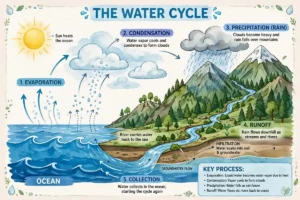
Water may look still in a glass or a lake, but on a planetary scale it is always moving. The water cycle describes how water evaporates from oceans, lakes, and land, rises into the atmosphere, condenses into clouds, falls back as precipitation, and then flows or soaks into the ground before the journey begins again. The same water molecules have been cycling for billions of years, moving between oceans, air, land, ice, and living things. That is why the water in your tap today may once have been part of an ocean, a glacier, a cloud over another continent, or even a dinosaur’s drink. Understanding this cycle helps explain weather, rivers, groundwater, and why fresh water, though constantly recycled, still needs careful protection. Observing it from space, as described in how satellites work, helps scientists track clouds, rainfall, and ocean patterns across the whole planet.
H2: Evaporation: From Liquid to Vapor
Evaporation happens when heat gives liquid water molecules enough energy to escape into the air as invisible water vapor. The Sun is the main source of that heat, warming oceans, lakes, rivers, and moist soil. Evaporation also happens from plants, in a process called transpiration, where water taken up by roots travels to leaves and escapes through tiny openings. Together, evaporation and transpiration move enormous amounts of water into the atmosphere every day, even though we rarely notice it happening. A puddle that disappears on a sunny day, laundry that dries on a line, and sweat cooling your skin are all small, everyday examples of the same process. Warmer air can hold more water vapor, which is one reason warmer climates and seasons often bring more humid air and heavier rainfall when conditions are right.
H2: Condensation and Cloud Formation
As water vapor rises, it cools, and cooling causes vapor to condense into tiny liquid droplets or ice crystals around microscopic particles in the air. Those droplets cluster together to form clouds, which are visible collections of water that float because the droplets are so small and light. Different kinds of clouds form at different heights and temperatures, from low, gray layers that bring steady rain to tall, towering clouds that signal thunderstorms. Fog is essentially a cloud at ground level, forming when moist air cools near the surface. Condensation also appears as dew on grass in the morning, when surfaces cool overnight and water vapor condenses directly onto them. Without condensation, water vapor would remain invisible in the air, and the cycle could not return water to the land as rain or snow.
H2: Precipitation: Rain, Snow, and More
When cloud droplets grow large enough, gravity pulls them down as precipitation. The most familiar forms are rain and snow, but precipitation also includes sleet, hail, and freezing rain, depending on temperature through the atmosphere. Where precipitation falls matters enormously: rain on a forest soaks into soil and feeds plants, rain on a city runs off roofs and streets into drains, and snow in mountains accumulates through winter and melts slowly in spring, feeding rivers through the dry season. Some precipitation returns quickly to the atmosphere through evaporation, some flows over land as runoff into streams and rivers, and some infiltrates the ground to become groundwater. That groundwater moves slowly through soil and rock, sometimes emerging later in springs or wells, and sometimes staying underground for years or centuries.
H2: Collection, Runoff, and Groundwater
After precipitation falls, water collects in oceans, lakes, rivers, glaciers, and underground aquifers. Oceans hold most of Earth’s water, while glaciers and ice caps hold most of its fresh water in frozen form. Rivers carry water from land back toward the sea, shaping valleys and deltas along the way. Groundwater, stored in porous rock and soil, is a vital source of drinking water and irrigation in many regions, yet it replenishes slowly, so overuse can lower water tables faster than rainfall can restore them. Human activities affect every stage of this cycle, from damming rivers and paving land, which changes runoff, to pumping groundwater and altering landscapes. Protecting wetlands, forests, and watersheds, as discussed in protecting ecosystems, helps keep the cycle healthy, because those ecosystems slow runoff, filter water, and support the plants and animals that depend on it.
The Water Cycle in Living Things
Living things are part of the water cycle, not separate from it. Plants take up water, use some for photosynthesis, and release the rest through transpiration. Animals drink water, use it in their bodies, and release it through breathing, sweating, and waste. Even microbes play a role, as explored in world of microbiology, by breaking down organic matter and cycling nutrients through soil and water. The human body itself is mostly water, and we depend on fresh water for drinking, cooking, cleaning, farming, and industry. That dependence makes water conservation a practical concern, not an abstract one: fixing leaks, using water-efficient appliances, and protecting local water sources all help ensure that the cycle continues to provide clean water where and when people need it.
H2: Why the Water Cycle Matters for Climate
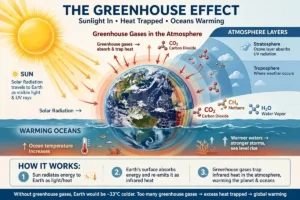
The water cycle and climate are closely linked. Warmer temperatures increase evaporation, which puts more moisture into the air, and that moisture can lead to heavier downpours in some places while other places become drier as rainfall patterns shift. Melting glaciers and ice caps add water to the oceans and raise sea levels, changing coastlines over time. Changes in snowpack affect rivers that millions of people depend on for water, power, and farming. Scientists study these links with models, field measurements, and satellite data, building the kind of evidence base described in research in everyday life and scientific inquiry. The same spirit of inquiry connects the water cycle to larger questions about the universe, from what dark matter is and what black holes are to the rockets in how rockets work and the lunar missions in Artemis program, and to the genetic code in what DNA is and the cells in what stem cells are. Even energy from the Sun, captured by panels described in how solar panels work, begins with the same star that drives evaporation every day.
H2: Seeing the Cycle in Everyday Life
You can see the water cycle almost anywhere once you know what to look for. Watch steam rise from a hot drink, clouds build on a summer afternoon, rain darken a sidewalk, and puddles shrink in the sun. Notice how a river flows after rain, how morning dew sparkles on grass, and how frost forms on a cold window. Each of these moments is a small piece of a global system that connects oceans to mountains, clouds to soil, and plants to people. Teaching children to notice these moments is a simple way to build scientific curiosity, because the water cycle is not hidden in a laboratory; it is happening overhead, underfoot, and all around us, every single day, quietly sustaining life on Earth.
Human Impacts on the Water Cycle
People influence the water cycle in many ways, some obvious and some subtle. Dams store water and change river flow, irrigation moves water from rivers and aquifers onto fields, and cities cover soil with pavement, increasing runoff and reducing the water that soaks into the ground. Deforestation reduces transpiration and changes local rainfall patterns, while draining wetlands removes natural sponges that once slowed floods and filtered water. Pollution adds another layer of harm, because water that cycles through the environment can carry fertilizers, chemicals, and waste into rivers, lakes, and oceans. Understanding these impacts helps communities make better choices: protecting forests and wetlands, managing groundwater sustainably, treating wastewater, and designing cities with permeable surfaces and green spaces that let water soak in rather than rush away. The water cycle will continue regardless of what people do, but how clean, reliable, and safe that water is depends greatly on how carefully we treat the land and water around us.
Conserving water at home is also part of caring for the cycle. Fixing a dripping tap, taking shorter showers, running full loads in washing machines and dishwashers, and watering gardens in the cooler parts of the day all reduce demand on local supplies. Collecting rainwater for gardens, where allowed, returns water to plants close to where it fell. In regions facing drought, these habits matter even more, because every liter saved is a liter that stays in a river, lake, or aquifer for wildlife and future use. Teaching children where their water comes from, and where it goes after use, builds a lifelong respect for this essential resource. The water cycle connects us all, from a mountain snowfield to a kitchen tap, and caring for it is one of the most practical ways to care for the planet and for each other.
Next time it rains, take a moment to follow that water in your mind: from cloud to roof to drain to river to sea, and eventually back to cloud again. That journey, repeated countless times across the planet, is the water cycle in action, and it connects your neighborhood to oceans and mountains far away.