H2: The Force You Feel Every Day
Gravity is the force that pulls you toward the Earth, keeps your feet on the ground, and makes a dropped ball fall instead of floating away. It is also the force that keeps the Moon in orbit around Earth, Earth in orbit around the Sun, and stars grouped together in galaxies. Unlike a push from your hand, gravity acts at a distance, without any visible contact, which made it mysterious for centuries. Isaac Newton was among the first to describe it mathematically, showing that the same force that makes an apple fall also governs the motion of the Moon. Later, Albert Einstein offered a deeper explanation, describing gravity not as a simple pull but as a curvature of space and time caused by mass and energy. Both descriptions are useful: Newton’s laws work excellently for everyday calculations, while Einstein’s theory explains extreme cases where Newton’s laws fall short.
H2: Mass, Distance, and the Strength of Gravity
The strength of gravity between two objects depends mainly on their masses and the distance between them. More massive objects exert stronger gravity, which is why Earth’s gravity is far stronger than the Moon’s, and why the Sun, despite being far away, holds the planets in orbit. Gravity weakens quickly with distance, so an astronaut far from Earth feels much less pull than someone standing on the surface. Your weight is a measure of gravity’s pull on your mass: your mass stays the same wherever you go, but your weight changes depending on the gravity of the planet or moon you stand on. That is why astronauts can bounce lightly on the Moon, where gravity is weaker, even though their bodies have not changed. This relationship between mass and distance explains everything from ocean tides to the orbits of satellites, as described in how satellites work.
H2: Gravity as Curved Spacetime
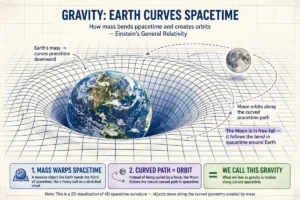
Einstein’s picture of gravity is harder to visualize but deeply elegant. Imagine space and time together as a flexible fabric, sometimes called spacetime. A massive object like the Sun curves that fabric, much as a heavy ball curves a stretched rubber sheet. Planets then move along the curved paths created by that curvature, which we perceive as orbits. Light, too, follows curved paths near massive objects, bending slightly as it passes the Sun, an effect that has been observed during solar eclipses. This picture also predicts that extremely massive, compact objects can curve spacetime so strongly that not even light can escape, which brings us to the objects described in what black holes are. It also predicts gravitational waves, ripples in spacetime caused by violent events such as colliding black holes, which scientists have now detected with exquisitely sensitive instruments.
H2: Gravity in Orbit: Falling Without Landing
Orbit is often misunderstood as a place where gravity disappears, but in fact astronauts in orbit still feel most of Earth’s gravity. What makes them float is that they are in continuous free fall around Earth, moving forward fast enough that as they fall toward the planet, the curved surface of Earth falls away beneath them at the same rate. The result is a stable orbit: falling, but never landing. Satellites, space stations, and the Moon all work the same way, each falling around a larger body while moving forward. Rockets, as described in how rockets work, must reach high speeds to achieve orbit, not merely high altitudes, because speed is what keeps a spacecraft falling around Earth rather than back to it. Understanding orbit as controlled falling makes spaceflight feel less magical and more logical.
H2: Gravity and the Structure of the Universe
On the largest scales, gravity is the architect of the universe. It pulled gas together to form the first stars, gathered stars into galaxies, and continues to shape clusters of galaxies today. Without gravity, stars would not have formed, planets would not have coalesced, and the universe would be a thin, uniform gas instead of the rich, structured cosmos we observe. Gravity also plays a role in the fate of stars: when a massive star runs out of fuel, gravity collapses its core, sometimes producing a supernova explosion and leaving behind a neutron star or a black hole. The mysterious substance described in what dark matter is also interacts gravitationally, influencing how galaxies rotate and cluster, even though it does not emit light we can see. Gravity, in short, connects the smallest falling apple to the largest structures in the cosmos.
Gravity on Earth: Tides, Weight, and Everyday Life
On Earth, gravity shapes daily life in ways we often take for granted. It drives ocean tides, as the Moon’s gravity pulls water toward it, creating bulges that move around the planet as Earth rotates. It determines how rivers flow downhill, how rain falls, and how our bodies develop muscles and bones strong enough to stand against its pull. Engineers must account for gravity when designing bridges, buildings, and vehicles, and athletes train against it every day. Even the plants around us grow against gravity, with roots growing downward and shoots growing upward, guided by gravity-sensing cells. The ecosystems shaped by these forces are explored in protecting ecosystems, and the tiny life that lives within them in world of microbiology. From the genetic instructions in what DNA is to the cells in what stem cells are, life on Earth has evolved under gravity’s constant influence.
H2: Testing Gravity and Looking Ahead
Scientists continue to test gravity with remarkable precision, from dropping objects in vacuum chambers to tracking spacecraft across the solar system and observing light bending around distant galaxies. So far, Einstein’s theory has passed every test, yet physicists suspect it is incomplete, because it does not yet fit together with quantum mechanics, the theory that describes the smallest particles. Reconciling those two great theories is one of the biggest challenges in modern physics, and it may reveal new aspects of gravity at tiny scales or extreme energies. That ongoing quest is part of the research journey in research in everyday life and scientific inquiry, and it motivates missions like those in Artemis program, which push exploration to new frontiers. Even the Sun’s energy, harnessed by how solar panels work, ultimately comes from a balance between gravity pulling inward and pressure pushing outward inside stars.
H2: A Force Both Ordinary and Profound
Gravity is both the most familiar force in daily life and one of the most profound in science. It holds you to your chair, guides the Moon, shapes galaxies, and bends light itself. It is simple enough to describe with a dropped ball, yet deep enough to lead to black holes, gravitational waves, and questions about the nature of space and time. The next time you drop something, catch a ball, or watch the Moon rise, you are witnessing the same force that built the universe. That connection between the ordinary and the cosmic is what makes gravity such a wonderful topic to understand simply: it is everywhere, it is always working, and it ties our everyday world to the grandest scales of all.
Gravity, Motion, and Everyday Puzzles
Gravity creates many everyday puzzles that become clear once you understand its rules. Why does a feather fall slowly while a hammer falls quickly in air, yet both fall together in a vacuum? Because air resistance slows the feather, not because gravity pulls it less strongly. In a vacuum, gravity accelerates all objects equally, regardless of mass, a fact famously demonstrated on the Moon. Why do you feel heavier in an elevator that accelerates upward and lighter in one that accelerates downward? Because what you feel as weight is the push of the floor against you, which changes with acceleration even though gravity itself has not changed. Why does water stay in a bucket swung overhead? Because the bucket’s motion and gravity combine to keep the water pressed against the bucket’s bottom. Each puzzle, solved with gravity and motion, shows how a few simple principles explain a wide range of experiences.
Gravity also affects how we explore space and how we imagine living beyond Earth. A long stay in low gravity weakens muscles and bones, because the body adapts to needing less strength to move, which is a major challenge for future long-duration missions. Artificial gravity, created by rotating a spacecraft, is one proposed solution, using rotation to mimic the feeling of gravity. On Mars, gravity is weaker than on Earth, so future explorers would need to adapt to a new weight and a new way of moving. Even on Earth, understanding gravity helps engineers design everything from roller coasters to satellites, and helps athletes understand jumping, throwing, and balance. Gravity may be invisible, but its effects are everywhere, shaping movement, structure, and exploration in ways we encounter every day.
Gravity, then, is not just a force that holds things down; it is a guide that shapes orbits, tides, galaxies, and the very structure of the universe. Once you see it that way, a falling leaf and a distant galaxy are part of the same elegant story.