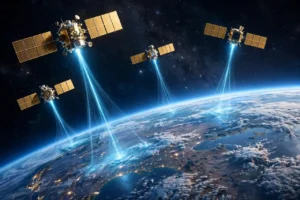
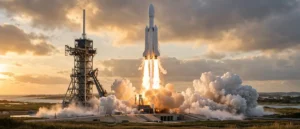
More than fifty years after the last Apollo astronaut left the lunar surface, America is going back to the Moon — this time to stay. NASA’s Artemis program is the boldest space effort in a generation, and it sits at the center of a new space race that is capturing imaginations across the United States — a journey through the high-tech universe unfolding in real time.
But Artemis is about far more than flags and footprints. From lunar science to a future Mars mission, here is what NASA’s Moon program is, why it matters, and how everyday Americans can follow along.

1. What Is the Artemis Program?
Artemis is NASA’s program to return astronauts to the Moon and establish a long-term human presence there. Named after the Greek goddess of the Moon — and Apollo’s twin sister — the program’s goals go well beyond a repeat of the 1960s landings.
The plan unfolds in stages. Early missions tested the giant Space Launch System (SLS) rocket and the Orion crew capsule on uncrewed and crewed flights around the Moon. Upcoming missions aim to land astronauts near the lunar south pole, a region rich in water ice that could be converted into drinking water, air, and even rocket fuel. Eventually, NASA envisions the Lunar Gateway — a small space station orbiting the Moon — serving as a staging point for surface expeditions and, one day, crewed missions to Mars.
2. Why Go Back to the Moon Now?
It is a fair question: why spend billions returning to a place we already visited? Scientists give three compelling answers.
Water and resources
The Moon’s south pole holds millions of tons of water ice in permanently shadowed craters. Learning to harvest local resources — a practice called in-situ resource utilization — is the key to sustainable deep-space exploration.
A science bonanza
The Moon is a four-billion-year archive of solar system history, untouched by wind and water. New samples and instruments could rewrite textbooks about how the Earth and Moon formed — scientific inquiry at its most thrilling.
A stepping stone to Mars
The Moon is the perfect training ground: close enough for relatively quick resupply, but far enough to force engineers to solve the life-support, radiation, and logistics problems a Mars mission will face.
3. The New Space Race: NASA, SpaceX, and China
The original space race was a duel between two superpowers. Today’s competition is more crowded — and more commercial — powered by emerging technologies. NASA is partnering with private companies in ways Apollo never did: SpaceX’s Starship is slated to serve as the Artemis lunar lander, while other firms are building rovers, spacesuits, and lunar cargo services.
Meanwhile, China has announced its own crewed Moon landing ambitions for the end of this decade, and its robotic missions have already returned lunar samples to Earth. For the United States, Artemis is partly about scientific leadership and partly about ensuring that the rules of the road for the Moon — who can mine resources, how heritage sites are protected — are written by democracies. The latest discoveries in science increasingly depend on this new era of exploration.
4. What Artemis Means for Everyday Americans
You do not need to be an astronaut to benefit from Moon missions. The Apollo program famously spun off technologies from water filters to CAT scanners — a classic example of how research shapes our everyday lives — and Artemis is already driving advances in robotics, solar power, and closed-loop life support that will find their way into hospitals, factories, and homes.
There is an economic story too. NASA estimates that every dollar spent on space returns several dollars to the economy through jobs and innovation, supporting tens of thousands of high-skilled jobs across states like Texas, Florida, Alabama, and California. Universities are expanding aerospace programs to train the workforce Artemis needs.
5. How You Can Follow the Missions
One of the best things about Artemis is how accessible it is. NASA streams launches live and free, complete with expert commentary. You can track the Orion capsule’s position in real time on NASA’s website during missions, and the agency’s social media channels share stunning images from lunar orbit.
- Watch a launch: NASA’s live streams turn each liftoff into a national event — gather the family.
- Visit a NASA center: Kennedy Space Center in Florida and Johnson Space Center in Texas offer unforgettable Artemis exhibits.
- Look up: During crewed missions, free apps let you spot the spacecraft and learn exactly what the crew is doing.
6. Artemis and the Future: What Comes After the Moon?
Artemis is deliberately designed as a proving ground for Mars. The life-support systems, radiation shielding, precision landing techniques, and surface habitats perfected on the Moon will feed directly into the first crewed Mars missions, which NASA hopes to attempt in the 2030s. Every Artemis milestone is therefore also a down payment on humanity’s next giant leap — and a reminder that the skills, industries, and inspiration generated today will shape the explorers of tomorrow — and rank among the latest tech trends reshaping our world.
Conclusion
The new space race is not just a contest between nations — it is humanity’s next great adventure, and America intends to lead it. NASA’s Artemis program promises new science, new jobs, new technologies, and, perhaps most importantly, a new generation inspired to look up and dream big. The Moon is calling again. This time, we are going to stay.
For mysteries even farther out than the Moon, see our dark matter explained guide to the invisible substance shaping the deep-space universe.
To understand the machine making these missions possible, see our rockets 2026 Starship guide — it explains the physics, staging, and reusability behind today’s moon rockets.