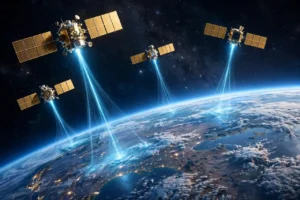
Right now, as you read this, thousands of satellites are racing overhead. They guide your road trips, forecast tomorrow’s weather, beam television into homes, and photograph hurricanes from hundreds of miles up. Most of us never think about them — but understanding how do satellites work reveals one of humanity’s greatest engineering achievements: machines that fall around the Earth forever, doing useful work the whole way down.
The core idea is beautifully simple. A satellite stays in orbit by moving so fast sideways that as gravity pulls it toward Earth, it keeps missing. Everything else — the solar panels, the radios, the cameras — exists to keep the satellite alive and useful while it falls. Let us go up and take a look.
How Do Satellites Work: The Orbit Trick
An orbit is not floating. It is falling — with style. A satellite in low orbit travels at roughly seventeen thousand miles per hour sideways. Earth’s gravity constantly tugs it downward, but because it moves so fast, the surface curves away beneath it at the same rate it falls. The result: the satellite falls around the planet in a continuous loop.
Getting there is the hard part. Rockets must lift the satellite above most of the atmosphere and accelerate it to orbital speed. Too slow, and it falls back. Fast enough, and it stays up essentially forever — there is no air resistance in space to slow it down. This is the same physics behind NASA’s Artemis missions, which use orbits as stepping stones to the Moon.
The Main Types of Orbit
Not all orbits are alike, and each type suits different jobs. Low Earth orbit, a few hundred miles up, is where the International Space Station and most Earth-observation satellites live — close enough for sharp photos and fast communication. Medium Earth orbit hosts navigation satellites. And geostationary orbit, about twenty-two thousand miles up, is special: satellites there circle Earth at exactly the planet’s rotation rate, so they hover over one spot. That is why a fixed satellite TV dish never needs to move.
Power: Living on Sunlight
Satellites cannot plug into the grid, so nearly all of them run on sunlight. Their wing-like solar panels convert sunlight into electricity, which powers the onboard computers, radios, and instruments. Batteries store energy for the periods when the satellite passes through Earth’s shadow.
Power management is a constant balancing act. Instruments and transmitters are switched on and off according to a careful schedule, and engineers design every watt of the power budget years before launch. A satellite that runs out of power becomes silent space junk — which is why reliable solar technology, much like the panels in home solar systems, is mission-critical in orbit too.
Communication: Talking to Earth
A satellite is useless if it cannot communicate. Satellites talk to ground stations using radio waves, beaming data down and receiving commands up. The process is straightforward: the satellite’s instruments collect data or receive signals, its computer packages the information, and its transmitter sends it Earthward at the speed of light.
Different frequencies serve different purposes. Lower frequencies punch through clouds and rain; higher frequencies carry more data but are blocked by bad weather. Engineers choose bands the way you might choose between Wi-Fi and 5G — each has strengths, and the mission decides.
Bent Pipes and Smart Satellites
The simplest communication satellites are “bent pipes”: they receive a signal from one ground station, amplify it, and rebroadcast it to another area. Television broadcast satellites work this way. Smarter satellites process data onboard — compressing images, routing internet traffic between users, or combining signals — before sending anything down.
The newest mega-constellations take this further. Instead of a few big satellites, they use thousands of small ones in low orbit, handing off connections from satellite to satellite like a cellular network in the sky. Starlink’s satellite internet is the best-known example, bringing broadband to places cables cannot reach.
Why Low Orbit Means Faster Internet
Distance creates delay. A signal traveling to a geostationary satellite and back covers roughly seventy thousand miles, which takes about half a second — noticeable on a video call. Low-orbit satellites sit much closer, so the round trip takes a small fraction of that time. This low latency is what makes modern satellite internet feel like a wired connection, and it is the main reason the new constellations fly low instead of parking in geostationary orbit.
How Long Do Satellites Last?
A satellite’s lifespan is set long before launch, and fuel is usually the limiting factor. Station-keeping thrusters nudge satellites back into position as orbits slowly decay, and when the propellant runs out, the mission effectively ends — even if every electronic system still works perfectly. Most communication and observation satellites are designed for roughly a decade or more of service.
What happens at the end? Responsible operators now plan for disposal. Low-orbit satellites are steered into the atmosphere to burn up harmlessly. Higher satellites are boosted into “graveyard orbits” far from working spacecraft. These end-of-life plans are becoming standard practice as the industry confronts the space junk problem — because an orbit crowded with dead satellites helps nobody.
Navigation: How GPS Finds You
Perhaps the most-used satellite service is one you never see: navigation. GPS satellites broadcast precise time signals from medium Earth orbit. Your phone receives signals from several satellites at once and compares their arrival times. Since the signals travel at the speed of light, tiny time differences reveal distances — and with four or more distances, your phone triangulates its exact position.
The clocks on these satellites are atomic — accurate to billionths of a second — because even a millionth-of-a-second error would throw your position off by hundreds of feet. It is a stunning example of Einstein’s relativity made practical: engineers must even correct for time running slightly differently in orbit than on the ground.
Earth Observation: The Planet’s Checkup
Many satellites never communicate with people at all — they watch the planet. Weather satellites track storms, measure cloud temperatures, and feed the forecasts on your phone. Imaging satellites photograph cities, farms, forests, and oceans in extraordinary detail. Scientific satellites measure sea levels, ice thickness, air pollution, and deforestation.
These eyes in the sky are central to climate technology, giving scientists the data needed to understand a changing planet. Farmers use satellite imagery to monitor crops, rescue teams use it to map disasters, and researchers track everything from wildfires to algal blooms.
Seeing the Invisible
Satellite cameras see far beyond visible light. Infrared sensors detect heat — useful for spotting wildfires or measuring ocean temperatures. Radar satellites can image the ground through clouds and at night by bouncing radio waves off the surface. Each wavelength reveals something our eyes cannot see.
Science Satellites: Telescopes in Orbit
Above the atmosphere’s blur and glow, space telescopes see the universe with unmatched clarity. They have photographed black holes‘ shadows, mapped the afterglow of the Big Bang, and are now probing dark matter and the expansion of the cosmos. Putting a telescope in space is expensive, but there is simply no substitute for getting above the air.
Space is also a laboratory. The International Space Station hosts experiments that need weightlessness — growing protein crystals, studying flames that behave strangely without gravity, and testing how the human body adapts to long missions. Robotic systems increasingly handle the delicate work, from docking cargo ships to maintaining instruments.
Staying Alive: The Challenges of Space
Space is brutal on hardware. Temperatures swing wildly between sunlight and shadow. Radiation degrades electronics. Tiny micrometeorites strike at enormous speeds. And there is no repair shop — although engineers have occasionally sent repair missions to precious satellites, most must work perfectly for a decade or more with zero maintenance.
Satellites also need to point precisely. A communication satellite must aim its antennas at ground stations; an imaging satellite must aim its cameras at targets. Reaction wheels — spinning flywheels inside the satellite — and small thrusters adjust orientation with exquisite precision, guided by star trackers that read the positions of stars like a celestial compass.
Space Junk: The Growing Problem
Every launch leaves traces: dead satellites, spent rocket stages, fragments from collisions. This debris orbits at lethal speeds, and even a paint fleck can damage a working satellite. Tracking networks monitor tens of thousands of objects, and satellite operators routinely dodge the bigger ones. Keeping orbits usable is becoming one of the space industry’s defining challenges — and new designs increasingly include plans for safe disposal at end of life.
The Satellite Boom of 2026
We are living through a satellite renaissance. Launch costs have fallen dramatically thanks to reusable rockets, so constellations that were once unthinkable are now routine. Thousands of new satellites go up every year, bringing internet to remote villages, sharper eyes on natural disasters, and new science missions that were impossible a decade ago.
The pace brings new questions: how to share orbits fairly, how to limit light pollution that bothers astronomers, and how to keep space sustainable. But the trajectory is clear — the sky above us is getting busier, smarter, and more useful every year.
Conclusion
So how do satellites work? They ride rockets to orbital speed, then fall around Earth forever. Solar panels power them, radios connect them to the ground, and specialized instruments do the real work — navigating your road trip, forecasting storms, beaming broadcasts, or peering into the deep universe. Precise pointing, atomic clocks, and clever engineering keep them alive in one of the harshest environments imaginable.
The next time your phone finds your location in seconds or your forecast warns you about tomorrow’s storm, remember the silent machines overhead making it happen. Thousands of satellites, each a small miracle of engineering, falling around the Earth — and working the whole way down.