H2: Evolution in One Simple Idea
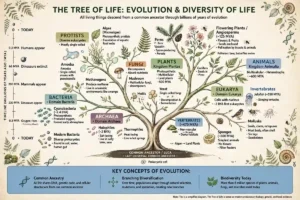
Evolution is the change in living things over generations. It does not mean that one animal suddenly turns into another, or that evolution has a goal or a plan. It means that populations of organisms gradually change as some traits become more common and others become less common, because the individuals carrying helpful traits tend to survive and reproduce more successfully in their environment. Over short timescales, those changes may be small, such as a change in the average size or color of a population. Over long timescales, small changes accumulate into larger differences, eventually producing new species that look and behave very differently from their ancestors. That simple idea, change over generations driven by variation and selection, explains the diversity of life on Earth, from bacteria to blue whales.
H2: Variation: Why No Two Individuals Are Alike
Variation is the raw material of evolution. Within any population, individuals differ in size, color, speed, resistance to disease, and many other traits, partly because of differences in their genes and partly because of differences in their environment and experiences. Genetic variation arises through mutations, which are changes in DNA, and through the shuffling of genes when organisms reproduce. Most mutations have little effect, some are harmful, and a few are helpful in a particular environment. Without variation, natural selection would have nothing to act on, because every individual would be identical. With variation, some individuals are slightly better suited to their surroundings than others, and that slight advantage, repeated over many generations, is what drives evolutionary change. The genetic code behind this variation is described in what DNA is, and the tiny organisms where evolution can be observed quickly are part of world of microbiology.
H2: Natural Selection: How Advantage Spreads
Natural selection works through a simple logic: organisms produce more offspring than can survive, offspring vary, and those with traits that help them survive and reproduce in their environment tend to leave more offspring. Over generations, helpful traits become more common in the population, while less helpful traits become rarer. A classic example is camouflage: in an environment where predators hunt by sight, individuals whose color blends with the background are more likely to survive and reproduce, so the population gradually becomes better camouflaged. Natural selection does not create perfect organisms; it favors traits that work well enough in a particular place and time. A trait that is helpful in one environment, such as thick fur in a cold climate, can be harmful in another, which is why evolution produces diversity rather than a single ideal form.
H2: Evidence From Fossils, Genes, and Living Things
Scientists do not accept evolution on faith; they test it against evidence from many independent sources. Fossils preserve a record of past life, showing gradual changes in form over time and transitional forms that share features of both older and newer groups. Comparative anatomy reveals similarities in bone structure between very different animals, such as the forelimbs of humans, bats, and whales, which suggest a common ancestor modified over time. Genetics provides even stronger evidence: species that are closely related share more DNA, and the pattern of genetic similarities matches the pattern predicted by common ancestry. Embryos of different vertebrates also show striking similarities early in development. Together, these lines of evidence, gathered by the research described in research in everyday life and scientific inquiry, form a coherent picture that has been tested and refined for more than a century.
H2: Common Misunderstandings About Evolution
Several misunderstandings about evolution are common, and clearing them up helps the science make sense. Evolution does not say that humans evolved from modern monkeys; rather, humans and modern monkeys share a common ancestor that lived millions of years ago, and both lineages have changed since then. Evolution is not a ladder with humans at the top; it is a branching tree, with every living species at the tip of its own branch, adapted to its own way of life. Evolution does not happen because organisms want or need to change; it happens because variation already exists and selection acts on it over generations. Finally, evolution is both a fact, in the sense that populations demonstrably change over time, and a theory, in the scientific sense of a well-tested explanation for how and why that change happens. Understanding that distinction helps explain why scientists treat evolution as one of the most secure ideas in biology.
Evolution You Can See in Your Lifetime
Evolution is not only about ancient history; it happens on timescales we can observe. Bacteria can evolve resistance to antibiotics in years or even months, because they reproduce so quickly and in such large numbers. Insects can evolve resistance to pesticides, and viruses can evolve new variants as they spread. Dog breeds, crop plants, and farm animals show how artificial selection, where humans choose which individuals reproduce, can produce dramatic changes in a relatively short time. These everyday examples make evolution tangible: it is not a distant story about dinosaurs, but an ongoing process affecting medicine, agriculture, and public health today. That is why understanding evolution matters for decisions about antibiotic use, pest control, and conservation, as discussed in protecting ecosystems.
H2: Evolution and the Story of Life on Earth
Over billions of years, evolution has produced the extraordinary diversity of life we see today, from single-celled organisms in extreme environments to forests, coral reefs, and human societies. All living things share a common ancestry, reflected in shared genetic code, shared cellular machinery, and shared biochemical pathways. That shared history is part of what makes biology a unified science, rather than a collection of separate facts about separate species. It also reminds us that humans are part of nature, not apart from it, shaped by the same processes that shaped every other species. From the cells described in what stem cells are to the distant universe in what dark matter is and what black holes are, and from the rockets in how rockets work to the satellites in how satellites work and the Moon missions in Artemis program, science tells a connected story: a universe that changes, a planet that changes, and life that changes with it. Even the Sun’s energy, captured by how solar panels work, powers the ecosystems in which evolution unfolds.
H2: Why Evolution Matters to Everyone
Evolution matters beyond biology classrooms because it affects medicine, food, and the environment. Understanding how pathogens evolve helps doctors use antibiotics wisely and helps researchers update vaccines. Understanding how crops and pests evolve helps farmers grow food more sustainably. Understanding how species adapt, or fail to adapt, to changing climates helps conservationists protect biodiversity. Evolution also teaches a broader lesson: small changes, repeated over time, can add up to profound transformation. That lesson applies to science itself, where patient observation and testing gradually refine our understanding of the world. Evolution, simply explained, is the story of life changing, generation by generation, into the rich and varied living world we share today.
Evolution, Medicine, and Conservation
Evolution has direct consequences for medicine, because pathogens evolve. When antibiotics are overused, resistant bacteria survive and spread, making infections harder to treat. Doctors therefore aim to use antibiotics only when needed, at the right dose, and for the full course when prescribed, to slow the evolution of resistance. Vaccines also interact with evolution, as viruses change over time, which is why flu vaccines are updated regularly and why researchers monitor new variants of many viruses. Understanding evolution helps public health officials anticipate these changes rather than being surprised by them. It also helps in cancer treatment, where tumor cells evolve resistance to drugs, and in agriculture, where pests evolve resistance to pesticides. In each case, the same principles apply: variation exists, selection favors survivors, and populations change over generations, whether we want them to or not.
Conservation also depends on evolutionary thinking. Species that have small populations lose genetic variation, making them less able to adapt to new diseases, climates, or habitats. Protecting large, connected habitats helps maintain that variation, giving species a better chance to adapt as conditions change. Captive breeding programs try to preserve genetic diversity for the same reason, avoiding inbreeding that can weaken a population. When we introduce species to new places, we also set evolution in motion, sometimes with harmful results, as invasive species outcompete natives that have no defenses against them. A deep understanding of evolution therefore helps us protect biodiversity not just by saving individual animals, but by preserving the processes and genetic diversity that allow life to keep changing and surviving.
Evolution is best understood as a story still being written, with every generation adding a small chapter. When you grasp that story, the diversity of life stops looking random and starts looking like the result of patient, understandable processes working over immense time.
That patience is the heart of evolutionary science: small, observable changes, studied carefully, revealing a grand history of life that continues to unfold around us every day.