H2: Climate, Weather, and a Warming Planet
Weather is what happens on a particular day: rain, sunshine, wind, or snow. Climate is the long-term pattern of weather in a place over decades, including average temperatures, rainfall, and seasons. Climate change refers to long-term shifts in those patterns, and the change most discussed today is the warming of the Earth’s average temperature over the past century and more. This warming is not about every place getting hotter every day; some places may see colder winters or wetter seasons even as the global average rises. What matters is the overall trend, measured by thermometers, satellites, ocean sensors, and records preserved in ice cores and tree rings. Together, those records show a clear warming trend, and scientists study its causes by comparing natural factors with human activities.
H2: The Greenhouse Effect: How Earth Stays Warm
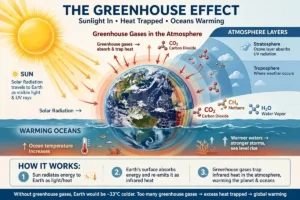
The greenhouse effect is a natural process that keeps Earth warm enough for life. Sunlight passes through the atmosphere and warms the surface, and the surface then radiates heat back upward. Certain gases in the atmosphere, called greenhouse gases, absorb some of that outgoing heat and radiate it back toward the surface, trapping warmth much like a blanket. Without any greenhouse effect, Earth would be far too cold for most life as we know it. The problem is not the greenhouse effect itself, but an increase in its strength: when greenhouse gas levels rise, more heat is trapped, and the planet warms. The main greenhouse gases discussed in climate science are carbon dioxide, methane, and nitrous oxide, along with water vapor, which increases as the air warms and amplifies the effect further.
H2: Human Activities That Increase Greenhouse Gases
Human activities have increased greenhouse gas levels in several ways. Burning fossil fuels such as coal, oil, and natural gas for electricity, transport, heating, and industry releases carbon dioxide that was stored underground for millions of years. Clearing forests reduces the number of trees that absorb carbon dioxide through photosynthesis, and in some cases releases stored carbon when trees are burned or decay. Agriculture contributes through livestock, fertilized soils, and rice farming, which release methane and nitrous oxide. Cement production and other industrial processes also release carbon dioxide. None of these activities is new, but their scale has grown enormously with population growth and industrialization, and the atmosphere now holds more carbon dioxide than it did before the industrial era. Measuring these changes relies on careful monitoring, including the satellite observations described in how satellites work.
H2: Natural Factors: Real, but Not the Whole Story
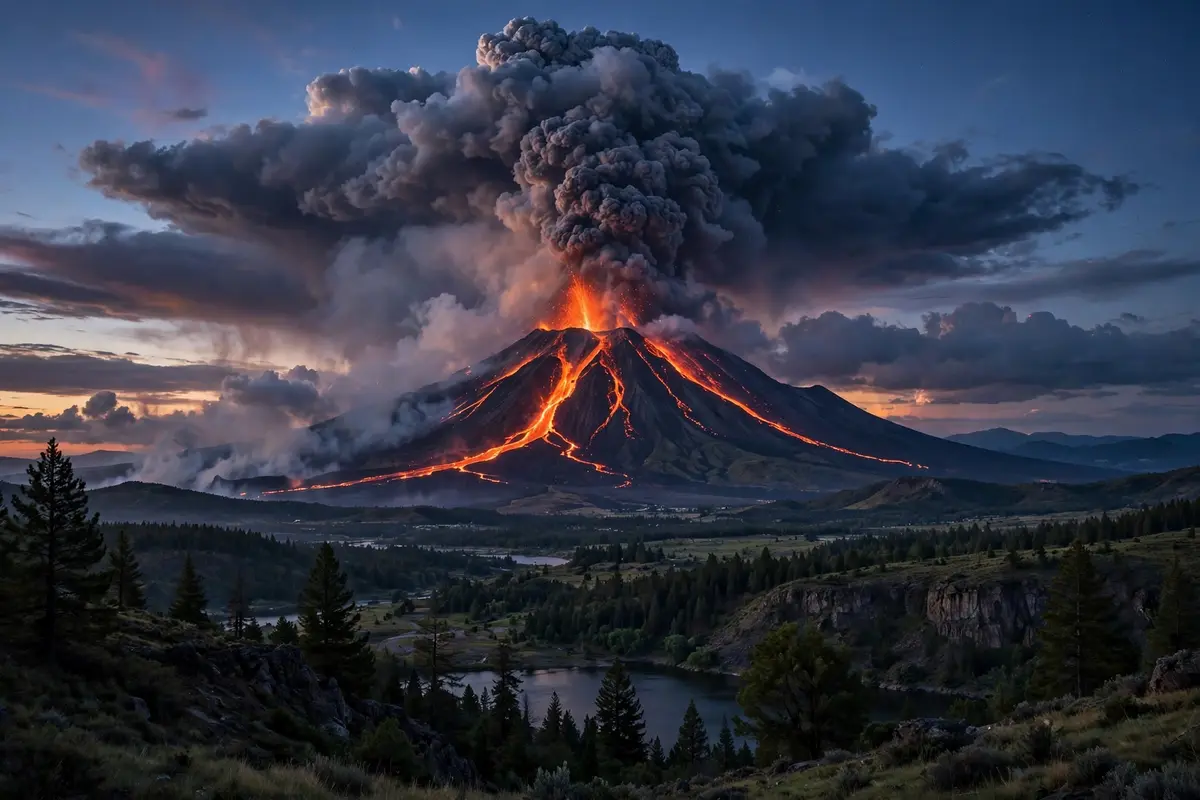
Natural factors also affect climate, and scientists study them carefully so they are not mistaken for human causes. Volcanic eruptions can release gases and particles that temporarily cool the planet by reflecting sunlight. Changes in the Sun’s output can affect climate, as can slow changes in Earth’s orbit that shift seasons over thousands of years. Natural cycles in the oceans can move heat around and cause warmer or cooler years in particular regions. Scientists test these factors by comparing them with observed warming, and they find that natural factors alone do not explain the warming trend of recent decades, while human greenhouse gas increases do. This distinction matters, because it tells us that the warming is not simply a natural cycle we must passively accept, but a change driven substantially by activities we can influence.
H2: How Warming Changes Weather and Ecosystems
As the planet warms, many related changes follow. Warmer air can hold more moisture, which can lead to heavier rainfall in some places and longer dry periods in others. Sea levels rise as ocean water expands when warmed and as land ice melts, which increases flooding risk in coastal areas. Arctic ice and glaciers retreat, changing habitats for wildlife and reflecting less sunlight back into space, which can amplify warming further. Ecosystems shift as species move toward cooler areas or higher elevations, and some species struggle to move fast enough. Coral reefs, forests, and wetlands face stress from heat, drought, and changing rainfall, and the science of protecting them is explored in protecting ecosystems. These changes do not happen evenly everywhere, which is why climate change can look different in different regions even though the global trend is warming.
What the Evidence Looks Like
The evidence for warming comes from many independent lines of observation, not a single measurement. Surface temperature records, ocean temperature measurements, satellite data, shrinking glaciers, earlier spring flowering, and shifting species ranges all point in the same direction. Ice cores drilled from ancient glaciers preserve bubbles of old air, allowing scientists to compare past greenhouse gas levels with temperatures over hundreds of thousands of years. That long view shows that carbon dioxide and temperature have moved together in the past, and that current carbon dioxide levels are unusually high for recent geological history. This convergence of evidence, gathered by many researchers over many decades, is why scientific organizations around the world describe human-caused warming as well established, even while research continues into exact regional effects and future pathways.
H2: What Can Reduce Greenhouse Gas Emissions
Reducing emissions means producing energy, moving people and goods, growing food, and building homes in ways that release fewer greenhouse gases. Renewable energy sources such as solar and wind, described in how solar panels work and how wind turbines work, produce electricity without burning fossil fuels. Energy efficiency, from better insulation and efficient appliances to heat pumps described in how heat pumps work, reduces the energy needed in the first place. Electric transport, explained in how electric cars work, can reduce emissions when powered by clean electricity. Protecting and restoring forests helps absorb carbon dioxide, while changes in farming and waste management can reduce methane and nitrous oxide. No single solution solves climate change alone, but together these approaches can substantially reduce emissions while also improving air quality and energy security.
H2: Understanding Causes Leads to Clearer Choices
Understanding what causes climate change helps move the conversation from confusion to choices. When we know that greenhouse gases trap heat, that human activities have increased those gases, and that natural factors alone do not explain recent warming, we can focus on practical steps rather than debating settled science. Individuals can make choices about energy use, transport, food waste, and home efficiency, while communities and countries can invest in cleaner energy, resilient infrastructure, and ecosystem protection. Research continues into new energy sources, including the fusion energy described in nuclear fusion and the nuclear power described in how nuclear power plants work, and into how ecosystems respond, as explored in research in everyday life and scientific inquiry. The causes are complex, but the core story is clear: Earth is warming because the blanket of greenhouse gases has thickened, and thinning that blanket is the central challenge of our time.
Regional Differences and Everyday Experience
Climate change does not feel the same everywhere, and that variation can make it confusing to understand from personal experience alone. One region may experience hotter summers and longer heatwaves, while another sees wetter winters, stronger storms, or shifting growing seasons. A single cold winter in one place does not disprove a global warming trend, just as a single hot summer does not prove it on its own. Scientists therefore look at long-term averages across the whole planet, combining land, ocean, and satellite records, rather than relying on any one location or year. That global view is essential, because climate is a planetary system: warming in the Arctic can affect weather patterns far away, and ocean warming can influence rainfall on distant continents. Understanding regional differences helps communities prepare for the specific changes they are most likely to face, from coastal flooding to drought to heat.
Everyday choices also look different depending on where you live. A household in a sunny region may benefit most from solar energy, while a household in a windy coastal area may benefit from wind power or better insulation against storms. A city may focus on cooling green spaces and public transport, while a farming community may focus on water conservation and drought-resistant crops. These local responses all contribute to the same global goal: reducing greenhouse gas emissions and adapting to changes already underway. When people understand the causes clearly, they can choose actions that fit their place and circumstances, rather than feeling overwhelmed by a problem that seems distant or abstract. That combination of global understanding and local action is how climate knowledge becomes practical, hopeful, and effective.
Hope Grounded in Evidence
Climate change is a serious challenge, but understanding its causes also points toward hope grounded in evidence rather than wishful thinking. Emissions have already slowed in some sectors where cleaner energy became cheaper and more available, and many communities have shown that adaptation measures, from restored wetlands to cooler cities, can reduce harm. Progress will not be instant or even, and some changes already underway cannot be fully reversed, but every reduction in emissions reduces future warming, and every adaptation step reduces present risk. That is why scientists emphasize both urgency and agency: the problem is large, yet the solutions are known, practical, and increasingly affordable. Acting on what we know, while continuing to learn, is the most reasonable response to a challenge whose causes we now understand well.