H2: The Earth Is Not One Solid Rock
When we stand on the ground, it feels completely solid and still, as if the Earth were a single unmoving block of rock. In reality, the outer shell of the Earth is broken into large pieces called tectonic plates, which fit together like a cracked eggshell around the planet. These plates include both continents and ocean floors, and they move very slowly, driven by heat and movement deep inside the Earth. The movement is far too slow to feel in daily life, often only a few centimeters each year, which is roughly the speed at which fingernails grow. Over millions of years, however, even that slow motion reshapes continents, builds mountains, and opens oceans. Understanding this slow, powerful movement is the key to understanding earthquakes, because most earthquakes happen where plates meet and interact. Scientists study these movements with instruments on land and with observations from space, and guides like how satellites work show how space technology helps us watch a planet that is always changing.
H2: What Happens at a Fault
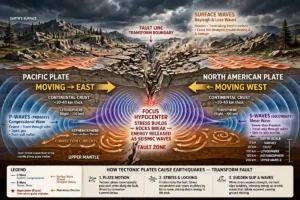
A fault is a crack or break in the Earth’s crust where blocks of rock have moved past each other, and many earthquakes begin at faults. As tectonic plates push, pull, or slide past one another, stress builds up along the fault, much like stress builds when you bend a stick. For a long time, friction holds the rocks in place, so they bend and store energy rather than moving. Eventually, the stress becomes greater than the friction can hold, and the rocks suddenly slip. That sudden slip releases the stored energy in the form of seismic waves, which travel outward through the Earth and shake the ground at the surface. The point deep underground where the slip begins is called the focus, and the point on the surface directly above it is called the epicenter. People near the epicenter usually feel the strongest shaking, while people farther away feel weaker shaking as the waves lose energy with distance.
H2: The Three Ways Plates Can Move
Plates can interact in three main ways, and each one creates a different kind of stress. At some boundaries, plates move apart, allowing new crust to form in the gap, which is common beneath oceans. At other boundaries, plates collide, and one plate may be pushed beneath another or crumpled upward to form mountain ranges. At a third kind of boundary, plates slide past each other sideways, neither creating nor destroying crust but building stress along the fault as they grind past. The San Andreas Fault in California is a well-known example of this sideways motion, and it has shaped both the landscape and the earthquake history of the region. Each type of movement can produce earthquakes, but the size and character of the shaking depend on how much rock slips, how deep the slip happens, and what kind of rock is involved. This slow planetary dance is part of the same Earth system that scientists explore in science protecting ecosystems and journey into scientific inquiry.
H2: Seismic Waves and How Shaking Travels
When rocks slip at a fault, they release energy as seismic waves, which are vibrations that travel through the Earth in different ways. Some waves travel through the interior of the Earth, moving quickly and arriving first, while others travel along the surface and tend to cause the most damage to buildings and roads. Surface waves roll and shake the ground in a way that can feel like being on a boat in rough water, and they often last longer than the first waves that arrive. The ground itself also matters: soft, loose soil can shake more strongly than solid rock, which is why two neighborhoods in the same city can feel the same earthquake very differently. Buildings respond differently too, depending on their height, materials, and design, which is why earthquake-resistant construction focuses on flexibility and strength rather than rigidity alone.
H2: Why Some Places Have More Earthquakes
Earthquakes can happen in many places, but they are far more common along plate boundaries, where stress builds up most often. The Pacific Ring of Fire, a belt around the Pacific Ocean, is famous for frequent earthquakes and volcanoes because many plate boundaries meet there. That does not mean other regions are completely free of risk, because ancient faults inside plates can also slip, sometimes with little warning. Scientists map past earthquakes, study fault lines, and monitor tiny tremors that most people never feel, building a picture of where future earthquakes are more likely. This work does not allow exact prediction of the day and time of a future earthquake, and honest scientists will say so plainly. What it does allow is better preparation: stronger building standards, early warning systems in some regions, and public education about what to do when shaking starts.
What to Do When the Ground Shakes
If you feel shaking, the widely taught advice in the United States is to drop, cover, and hold on: drop to your hands and knees, cover your head and neck under a sturdy table if one is nearby, and hold on until the shaking stops. Stay away from windows, heavy objects that could fall, and exterior walls if you are inside. If you are outside, move to an open area away from buildings, trees, and power lines. If you are driving, pull over safely and stay in the vehicle until shaking stops. After shaking, check yourself and others for injuries, watch for hazards like broken glass or damaged power lines, and be ready for aftershocks, which are smaller earthquakes that can follow a larger one. Preparedness also means having a basic emergency kit and a family plan, so a frightening moment does not become a confusing one.
H2: Measuring Earthquakes and Learning From Them
Scientists measure earthquakes with instruments called seismometers, which record ground motion, and they describe size using magnitude scales that reflect the energy released. A small increase in magnitude represents a much larger increase in energy, which is why a magnitude difference that sounds small can feel very different. Scientists also describe intensity, which is how strongly shaking is felt in a particular place, since the same earthquake can feel different in different locations. Every earthquake adds to a growing record that helps researchers understand faults, test models, and improve safety. From the deep interior of the planet to the distant universe explored in what dark matter is and what black holes are, science advances by careful observation, and earthquake science is a powerful example of that patient work. Other Earth systems, from how solar panels work to how wind turbines work, and even the energy research described in what nuclear fusion is, all depend on the same habit of measuring, recording, and learning over time.
H2: Earthquakes as Part of a Living Planet
It is natural to think of earthquakes as disasters, and they certainly can cause great harm, but they are also a sign that Earth is a living, changing planet rather than a cold, dead rock. The same plate movements that cause earthquakes also build mountains, recycle ocean crust, and shape the continents where we live. Without that slow motion, Earth would look very different, and many of the landscapes we admire would not exist. Learning how earthquakes happen does not make them less serious, but it does make them less mysterious, and it helps communities prepare with knowledge instead of fear. Whether we look at our own planet or at the Moon missions described in new space race and Artemis program, or at the tiny life studied in fascinating world of microbiology, the story is the same: careful science turns a frightening unknown into something we can understand, respect, and prepare for.
Earthquakes Through History and Science
People have felt earthquakes for as long as people have lived on Earth, and early explanations often involved myths about giant animals or angry gods moving beneath the ground. Over time, careful observation replaced myth with measurement, as people recorded where shaking happened, how often it returned, and what kind of damage it caused. The modern theory of plate tectonics, developed in the twentieth century, brought those observations together into a single explanation: the outer shell of Earth moves, stress builds at boundaries and faults, and sudden slips release energy as seismic waves. That theory did not arrive all at once; it grew from evidence in ocean floors, magnetic patterns in rocks, fossil distributions, and earthquake locations that matched plate boundaries remarkably well. Today, earthquake science continues that tradition of patient observation, using dense networks of sensors to record even tiny tremors that help map faults before larger events occur.
Studying past earthquakes also helps communities plan for future ones, because the geological record preserves evidence of shaking long before written history began. Scientists examine offset layers of soil, uplifted coastlines, and ancient landslide deposits to estimate how large past earthquakes were and how often they returned. That history informs building codes, land-use decisions, and emergency planning, especially in regions where a major earthquake may happen only once in several generations. It is easy to forget a hazard that has not happened in living memory, which is why written records, oral histories, and geological evidence all matter. A community that remembers its earthquake history, and that builds and prepares accordingly, is far safer than one that treats a long quiet period as proof that shaking will never return.