H2: Planets Beyond Our Sun
An exoplanet is a planet that orbits a star other than our Sun. For most of human history, exoplanets were only a guess: astronomers suspected other stars might have planets, but they had no way to see them. That changed in the 1990s, when the first confirmed exoplanets were discovered, and since then thousands more have been found. Today we know that planets are common in the universe, with many stars hosting at least one planet, and some hosting several. Exoplanets come in astonishing variety: some are gas giants larger than Jupiter, some are rocky worlds smaller than Earth, some orbit so close to their star that a year lasts only a few days, and some drift through space without a star at all. Studying them has transformed our understanding of how planets form and how common Earth-like worlds might be.
H2: Why Exoplanets Are So Hard to See
Exoplanets are extremely hard to see directly because they are small, faint, and very close to their stars from our viewpoint. A star is typically billions of times brighter than its planets, much like trying to see a firefly next to a searchlight from miles away. Planets also shine mostly by reflecting starlight, rather than producing their own light, which makes them even fainter. That is why astronomers usually detect exoplanets indirectly, by watching for their effects on their stars rather than photographing the planets themselves. New telescopes and techniques are beginning to image some large, distant exoplanets directly, especially in infrared light, but indirect methods remain the workhorses of exoplanet discovery. The challenge of seeing faint objects near bright ones is a reminder of how clever astronomical techniques must be.
H2: How Scientists Find Exoplanets
The most successful method so far is the transit method: when a planet passes in front of its star from our viewpoint, it blocks a tiny fraction of the star’s light, causing a small, regular dip in brightness. By measuring those dips, astronomers can learn the planet’s size and orbital period. Another method, called radial velocity, measures tiny wobbles in a star’s motion caused by the gravitational tug of an orbiting planet. A third method, direct imaging, photographs the planet itself, usually after blocking out the star’s light. Other methods include gravitational microlensing, where a planet’s gravity briefly magnifies light from a distant star, and astrometry, which measures tiny shifts in a star’s position. Each method has strengths and limits, and together they reveal different kinds of planets. Space telescopes, following the tradition of the satellites in how satellites work and the rockets in how rockets work, have been essential to this work.
H2: Types of Exoplanets
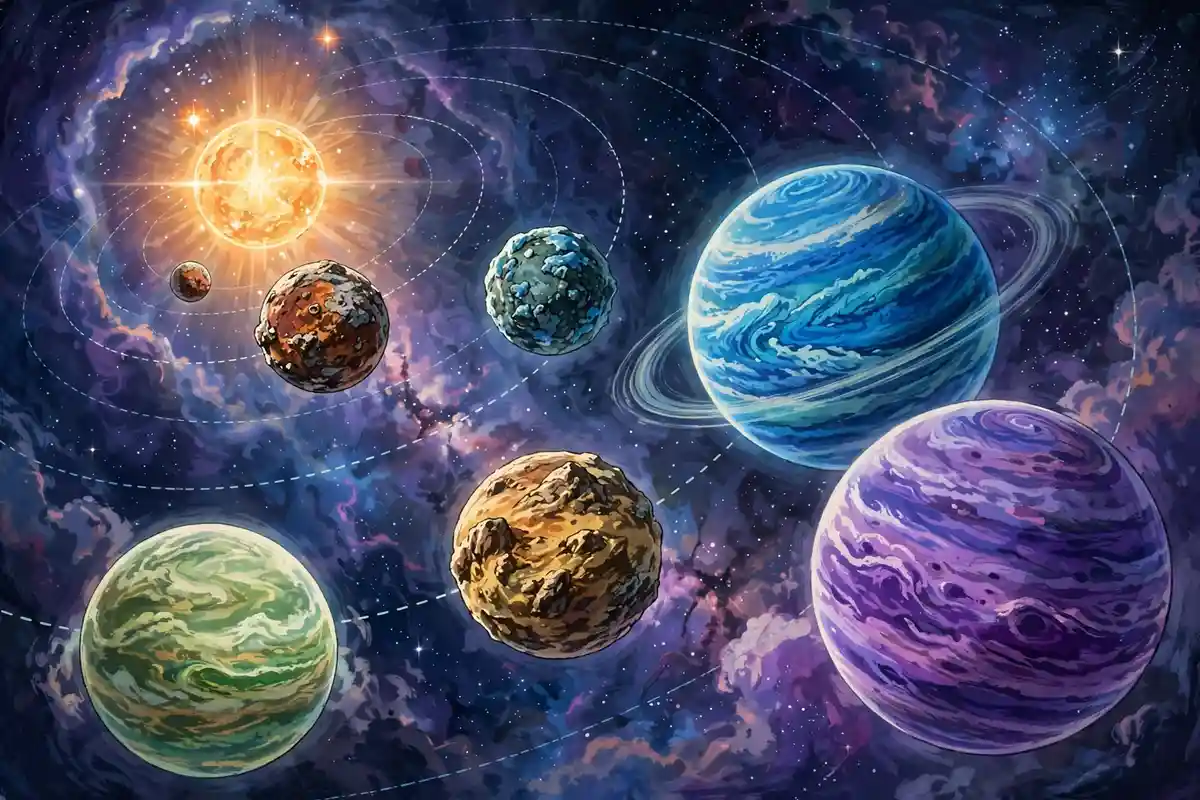
Exoplanets are often grouped by size and composition. Gas giants are large planets made mostly of hydrogen and helium, similar to Jupiter and Saturn. Ice giants are somewhat smaller and contain more water, ammonia, and methane. Rocky planets, sometimes called terrestrial planets, are made mostly of rock and metal, like Earth, Venus, and Mars. Super-Earths are rocky planets larger than Earth but smaller than Neptune, a type with no exact equivalent in our solar system. Mini-Neptunes are slightly larger, with thick atmospheres over rocky or icy cores. Some exoplanets are so hot they are called hot Jupiters, orbiting extremely close to their stars, while others orbit in the habitable zone, where temperatures might allow liquid water on the surface. That diversity surprised astronomers, who once expected other solar systems to look like ours, and it has forced new theories about how planets form and migrate.
H2: The Habitable Zone and the Search for Life
The habitable zone is the region around a star where temperatures are right for liquid water to exist on a planet’s surface, assuming the planet has a suitable atmosphere. It is sometimes called the Goldilocks zone, because it is neither too hot nor too cold. Being in the habitable zone does not guarantee life, and being outside it does not rule life out entirely, since subsurface oceans or thick atmospheres could support life in unexpected places. Scientists look for biosignatures, chemical signs in a planet’s atmosphere that might indicate life, such as oxygen, methane, or water vapor in combinations that are hard to explain without biology. So far, no biosignature has been confirmed, and scientists are careful not to overclaim. The search for life connects exoplanet science to biology, from the microbes in world of microbiology to the genetics in what DNA is and the cells in what stem cells are.
Famous Exoplanets and Systems
Some exoplanet systems have become famous for their intrigue. TRAPPIST-1 is a small, cool star with seven Earth-sized rocky planets, several of which lie in its habitable zone, making it a prime target for further study. Proxima Centauri b orbits the nearest star to the Sun, raising the tantalizing possibility of a relatively nearby world to study in detail. The Kepler mission discovered thousands of exoplanets by watching for transits, revealing that small planets are common and that many stars host multiple planets. Each new system adds to our picture, showing that planetary systems form in many configurations, not just the neat, orderly pattern of our own solar system. Those discoveries are part of the ongoing exploration described in Artemis program and the research in research in everyday life and scientific inquiry.
H2: What Exoplanets Teach Us About Earth
Studying exoplanets also teaches us about Earth, by showing us what our planet might have been like under different conditions. A rocky planet slightly closer to its star might have runaway warming, like Venus, while one slightly farther might have frozen, like Mars. Comparing Earth to exoplanets helps scientists understand which factors make a planet habitable: its size, composition, atmosphere, magnetic field, and the stability of its star. It also puts Earth’s rarity into perspective: Earth-like planets may be common in number, yet each one is unique in its history and conditions. Protecting Earth’s ecosystems, as discussed in protecting ecosystems, takes on new meaning when we realize how special a stable, life-supporting planet may be. The Sun’s energy, harnessed by how solar panels work, is the same kind of starlight that warms exoplanets around distant stars.
H2: The Future of Exoplanet Exploration
The future of exoplanet science is bright, with new telescopes able to study atmospheres in greater detail, search for biosignatures, and image planets directly. Scientists hope to find an Earth-like planet in a habitable zone and study its atmosphere for signs of water, clouds, and potentially life. Even if life is not found soon, each new planet refines our understanding of planet formation and the conditions for habitability. The search also raises profound questions: are we alone, how common is life, and what does it mean to be part of a universe filled with worlds? From the dark matter in what dark matter is to the black holes in what black holes are, the universe keeps surprising us, and exoplanets are one of its most exciting recent surprises. They remind us that our solar system is one neighborhood in a vast cosmic city, filled with worlds we are only beginning to explore.
Could We Ever Visit an Exoplanet?
Visiting an exoplanet in person remains far beyond current technology, because even the nearest exoplanet is light-years away, meaning light itself takes years to travel there. A spacecraft traveling at the fastest speeds humans have achieved would take tens of thousands of years to reach the nearest star system, far longer than a human lifetime. That does not mean exploration is impossible in principle; scientists have proposed ideas such as tiny, light-driven probes that could be pushed by powerful lasers to a fraction of light speed, potentially reaching a nearby star within decades. Those ideas face enormous engineering challenges, from powering the laser to communicating across light-years, and they remain speculative. For now, exploration means telescopes, not spaceships: studying light from distant planets to learn about their atmospheres, climates, and potential habitability, without ever leaving our solar system.
That limitation does not diminish the excitement of exoplanet science; it focuses it. Each new telescope generation brings sharper views, better atmospheric measurements, and more sensitive detections, gradually turning distant points of light into worlds with weather, chemistry, and history. Perhaps one day we will find a planet whose atmosphere strongly suggests life, and that discovery would transform how humanity sees itself. Until then, the search itself is valuable, teaching us about planet formation, about Earth’s place in the cosmos, and about the patience and ingenuity required to explore a universe far larger than we can travel. Exoplanets remind us that the night sky is not just a backdrop of stars, but a sky full of worlds, each waiting to be understood.
Each exoplanet discovered is a reminder that the universe is richer than we imagined, and that the search for other worlds is also a search for a deeper understanding of our own planet and our place among the stars.
The night sky, once thought to hold only stars, now holds thousands of known worlds, and many more waiting to be found.