Every cell in your body carries an instruction manual written in a chemical code. That code decides your eye color, influences your height, and helps determine how your body responds to disease. It is called DNA, and understanding what is DNA unlocks one of the deepest ideas in all of science: how life stores, copies, and passes on information.
You do not need a biology degree to grasp it. DNA works a lot like a recipe book written in a four-letter alphabet. Once you know the letters, the structure, and how cells read them, everything from inheritance to genetic testing starts to make sense. This guide explains DNA from the ground up — simply, accurately, and without jargon.
What Is DNA: The Molecule of Life
DNA stands for deoxyribonucleic acid. It is a long molecule found in the nucleus of nearly every cell in your body. Its job is to store the instructions for building and operating a living organism — which proteins to make, when to make them, and how cells should behave.
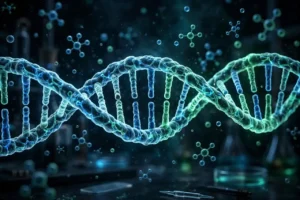
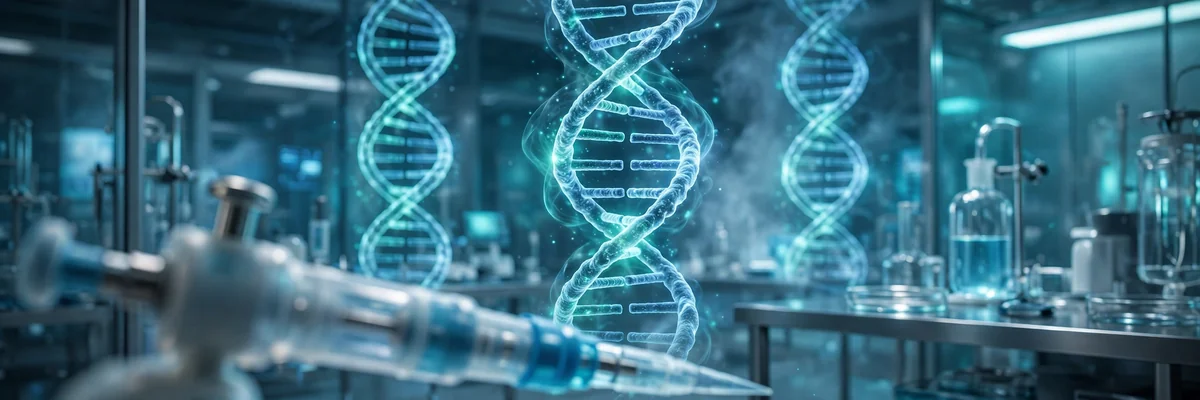
The most famous image in biology is DNA’s shape: the double helix, two strands twisted around each other like a spiral staircase. The “steps” of the staircase are pairs of chemical units called bases, and the sequence of those bases is the actual information. Change the sequence, and you change the instructions.
The Four-Letter Alphabet
DNA uses just four chemical letters: A, T, C, and G. These bases pair up in strict couples — A always pairs with T, and C always pairs with G. So if one strand reads A-C-G-T, the opposite strand must read T-G-C-A. This pairing rule is the secret behind both DNA’s structure and its ability to copy itself.
Three billion of these letter pairs, arranged in a precise order, make up the human genome. It sounds like a lot, but in physical terms it is astonishingly compact: the DNA in a single cell, stretched end to end, would be about two meters long — yet it fits inside a nucleus far too small to see with the naked eye.
From DNA to You: Genes and Proteins
A gene is a stretch of DNA that carries instructions for making one particular protein (or performing a related job). Humans have roughly twenty thousand genes, and proteins do most of the actual work in the body: building tissues, carrying oxygen in the blood, digesting food, fighting infections.
The path from gene to protein runs through an intermediary molecule. When a cell needs a particular protein, it copies the relevant gene’s sequence into a temporary message — and this is exactly where messenger RNA, or mRNA, enters the picture. Cellular machinery then reads that message and assembles the protein, amino acid by amino acid, following the code.
The Genetic Code
Cells read DNA three letters at a time. Each three-letter “word,” called a codon, specifies one amino acid — the building blocks of proteins. With four letters and three-letter words, there are sixty-four possible codons, more than enough to cover the twenty amino acids plus start and stop signals. Remarkably, this code is nearly universal: bacteria, oak trees, and humans all read it the same way, powerful evidence that all life on Earth shares a common origin.
Chromosomes: DNA’s Packaging
Your DNA is not floating loose in the cell. It is organized into structures called chromosomes — tightly coiled bundles of DNA wrapped around proteins. Humans have forty-six chromosomes in each cell, arranged in twenty-three pairs. You inherited one set of twenty-three from your mother and one from your father.
This is why you resemble your parents but are not identical to either: you received a shuffled mix of their genetic instructions. The shuffling happens when reproductive cells form, mixing and matching chromosome segments in new combinations. Siblings share, on average, half their DNA — the same parents, but a different shuffle.
Why Twins Can Differ
Even identical twins, who start with the same DNA, are not perfectly alike. Small copying errors called mutations accumulate over a lifetime, and environmental factors switch genes on and off through a layer of regulation called epigenetics. Same starting code, slightly different life stories written on top of it.
How DNA Copies Itself
Before a cell divides, it must copy its entire genome so each daughter cell gets a complete set. The double helix unzips down the middle, and each strand serves as a template for building a new partner strand. Because A pairs with T and C with G, each old strand automatically dictates the sequence of its new partner.
The result is two identical DNA molecules where there was one. This copying is extraordinarily accurate, but not perfect — and those rare mistakes, mutations, are the raw material of evolution. Most mutations are harmless or are repaired; a few cause disease; and very rarely, one proves beneficial and spreads through a population over generations.
Mutations: Typos in the Code
A mutation is simply a change in the DNA sequence — a substituted letter, a missing letter, or an extra one. Because the code is read in three-letter words, even a single-letter change can alter a protein or garble the message entirely.
Many mutations do nothing at all, because they land in regions of DNA with no critical function, or because the genetic code has built-in redundancy. Some cause genetic conditions when they disrupt important genes — which is why gene therapy aims to fix faulty genes at their source. And a few mutations are helpful: the classic example is a mutation that lets some adults digest milk, which spread because it offered a nutritional advantage.
What Causes Mutations
Mutations arise from copying errors during cell division, and from damage caused by radiation, certain chemicals, and even normal cellular wear and tear. Your cells run constant repair crews that fix most damage before it becomes permanent. Cancer begins when mutations disable the very genes that control cell growth and repair — which is also why stem cell research and regenerative medicine hold such promise for repairing damaged tissues.
DNA Testing: Reading Your Code
Modern genetic testing reads parts of your DNA to reveal ancestry, inherited health risks, and traits. A saliva sample contains cells; lab machines extract the DNA and read millions of positions, comparing your sequence to reference data. The results can connect you with distant relatives or flag variants worth discussing with a doctor.
These tests have limits worth knowing. Most traits — height, intelligence, disease risk — are influenced by hundreds of genes plus environment, so no test can predict them precisely. Privacy matters too: your DNA is the most personal data you own, so understanding a testing company’s data policies is as important as the results themselves.
CRISPR and the Future of DNA
For most of history, humans could only read DNA. CRISPR gene editing changed that by giving scientists a precise way to rewrite it — cutting DNA at a chosen spot and inserting corrected sequences. Researchers are using it to develop treatments for inherited blood disorders, to engineer crops, and to study what individual genes do.
The same biotechnology revolution is producing medical innovations that are changing lives in 2026, from personalized cancer therapies to lab-grown tissues. Meanwhile, artificial intelligence now helps scientists predict protein structures from DNA sequences in minutes — work that once took years — and quantum computing may one day simulate molecules with unprecedented accuracy.
DNA as Data Storage
Here is a delightful twist: because DNA stores information so densely, researchers are experimenting with using it as a data storage medium. A single gram of DNA could theoretically hold enormous amounts of digital data, preserved for centuries. The same molecule that stores the instructions for life might one day archive humanity’s libraries — and the microchips that read and write these sequences keep getting faster and cheaper.
Everyday DNA: It Is Closer Than You Think
You encounter DNA constantly without realizing it. The food you eat contains the DNA of plants and animals. Forensic scientists solve crimes with DNA left at scenes. Doctors use DNA tests to match organ donors and recipients. Conservationists track endangered species through DNA in water samples. Even 3D bioprinting researchers are learning to build tissues guided by genetic instructions.
DNA also quietly powers modern medicine behind the scenes. When doctors choose the right drug dose for a patient, they increasingly check genetic variants that affect how bodies process medications. When epidemiologists trace an outbreak, they compare the DNA of pathogens to find the source. The molecule is no longer just a biology-class topic — it is a working tool woven into healthcare, agriculture, and law enforcement across America.
Conclusion
So what is DNA? It is a four-letter chemical code, twisted into a double helix, organized into chromosomes, and copied with remarkable fidelity every time your cells divide. Genes — segments of that code — direct the building of proteins, and proteins build and run your body. Mutations introduce variation; inheritance shuffles it; and modern science can now read and even rewrite it.
From a crime lab to a cancer clinic, from an ancestry test to a farm field, DNA is the common thread. Understanding this molecule does not just explain how you got your mother’s eyes or your father’s laugh — it reveals the information system underlying all of life on Earth, and the foundation of the most exciting medicine of our century.