H2: The Universe Had a Beginning
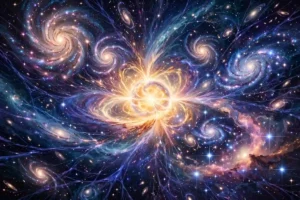
The Big Bang theory is the leading scientific explanation for how the universe began and how it has changed since then. In simple terms, it says that the universe began in an extremely hot, dense state about 13.8 billion years ago, and has been expanding and cooling ever since. That expansion is still happening today: galaxies are moving away from each other, much as raisins in rising bread dough move apart as the dough expands. The Big Bang was not an explosion in space, like a bomb going off in an empty room. It was an expansion of space itself, carrying matter and energy with it, and there was no outside to explode into. Understanding that distinction is the first step to understanding the theory, because it changes the picture from a blast to a stretching, cooling universe that gradually formed stars, galaxies, and planets.
H2: How We Know the Universe Is Expanding
One of the strongest pieces of evidence for the Big Bang is that the universe is expanding. Astronomers observe that light from distant galaxies is shifted toward the red end of the spectrum, a phenomenon called redshift, which indicates those galaxies are moving away from us. The farther away a galaxy is, the faster it appears to recede, a pattern first described by Edwin Hubble. This pattern makes sense if space itself is expanding, carrying galaxies apart like dots on an inflating balloon. If the universe is expanding now, then running the clock backward suggests it was smaller, denser, and hotter in the past, leading to the hot, dense beginning described by the theory. This reasoning, tested against many observations, is a cornerstone of modern cosmology.
H2: The Afterglow: Cosmic Microwave Background
Another powerful piece of evidence is the cosmic microwave background, a faint glow of radiation that fills the entire sky. In the early universe, matter and light were so hot and dense that light could not travel freely. As the universe expanded and cooled, light was finally able to travel across space, and that ancient light has been stretched by expansion into microwaves we can detect today. The cosmic microwave background is remarkably uniform in all directions, with tiny variations that later grew into galaxies and clusters. Its discovery, and the detailed maps made since, match the predictions of Big Bang theory with impressive precision. It is, in effect, a baby picture of the universe, showing us what the cosmos looked like when it was only a few hundred thousand years old.
H2: The First Moments and the First Elements
In the earliest moments, the universe was far too hot for atoms to exist. As it expanded and cooled, particles formed, then protons and neutrons, and then the lightest elements: mostly hydrogen and helium, with a trace of lithium. Those elements, forged in the Big Bang itself, still dominate the universe today: stars are mostly hydrogen and helium, and our own bodies contain hydrogen formed in that early era. Heavier elements, such as carbon, oxygen, and iron, formed later inside stars and in stellar explosions, and were scattered into space to form new stars, planets, and eventually life. That is why astronomers sometimes say we are made of star stuff: the atoms in your body were built in stars, from raw material that began in the Big Bang. The mysterious matter described in what dark matter is and the extreme objects in what black holes are are part of the same cosmic story.
H2: From Gas to Galaxies, Stars, and Planets
After the first elements formed, gravity gradually pulled gas together into clouds, and those clouds collapsed to form the first stars. The light from those stars ended a long dark period and began to reshape the gas around them. Over billions of years, stars gathered into galaxies, galaxies gathered into clusters, and within galaxies, clouds of gas and dust formed new stars and planetary systems, including our own solar system about 4.6 billion years ago. Earth formed from that material, and life evolved on Earth over billions of years, as described in the broader research in research in everyday life and scientific inquiry. The universe we see today, with its galaxies, stars, planets, and life, is the result of that long, gradual process of expansion, cooling, and gravitational assembly, all beginning from a hot, dense state.
What the Big Bang Does Not Explain
Honest science also notes what the Big Bang theory does not yet explain. It does not explain what, if anything, came before the hot, dense beginning, or why the universe began in that state. It does not fully explain dark matter or dark energy, the mysterious components that appear to make up most of the universe’s content and drive its accelerating expansion. Scientists have ideas about these questions, including theories about a rapid early expansion called inflation, but those ideas are still being tested. Acknowledging these open questions does not weaken the theory; it shows how science works, by distinguishing what is well established from what is still under investigation. The rockets in how rockets work, the satellites in how satellites work, and the missions in Artemis program all contribute observations that help test and refine our cosmic picture.
H2: Misconceptions About the Big Bang
Several misconceptions about the Big Bang are common. It was not an explosion at a single point in space, because space itself was expanding everywhere at once. There is no center of the universe from which everything is moving away; from any galaxy, other galaxies appear to recede, just as every raisin in rising dough sees the others moving away. The theory does not claim that the universe came from nothing in a simple sense; it describes how the universe evolved from a hot, dense state, while the question of ultimate origin remains open. Finally, the Big Bang is not a guess or a single observation, but a framework supported by multiple independent lines of evidence, including expansion, the cosmic microwave background, and the abundances of light elements. Those lines of evidence converge, which is why the theory is widely accepted among cosmologists.
H2: Why the Big Bang Matters
The Big Bang matters because it gives us a shared origin story grounded in evidence, connecting the smallest particles to the largest galaxies. It tells us that the universe has a history, that it changes over time, and that we can study that history by looking at distant light, ancient radiation, and the elements around us. It also connects to other sciences: the genetics in what DNA is, the cells in what stem cells are, the microbes in world of microbiology, and the ecosystems in protecting ecosystems all exist within a universe whose history began with the Big Bang. Even the Sun’s light, captured by how solar panels work, comes from a star formed billions of years after that beginning. To understand the Big Bang is to understand that we live in an old, expanding, evolving universe, and that our own story is a small but meaningful chapter in a much larger cosmic tale.
The Universe Today and Its Future
Today, the universe is vast, cold in most places, and filled with galaxies, stars, and planets that formed over billions of years. It is still expanding, and observations suggest that expansion is accelerating, driven by a mysterious component called dark energy. If that acceleration continues, distant galaxies will recede faster and faster, eventually becoming so distant that their light can no longer reach us. Closer to home, our own galaxy will one day merge with its neighbor, Andromeda, in a slow collision that will reshape both galaxies over billions of years. Stars will continue to form, burn, and die, gradually using up the gas available for new stars, until the universe becomes darker and colder over immense timescales. These far-future predictions are uncertain in detail, but they follow from the same physics that explains the past, applied forward in time.
For all its vastness, the Big Bang story is also deeply personal, because it explains the origin of the atoms that make up our bodies, our planet, and everything we see. Hydrogen in water, carbon in living things, oxygen in the air, and iron in our blood all trace back to the early universe and to stars that formed later. When we look at the night sky, we are looking back in time, seeing light that left distant galaxies millions or billions of years ago. That light carries information about the universe’s past, allowing us to reconstruct a history we could never witness directly. The Big Bang theory, then, is not just an abstract idea about the distant past; it is a framework that connects us to the cosmos, showing that we are products of a universe that has been expanding, cooling, and creating for nearly fourteen billion years.
In the end, the Big Bang theory invites humility and wonder in equal measure: humility, because our cosmic history is vast and still partly mysterious, and wonder, because we can understand so much of it from light, atoms, and careful observation.