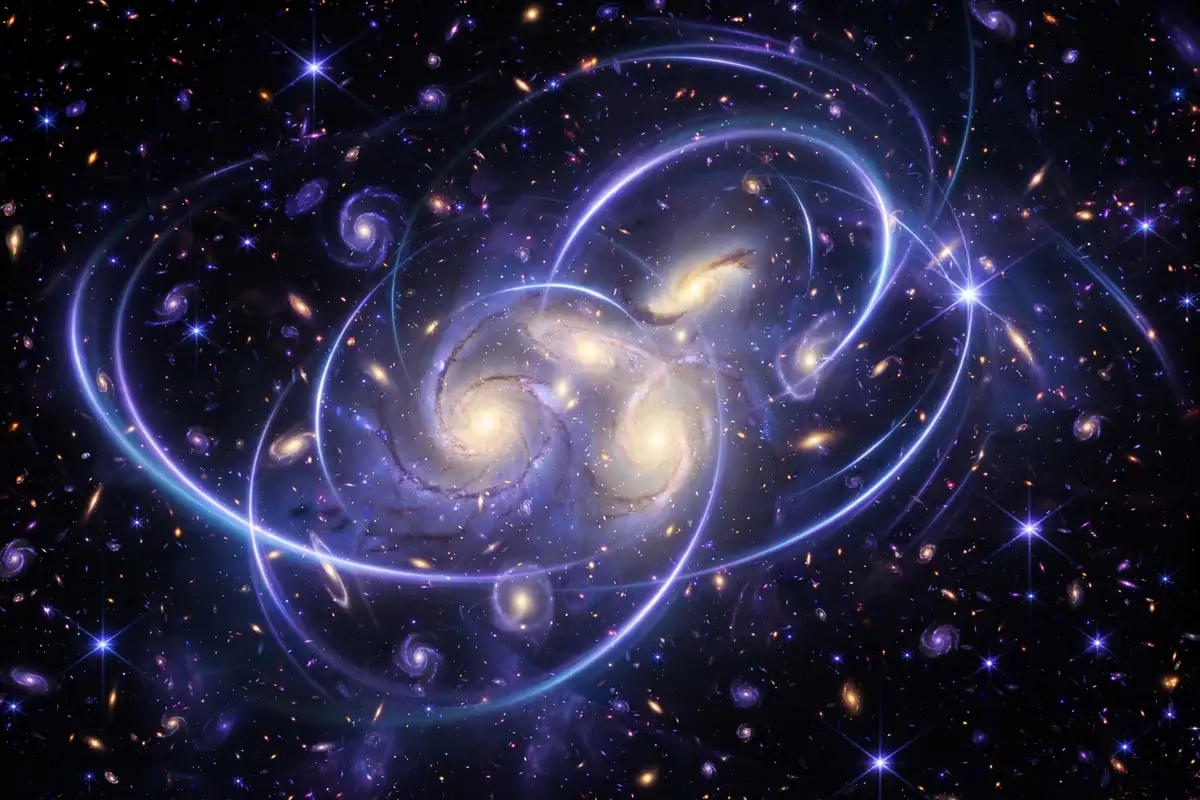
Everything you have ever seen — every star, planet, person, and pizza — makes up less than five percent of the universe. The rest is invisible. About 27 percent of the cosmos is dark matter: a mysterious substance that has gravity but emits no light, and scientists have never directly detected a single particle of it. Yet without dark matter, galaxies would fly apart, stars would never have formed, and you would not exist.
This guide explains what dark matter is, how astronomers discovered something they cannot see, the leading theories about what it might be, and how the most powerful observatories of 2026 — including the brand-new Vera Rubin Observatory — are closing in on the answer.
What Is Dark Matter? The Invisible Majority
Dark matter is matter that does not interact with light or any electromagnetic radiation. It does not glow, reflect, absorb, or block light. The only way astronomers know it exists is through its gravity: it pulls on visible matter, bends light, and holds galaxies together.
To grasp the scale, cosmologists divide the universe’s energy budget into three parts: roughly 5 percent ordinary matter (everything made of atoms), about 27 percent dark matter, and about 68 percent dark energy (the even stranger force accelerating the universe’s expansion). Dark matter outweighs visible matter by more than five to one. It forms an invisible scaffolding — vast halos and filaments — around and between which ordinary matter gathered to form galaxies and stars.
Crucially, dark matter is not just hard to see; it appears fundamentally different from ordinary matter. It does not form atoms, molecules, or stars. It passes through ordinary matter — and through you — constantly, without interacting. Billions of dark matter particles may be streaming through your body right now, completely unnoticed.
How Astronomers Discovered Dark Matter
The story begins in the 1930s, when Swiss astronomer Fritz Zwicky studied the Coma Cluster, a swarm of galaxies bound together by gravity. He measured how fast the galaxies moved and found a problem: they were moving so fast that the cluster’s visible mass could not possibly hold them together. They should have flown apart billions of years ago. Zwicky concluded that enormous amounts of unseen mass — which he called “dunkle Materie,” dark matter — must be providing the extra gravity.
His colleagues largely ignored him for decades. Then in the 1970s, astronomer Vera Rubin — after whom the new observatory is named — measured the rotation of spiral galaxies and found the same impossible pattern. Stars at the outer edges of galaxies orbit just as fast as stars near the center, which defies the expectation that gravity weakens with distance. The only explanation: each galaxy sits inside a vast halo of invisible mass far outweighing its stars. This discovery cemented dark matter as one of astronomy’s central mysteries.
Since then, the evidence has piled up from independent directions. The cosmic microwave background — the afterglow of the Big Bang — shows patterns that only make sense with large amounts of dark matter. Computer simulations of galaxy formation fail without it. And gravitational lensing, described below, lets astronomers literally map where it sits.
Gravitational Lensing: Seeing the Invisible by Its Shadow
Einstein’s general relativity predicts that mass bends the fabric of spacetime, and light follows those bends. When a massive object — like a galaxy cluster full of dark matter — sits between Earth and a distant galaxy, its gravity warps and magnifies the background galaxy’s light, stretching it into arcs and rings. This is gravitational lensing.
By measuring these distortions with extreme precision, astronomers can reconstruct the distribution of all mass along the line of sight — visible and invisible alike. Think of it like detecting a wine glass by the distortion it creates in the view through it: you never see the glass directly, but the warped image reveals its shape and position. Weak gravitational lensing surveys are now mapping dark matter across huge swaths of sky, producing the strongest evidence yet that cold dark matter — slow-moving, weakly interacting particles — matches observations far better than theories that try to explain galaxies without it.
What Could Dark Matter Be? The Leading Candidates
After nearly a century, physicists still do not know what dark matter is made of. But they have strong ideas about what it is not: it is not ordinary matter hiding in dim stars or black holes (astronomers have counted those, and there are not nearly enough), and it is not antimatter or neutrinos in any sufficient quantity. The leading candidates are new, undiscovered particles.
WIMPs: The Longtime Favorite
Weakly Interacting Massive Particles — WIMPs — have been the leading theoretical candidate for decades. They would be heavy particles that interact with ordinary matter only through gravity and the weak nuclear force, which explains why they are so hard to detect. Elegant theories beyond the Standard Model of particle physics naturally predicted particles with about the right properties and abundance.
The problem: decades of increasingly sensitive underground detectors — shielded from cosmic rays in deep mines — have found nothing. Each null result narrows the possible properties of WIMPs but does not kill the idea. The search continues with ever-larger detectors, and physicists remain divided on whether WIMPs will ever show up.
Axions and Other Contenders
Axions are hypothetical ultralight particles originally proposed to solve a puzzle in particle physics, and they happen to make excellent dark matter candidates too. Unlike heavy WIMPs, axions would be extraordinarily light — trillions of times lighter than an electron — but so numerous that their collective gravity shapes galaxies. Dedicated experiments using powerful magnets and sensitive resonators are hunting for the faint signal of axions converting into photons.
Other candidates include sterile neutrinos, primordial black holes formed in the Big Bang’s first moments, and entirely new frameworks like modified gravity theories that attempt to explain the observations without any new particles at all. The lensing evidence increasingly favors particle explanations, but the field remains genuinely open — which is what makes this one of the most exciting hunts in science.
The 2026 Dark Matter Hunt: Rubin, Euclid, and Roman
Three great observatories are attacking the dark matter problem from complementary angles, and 2026 is a landmark year for all of them.
Vera Rubin Observatory: Filming the Entire Sky
Perched in the Chilean Andes, the Vera C. Rubin Observatory began its ten-year Legacy Survey of Space and Time (LSST) on June 30, 2026. With the largest digital camera ever built for astronomy — 3.2 gigapixels — it photographs the entire southern sky every few nights, each position roughly 800 times over the decade, generating some 10 terabytes of data per night.
Even before the official survey start, Rubin was delivering. Its early test observations identified Aquarius IV, an ultra-faint dwarf galaxy about 359,000 light-years away — one of the smallest, most dark-matter-dominated galaxies known, invisible to every previous telescope. In just ten hours of commissioning observations, Rubin also spotted roughly 2,000 previously unknown asteroids, and early 2026 data yielded more than 11,000 new asteroids from about six weeks of observations. For dark matter, Rubin’s repeated imaging will measure gravitational lensing time delays at industrial scale and map the faintest dwarf galaxies — the systems where dark matter’s grip is most extreme.
Euclid: Mapping the Dark Universe From Space
The European Space Agency’s Euclid telescope, in space since July 2023, is purpose-built for weak gravitational lensing: above the atmosphere, with razor-sharp vision and infrared eyes for measuring galaxy distances. Its first data already identified roughly 500 strong gravitational lens candidates in just 0.45 percent of the planned survey area — extrapolating to over 100,000 across the full mission, a hundredfold increase over everything previously known.
Euclid will measure the subtle lensing warp for over a billion galaxies with precision far beyond ground-based telescopes, building the most detailed map of dark matter ever made. Its first full data release is expected in stages through late 2026 and 2027. Combined with Rubin’s ground-based survey and NASA’s upcoming Nancy Grace Roman Space Telescope, astronomers will soon have three independent, ultra-precise maps of the invisible universe.
Why Dark Matter Matters to You
It is fair to ask why anyone should care about invisible cosmic scaffolding. The answer is that dark matter is not a curiosity at the edge of science — it is the framework everything hangs on. Without dark matter’s gravity pulling ordinary matter together in the early universe, the first stars and galaxies might never have formed. No galaxies means no solar systems, no Earth, no you.
The hunt also drives technology. The ultrasensitive detectors, giant cameras, and data-processing methods built for dark matter research spill over into medicine, computing, and engineering. The algorithms that find faint galaxies in petabytes of Rubin data descend from the same AI techniques reshaping American life in 2026, and the precision engineering echoes advances in quantum computing. Even the new space race back to the Moon shares its roots in humanity’s drive to understand the cosmos, while the satellites mapping our own planet — from Starlink’s internet constellation to the GPS satellites timing your location — ride the same wave of space technology. And black holes, dark matter’s most extreme cousins, remind us how much of gravity’s story remains unwritten, even as the physics of stars themselves and the networks carrying these discoveries to your phone advance in parallel. For a broader tour of cosmic frontiers, see a journey through the high-tech universe, and remember that research like this shapes everyday life in ways we only recognize decades later.
Conclusion
Dark matter is the invisible majority of the universe’s matter — about 27 percent of everything that exists — detected only through its gravitational pull on galaxies, light, and the cosmic web. Discovered through the too-fast motions of galaxies by Fritz Zwicky and Vera Rubin, mapped today through gravitational lensing, it remains unidentified: WIMPs, axions, and other candidates await confirmation.
But the hunt has never been better equipped. With the Vera Rubin Observatory now filming the sky, Euclid mapping a billion galaxies, and new detectors growing ever more sensitive, the 2020s may finally be the decade when humanity meets the invisible scaffolding that built everything. The universe is mostly dark — and we are finally learning to see in it.