H2: The Daily Rise and Fall of the Sea
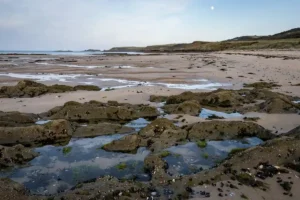
If you have ever visited a beach at different times of day, you may have noticed that the sea does not stay at the same level. At high tide, water creeps up the beach, covering sand that was dry hours before. At low tide, it retreats, exposing rocks, pools, and mudflats. This regular rise and fall is called the tide, and it happens most places about twice a day, though the exact timing and size vary by location. Tides are not caused by wind or weather, though wind can modify them; they are caused mainly by gravity, especially the Moon’s gravity, acting on Earth’s oceans. Understanding tides means understanding how the Moon pulls on water, how Earth rotates beneath tidal bulges, and how coastlines shape the result.
H2: The Moon’s Pull and Tidal Bulges
The Moon’s gravity pulls on Earth, and it pulls more strongly on the side of Earth facing the Moon than on Earth’s center, and more strongly on the center than on the far side. That difference in pull, called a tidal force, stretches the oceans into two bulges: one on the side facing the Moon, where water is pulled toward the Moon, and one on the opposite side, where Earth is pulled toward the Moon more strongly than the water there, leaving water behind as a second bulge. As Earth rotates, different places pass through these bulges, experiencing high tide when they are under a bulge and low tide when they are between bulges. Because there are two bulges, most places experience two high tides and two low tides each lunar day, which is slightly longer than a solar day because the Moon moves in its orbit while Earth rotates.
H2: The Sun’s Role: Spring and Neap Tides
The Sun also exerts a tidal force on Earth, though it is weaker than the Moon’s despite the Sun’s greater mass, because the Sun is much farther away and tidal force weakens quickly with distance. When the Sun, Moon, and Earth line up, as during new and full moons, their tidal forces combine, producing larger tides called spring tides, which have higher high tides and lower low tides. When the Sun and Moon are at right angles relative to Earth, as during quarter moons, their tidal forces partly cancel, producing smaller tides called neap tides. The names can be confusing: spring tides have nothing to do with the season of spring, but come from an old word meaning to leap or surge. Fishermen, sailors, and coastal communities have tracked these cycles for centuries, because spring tides affect navigation, fishing, and flooding risk.
H2: Why Tides Differ From Place to Place
Tides are not the same everywhere, because coastlines, ocean basins, and seafloor shapes modify how tidal bulges move. In some places, tides rise and fall by only a few centimeters, while in others, such as the Bay of Fundy in Canada, they can rise and fall by many meters, creating dramatic changes in the shoreline. Some places experience two nearly equal high tides each day, others experience one high and one low tide, and still others experience mixed tides with unequal highs and lows. These differences arise from the shape and depth of ocean basins, which can amplify or dampen tidal waves as they travel, and from resonance, where a basin’s natural oscillation matches the tidal period. Local geography therefore turns a global gravitational effect into a highly local experience, which is why tide tables are specific to each location.
H2: Tides, Life, and Human Activity
Tides shape coastal ecosystems in profound ways. Intertidal zones, the areas between high and low tide, are home to creatures adapted to alternating immersion and exposure, from barnacles and mussels to crabs and shorebirds that feed when the tide retreats. Tidal currents move nutrients, larvae, and sediments, connecting estuaries, marshes, and open ocean. Humans have long used tides for fishing, navigation, and even power: tidal mills once ground grain using tidal currents, and modern tidal turbines generate electricity from the predictable flow of tidal water. Coastal planning must account for tides, especially combined with storms and sea-level rise, because a storm surge arriving at high spring tide can cause far more flooding than the same storm at low tide. Protecting coastal ecosystems, as discussed in protecting ecosystems, means understanding tides as a fundamental rhythm of coastal life.
Tides Beyond Earth
Tides are not unique to Earth’s oceans. The Moon itself experiences tides from Earth, and over billions of years Earth’s tidal pull has slowed the Moon’s rotation until the Moon always shows the same face to Earth, a state called tidal locking. Many moons in the solar system are tidally locked to their planets, and some, such as Jupiter’s moon Europa, are heated by tidal flexing as they orbit, potentially maintaining liquid oceans beneath icy surfaces. Tidal forces can even tear apart objects that venture too close to a massive body, and they play a role in shaping planetary systems around other stars. The same gravitational principles that raise tides on Earth, explored through the satellites in how satellites work and the rockets in how rockets work, govern tides throughout the universe, from moons to stars to galaxies.
H2: Measuring and Predicting Tides
Tides are among the most predictable natural phenomena, because they depend mainly on the known motions of the Moon and Sun. Tide tables, published for coastal locations, predict high and low tide times and heights days, months, or years in advance, using harmonic analysis that breaks tidal motion into components caused by different astronomical cycles. Modern tide gauges and satellite altimeters measure sea level continuously, improving predictions and tracking long-term changes such as sea-level rise. That predictability is useful for shipping, fishing, construction, and recreation, and it also makes tides a powerful teaching tool: a phenomenon that is both everyday and cosmic, governed by gravity and geometry, and predictable with remarkable accuracy. The research behind those predictions is part of the work in research in everyday life and scientific inquiry.
H2: Tides as a Reminder of Cosmic Connections
Tides remind us that Earth is not isolated; it is part of a dynamic system with the Moon and Sun, whose motions shape our daily lives in visible ways. The Moon, often thought of as a distant, passive object in the night sky, actively moves our oceans twice a day, every day, without fail. The Sun, which powers weather and climate through its light, as captured by how solar panels work, also tugs on our oceans through gravity. Even the invisible matter in what dark matter is and the extreme gravity in what black holes are are part of the same gravitational story. From the genetics in what DNA is to the cells in what stem cells are and the microbes in world of microbiology, life on Earth evolved in a world shaped by tides, and the missions in Artemis program continue our exploration of the Moon that drives them. The next time you watch the tide come in, you are watching the Moon at work.
H2: Watching Tides Safely
If you visit a tidal shore, safety matters as much as curiosity. Tides can return faster than expected, cutting off causeways, trapping walkers on sandbanks, and turning a calm beach into a dangerous current. Always check local tide times before exploring intertidal areas, tell someone where you are going, and leave plenty of time to return before high tide. Respect wildlife in tide pools, observing without removing creatures or disturbing their habitat. With those precautions, tide-watching is a wonderful way to see science in action: water rising and falling on a schedule set by the Moon, shaping beaches, feeding wildlife, and connecting a single shoreline to the motions of the whole Earth-Moon system.
Tides and Coastal Communities
Coastal communities have lived by the tides for thousands of years, timing fishing, farming, and travel to the rhythm of high and low water. In some cultures, tidal knowledge was passed down through generations, encoded in stories, calendars, and practical rules about when to cross mudflats or launch boats. Modern tide tables formalize that knowledge, but the underlying rhythm is the same: the Moon’s pull, Earth’s rotation, and local geography combining to raise and lower the sea. In tidal energy projects, engineers harness that rhythm, placing turbines in channels where tidal currents are strong and predictable, generating electricity without fuel or emissions. Those projects must be designed carefully to avoid harming marine life and navigation, but they show how an ancient natural cycle can support modern sustainable energy.
Tides also affect recreation and safety in ways that visitors should respect. Beachgoers who arrive at low tide may find a wide, inviting beach, only to discover that the returning tide cuts off their route back, especially around headlands or causeways. Swimmers should be aware of tidal currents, which can be strong in narrow channels even when the sea looks calm. Kayakers and sailors plan journeys around tidal flows, using favorable currents to travel efficiently and avoiding opposing currents that can exhaust paddlers. By checking tide times, understanding local conditions, and respecting warning signs, visitors can enjoy tidal shores safely, experiencing firsthand the powerful, predictable rhythm that the Moon imposes on Earth’s oceans every day.