H2: What a Tornado Is
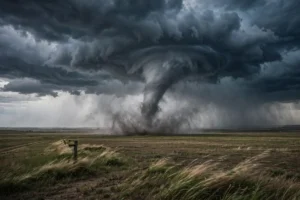
A tornado is a violently rotating column of air that extends from a thunderstorm to the ground, visible as a funnel cloud when it picks up dust, debris, or condensation. Tornadoes are among the most intense and localized weather phenomena on Earth, with winds that can exceed those of hurricanes in the strongest cases, though over a much smaller area and for a much shorter time. Most tornadoes last only minutes and travel a few miles, but the strongest can last over an hour and travel dozens of miles, leaving a path of destruction. Tornadoes occur in many countries, but they are most common in the central United States, an area often called Tornado Alley, where geography and weather patterns frequently create the conditions they need. Understanding how tornadoes form helps explain why they are so hard to predict precisely, and why warnings must be taken seriously even when the sky looks calm.
H2: The Thunderstorm Connection
Almost all tornadoes form from thunderstorms, and the most violent ones form from a special kind of thunderstorm called a supercell. A supercell is a long-lived, rotating thunderstorm with a deep, persistent updraft, a column of rising warm, moist air. Ordinary thunderstorms can also produce weaker tornadoes, but supercells provide the organized rotation and sustained energy that allow strong tornadoes to develop. For a supercell to form, the atmosphere needs warm, moist air near the surface, cooler, drier air aloft, and instability that allows air to rise rapidly. When those conditions come together, especially in spring and early summer in the central United States, thunderstorms can grow tall and powerful, with updrafts strong enough to support hail, heavy rain, and, in some cases, tornadoes.
H2: Wind Shear: The Key to Rotation
Wind shear, the change in wind speed and direction with height, is the key ingredient that turns a rising column of air into a rotating one. Near the surface, winds may blow from the south, bringing warm, moist air, while higher up winds blow from the west or southwest at greater speeds. That difference creates a rolling motion in the atmosphere, like a rolling pin lying on its side. When a thunderstorm’s updraft lifts that rolling air into a vertical position, the rotation becomes upright, forming a rotating column called a mesocyclone within the supercell. If that rotation tightens and extends downward to the ground, a tornado forms. Not every mesocyclone produces a tornado, and scientists are still studying why some do and others do not, which is part of why tornado forecasting remains challenging even as radar and modeling improve.
H2: From Funnel Cloud to Touchdown
A tornado begins as a funnel cloud descending from the base of a thunderstorm, formed by condensation as pressure drops inside the rotating column. When that funnel reaches the ground, it becomes a tornado, and it may pick up dust and debris, making it visible even when condensation is limited. The tornado’s path depends on the movement of its parent thunderstorm, usually from southwest to northeast in the United States, though paths can vary. Tornado intensity is rated on the Enhanced Fujita scale, based on damage, from EF0 for the weakest to EF5 for the most violent, with winds estimated from the damage caused. Most tornadoes are weak, but a small fraction are strong or violent, and those cause most deaths and destruction. Because tornadoes are small and fast-forming, warnings often give only minutes of lead time, making preparedness essential.
H2: Why Tornado Alley Exists
Tornado Alley exists because of a unique combination of geography and weather patterns in the central United States. Warm, moist air flows north from the Gulf of Mexico, cool, dry air flows east from the Rocky Mountains, and cold air sometimes moves south from Canada. When these air masses meet, especially in spring when temperature contrasts are strong, they create instability and wind shear favorable for supercells. The flat terrain of the Great Plains allows these air masses to meet without mountains disrupting them, and the jet stream overhead adds additional shear and lift. Other regions, including parts of Europe, Australia, and South America, also experience tornadoes, but none combine these factors as frequently as the central United States. Understanding this geography helps explain why tornado risk is not uniform, and why some communities face it far more often than others.
Tornado Safety: What to Do
If a tornado warning is issued for your area, meaning a tornado has been spotted or indicated by radar, take shelter immediately in a sturdy building, on the lowest floor, in an interior room away from windows, such as a bathroom, closet, or basement. Crouch low, protect your head and neck with your arms or a sturdy object, and stay away from exterior walls, windows, and doors. Mobile homes and vehicles offer little protection and should be abandoned for a sturdier shelter if possible; if no shelter is available in a vehicle, lie flat in a low ditch away from the vehicle, though this is a last resort. After a tornado passes, watch for hazards such as downed power lines, broken glass, and damaged gas lines, and avoid entering damaged buildings until officials say it is safe. Practicing a tornado plan with your family, including where to go and what to bring, can save precious minutes when a warning arrives.
H2: Forecasting and Warning Systems
Tornado forecasting relies on weather models that predict favorable conditions days in advance, and on radar that detects rotation within thunderstorms in real time. Forecasters issue outlooks for severe weather risk, watches when conditions are favorable for tornadoes over a broad area, and warnings when a tornado is imminent or occurring in a specific location. Doppler radar can detect rotation and debris signatures, giving forecasters crucial minutes to warn communities. Sirens, weather radios, phone alerts, and television broadcasts all play a role in spreading warnings, but no system works if people do not receive or act on the warning. That is why weather radios, phone alerts, and family plans matter as much as the science itself. The observation networks behind warnings share a spirit with the satellite systems in how satellites work and the research in research in everyday life and scientific inquiry, turning data into decisions that save lives.
H2: Tornadoes in a Changing Climate
Scientists are studying how climate change might affect tornadoes, but the picture is complex and less clear than for some other weather phenomena. Warmer temperatures could increase atmospheric moisture and instability, potentially favoring severe thunderstorms, while changes in wind shear could work in the opposite direction. So far, there is no clear trend in the total number of tornadoes in the United States, though there are signs of shifts in when and where tornadoes occur, and in the clustering of tornado outbreaks. Researchers caution against attributing any single tornado to climate change, while continuing to study long-term patterns. Protecting communities, as discussed in protecting ecosystems, involves both understanding these trends and improving warnings, building codes, and shelter access regardless of future changes.
H2: Respecting a Powerful, Local Storm
Tornadoes are a reminder that weather can be both beautiful and terrifying, sometimes within the same sky. A supercell thunderstorm, with its towering clouds and dramatic light, can be awe-inspiring to watch from a safe distance, yet the tornado it produces can destroy a neighborhood in minutes. That contrast demands respect: admire storms from safety, heed warnings without delay, and never attempt to chase or photograph a tornado unless you are a trained professional with proper equipment. From the Sun’s energy in how solar panels work that warms the air, to the gravity in what dark matter is and what black holes are that shapes the planet, to the life in what DNA is, what stem cells are, and world of microbiology that must shelter from storms, and to the exploration in how rockets work and Artemis program that expands our knowledge, tornadoes sit within a wider natural world that is powerful, interconnected, and worthy of both study and caution.
Tornadoes, Communities, and Recovery
Recovery from a tornado is different from recovery from a hurricane, because tornado damage is often narrow but intense, destroying some homes completely while leaving neighbors untouched. That pattern can feel arbitrary and unfair, and it creates unique challenges for aid, insurance, and rebuilding. Neighbors often become first responders, checking on each other, clearing debris, and sharing shelter in the first hours after a tornado, before official help arrives. Community organizations, churches, and schools frequently serve as coordination points, distributing food, clothing, and information. Rebuilding may involve stronger construction, such as reinforced safe rooms or storm shelters, which can save lives in future tornadoes. Investing in a safe room, where feasible, is one of the most effective steps a household in a high-risk area can take, providing protection even when warnings give only minutes to act.
Education is also a powerful tool against tornado risk. Schools in tornado-prone regions practice drills, teaching children where to go and what to do when a warning sounds. Workplaces develop severe weather plans, identifying interior rooms and accounting for employees after a storm. Families that discuss their plan in advance, including a meeting point if separated and a way to communicate if phone service fails, are better prepared than families that first think about tornadoes when sirens sound. Tornadoes will remain a fact of life in certain regions, but knowledge, warnings, and preparation transform them from unpredictable terrors into hazards that communities can face with greater confidence, resilience, and care for one another.