H2: Our Home Galaxy
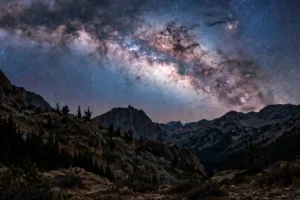
The Milky Way is the galaxy we live in, a vast collection of stars, gas, dust, and dark matter bound together by gravity. It contains hundreds of billions of stars, including our Sun, along with planets, moons, asteroids, comets, and clouds of gas where new stars are born. From inside, we cannot see the whole galaxy at once, which is why understanding its shape took centuries of careful observation. When you look at the night sky away from city lights, the pale, cloudy band stretching across the sky is the Milky Way seen edge-on: countless distant stars too faint to separate with the naked eye, blending into a river of light. That band gave the galaxy its name, inspired by ancient stories about a milky path across the heavens.
H2: A Spiral Galaxy With Arms
The Milky Way is a barred spiral galaxy, meaning it has a central bar of stars with spiral arms winding outward from its ends. Our Sun sits in one of the smaller arms, called the Orion Arm, roughly two-thirds of the way from the center to the edge. The galaxy’s disk, where most stars and gas lie, is relatively thin compared with its width, which spans roughly one hundred thousand light-years. A light-year is the distance light travels in one year, so crossing the galaxy at light speed would still take one hundred thousand years. Around the disk lies a more spherical halo of old stars and globular clusters, ancient, tightly packed groups of stars that orbit the galaxy. This structure, revealed by mapping stars and gas, shows a galaxy that is both orderly in its spiral pattern and dynamic, with stars constantly moving in their orbits around the center.
H2: The Center of the Milky Way
At the center of the Milky Way lies a supermassive black hole called Sagittarius A*, with a mass millions of times that of the Sun. A black hole is a region where gravity is so strong that not even light can escape from within its boundary, as described in what black holes are. Stars near the center orbit this black hole at tremendous speeds, and their motions allowed astronomers to measure its mass without seeing it directly. The central region is crowded with stars, gas, and dust, and it glows brightly in infrared light, which can penetrate dust that blocks visible light. Despite its dramatic center, the Milky Way is a relatively calm galaxy today, forming new stars at a modest rate in its spiral arms, where gas clouds collapse under gravity to ignite new suns.
H2: How We Mapped a Galaxy From Inside
Mapping the Milky Way from inside is like trying to draw a forest while standing among the trees, yet astronomers have done it by combining many kinds of evidence. They measure distances to stars using parallax, the apparent shift of a nearby star against distant background stars as Earth orbits the Sun. They map gas clouds using radio waves, which pass through dust that blocks visible light. They study the motions of stars to infer the galaxy’s rotation and mass, including the influence of the invisible substance described in what dark matter is. Space telescopes, building on the satellite technology in how satellites work and the rockets in how rockets work, have measured positions and motions for billions of stars, creating the most detailed map of our galaxy ever made. Each new survey refines the picture, revealing streams of stars left by smaller galaxies that the Milky Way absorbed long ago.
H2: Stars, Planets, and Life in the Milky Way
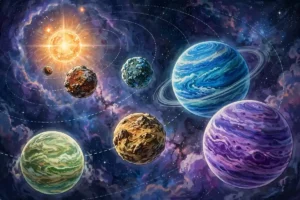
The Milky Way is home to an astonishing variety of stars, from small, cool red dwarfs that burn slowly for trillions of years to massive, hot blue stars that live fast and die young in spectacular explosions. Around many of those stars orbit planets, including the exoplanets now being discovered in large numbers. Our solar system is just one planetary system among billions in the galaxy, orbiting an ordinary star in a quiet suburb of the Milky Way. That ordinariness is reassuring: our Sun is stable, our neighborhood is not crowded with dangerous neighbors, and our galaxy provides a relatively calm environment where life could evolve over billions of years. The biology of that life, from the genetics in what DNA is to the cells in what stem cells are and the microbes in world of microbiology, unfolded on a planet orbiting one star among hundreds of billions.
The Milky Way’s Past and Future
The Milky Way has grown by merging with smaller galaxies over billions of years, absorbing their stars and gas into its own structure. Evidence of those ancient mergers survives as streams of stars moving together through the halo, like fossils of past collisions. In the future, the Milky Way is expected to merge with its large neighbor, the Andromeda Galaxy, in about four billion years, forming a new, larger galaxy. That merger will reshape both galaxies, though individual stars are so far apart that direct collisions between stars will be rare. The Sun itself will have changed by then, having evolved into a red giant, so the merger is a distant event for the galaxy, not an immediate threat to Earth. Understanding this long history, as explored in research in everyday life and scientific inquiry, puts our brief human history into a cosmic perspective.
H2: Seeing the Milky Way Yourself
You can see the Milky Way with your own eyes from a dark location, away from city lights, on a clear, moonless night. In the Northern Hemisphere, it is most prominent in summer, stretching from the northeast to the southwest, while in the Southern Hemisphere it passes nearly overhead. Give your eyes twenty minutes to adapt to darkness, avoid looking at bright phone screens, and look for the pale band rather than individual stars. Binoculars reveal more stars within the band, and a small telescope reveals star clusters and nebulae, glowing clouds of gas where new stars form. Even the Sun’s energy, captured by how solar panels work, is a reminder that starlight powers life, and the missions in Artemis program extend our exploration beyond Earth into the wider galaxy. Seeing the Milky Way is a humbling experience: a direct view of our galactic home, filled with stars too numerous to count.
H2: Why Our Galaxy Matters
The Milky Way matters because it is our cosmic address, the context for everything we know. It shaped the Sun’s formation, the Earth’s chemistry, and the environment in which life evolved. Studying it helps us understand other galaxies, which we see from outside and can compare with our own. It also reminds us of scale: Earth is one planet around one star in one galaxy among trillions of galaxies in the observable universe. That scale can feel overwhelming, but it can also feel inspiring, because it shows how much there is to explore and learn. Protecting the dark skies that let us see the Milky Way, as part of caring for ecosystems in protecting ecosystems, preserves not only a beautiful sight but also our connection to the galaxy we call home.
H2: A Galaxy Still Full of Mysteries
Despite great progress, the Milky Way still holds mysteries. Scientists are still mapping its exact spiral structure, measuring the distribution of dark matter, and searching for the faintest stars and planets in its far reaches. They are studying how its central black hole influences its surroundings, how new stars form in its clouds, and how its halo preserves the history of past mergers. Each answer raises new questions, which is the nature of science at its best. The Milky Way is not a finished picture in a textbook; it is a living, evolving galaxy that we are still learning to read, star by star, cloud by cloud, and orbit by orbit, from our small but privileged position inside it.
Exploring the Milky Way From Earth
For most of human history, the Milky Way was a mystery band of light, explained by myths and stories long before telescopes revealed it as countless stars. Galileo’s telescope first resolved that band into individual stars, transforming a poetic image into a scientific fact. Later astronomers measured star distances, mapped spiral arms, and discovered the central black hole, each step building on the last. Today, amateur astronomers with modest telescopes can observe star clusters, nebulae, and the galactic center region, participating in the same exploration that professionals pursue with giant observatories. That continuity, from ancient skywatchers to modern astrophysicists, shows how curiosity about our galactic home has driven science forward for centuries, and how much remains to discover.
Dark-sky preservation is also part of Milky Way exploration, because light pollution now hides the galactic band from most people in cities. Communities that reduce unnecessary lighting, shield streetlights downward, and create dark-sky parks help restore a view that humans enjoyed for millennia. Those efforts benefit wildlife as well, since many animals navigate by starlight or depend on natural darkness. When you travel to a dark location and see the Milky Way for the first time, the experience often inspires a deeper interest in astronomy, science, and the natural world. Preserving dark skies is therefore not only about astronomy; it is about preserving a shared human heritage, a view of our galaxy that connects us to the cosmos and to each other.