About one in five light bulbs in America glows with nuclear power. No smoke. No carbon dioxide. Just the controlled splitting of atoms — a process so energetic that a single uranium fuel pellet, smaller than your fingertip, holds as much energy as a ton of coal. Nuclear power plants turn that atomic energy into electricity with staggering efficiency, and in 2026 they remain the largest source of carbon-free electricity in the United States.
Yet most people could not explain how a nuclear power plant actually works. This guide walks through the whole chain — from uranium atoms to your wall outlet — plus the 2026 state of the American nuclear fleet, the new reactors coming online, and honest answers to the questions everyone asks about safety and waste.
How Nuclear Power Plants Work: The One-Sentence Version
A nuclear power plant is, at heart, a very fancy way to boil water. Nuclear fission — the splitting of uranium atoms — releases heat. That heat boils water into steam. The steam spins a turbine. The turbine spins a generator. The generator makes electricity. Every other detail is about controlling the splitting, capturing the heat, and doing it safely.
Nuclear Fission: Splitting Atoms to Release Energy
Most American reactors burn uranium-235, a rare isotope that makes up less than one percent of natural uranium. (Fuel is “enriched” to about 3–5 percent U-235.) When a free neutron strikes a U-235 nucleus, the nucleus becomes unstable and splits into two smaller nuclei — fission fragments — plus two or three new neutrons and an enormous burst of energy.
Those new neutrons can strike other U-235 nuclei, splitting them in turn. This is a chain reaction: one split causes several more, each releasing energy. In a power plant, control rods made of neutron-absorbing materials like boron or cadmium slide between the fuel assemblies, soaking up just enough neutrons to keep the reaction steady. Pull the rods out slightly and power rises; push them in and power falls; push them all the way in and the reactor shuts down.
The energy released is staggering because of Einstein’s E=mc². A tiny fraction of the atom’s mass converts directly into energy — millions of times more energy per atom than any chemical reaction. That is why nuclear fuel is so compact, and why nuclear fusion, the process that powers stars, is so tantalizing as a future energy source: fusion squeezes atoms together instead of splitting them apart, but both tap the same deep physics.
From Heat to Steam to Electricity
The reactor core sits inside a thick steel pressure vessel, submerged in coolant water. Fission heats that water to around 300°C (over 570°F) — kept liquid by enormous pressure, like a pressure cooker. In the most common American design, the pressurized water reactor (PWR), this superheated water circulates through a heat exchanger called a steam generator, where it boils a separate loop of water into steam without the two waters ever mixing.
The steam rushes through turbine blades at high speed, spinning a shaft connected to a generator. Inside the generator, electromagnets rotate past coils of wire, inducing electric current. The steam then condenses back to water in a condenser — cooled by those iconic hyperbolic cooling towers or by river water — and returns to the steam generator. The loop repeats endlessly.
The second common design, the boiling water reactor (BWR), is simpler: water boils directly in the reactor vessel and the steam goes straight to the turbine. About two-thirds of American reactors are PWRs and one-third are BWRs, but both end at the same place: spinning turbines and flowing electrons.
The American Nuclear Fleet in 2026
The numbers are impressive. According to the U.S. Energy Information Administration, as of early 2026 the United States operates 94 commercial nuclear reactors at 54 power plants across 28 states — the largest nuclear fleet in the world. Those reactors generate roughly 19 percent of all American electricity, making nuclear the country’s top source of carbon-free power.
Reliability is nuclear’s superpower. Reactors run at a capacity factor above 90 percent, meaning they produce near-maximum output almost all the time. Compare that to solar and wind, which depend on weather, and you understand why grid operators value nuclear so highly. The average American reactor is about 44 years old — these machines were built to last, and most are now licensed or seeking licenses to operate for 60 to 80 years.
Illinois leads the nation with 11 reactors. The largest single plant is Vogtle in Georgia, with four reactors totaling about 4,658 megawatts after Units 3 and 4 — the newest American reactors — entered service in 2023 and 2024. The Vogtle expansion cost roughly $35 billion, a cautionary tale about the economics of building giant reactors in the United States, and one reason the industry’s future bets look very different.
Small Modular Reactors: The Next Wave
The industry’s big hope for new construction is the small modular reactor (SMR): factory-built units of 50–300 megawatts, small enough to ship by truck and install in multiples. SMRs promise standardized manufacturing, lower upfront costs, and passive safety systems that cool themselves without operator action or external power.
As of 2026, several SMR designs are working through licensing with the Nuclear Regulatory Commission, and demonstration projects are underway — including advanced designs like TerraPower’s Natrium sodium-cooled reactor. The timeline is uncertain, but the direction is clear: the next American reactors will likely be smaller, simpler, and built in factories rather than poured in concrete on site. These advanced designs sit alongside the broader wave of climate tech innovations fighting climate change in 2026.
Nuclear Safety: What Three Mile Island, Chernobyl, and Fukushima Taught Us
No honest discussion of nuclear power plants can skip the accidents. Three Mile Island (1979, Pennsylvania) was a partial meltdown caused by equipment failure and operator confusion; its containment held, and public health studies found no significant radiation exposure. Chernobyl (1986, Soviet Ukraine) was a catastrophic explosion in a reactor design with no containment building, operated recklessly during a test — a combination impossible in American plants. Fukushima (2011, Japan) was overwhelmed by a massive earthquake and tsunami that destroyed backup power; the meltdown released radiation but caused no radiation deaths, though the evacuation itself was devastating.
Each accident reshaped the industry. American plants added redundant cooling, hardened backup power, better operator training, and severe-accident management procedures. Modern designs add passive safety — systems that work by gravity and natural circulation, needing no electricity and no human intervention. Statistically, nuclear remains among the safest ways to generate electricity: even including the accidents, deaths per terawatt-hour are lower than for coal, oil, gas, and even some renewables, because air pollution from fossil fuels kills far more people every year.
The white clouds rising from cooling towers, by the way, are just water vapor — the same as a kettle’s steam. They are not smoke, and they contain no radioactivity.
The Waste Question: Honest Answers
Spent nuclear fuel is the industry’s most legitimate long-term challenge. After several years in a reactor, fuel assemblies are removed and stored in deep pools of water, then eventually in massive dry casks of steel and concrete. The casks are extraordinarily robust — tested against crashes, fires, and drops — and have an excellent safety record.
The volume is smaller than most people imagine. All the high-level nuclear waste ever produced by American commercial reactors could fit on a single football field stacked a few meters deep. Compare that to the billions of tons of coal ash and the CO₂ fossil plants emit every year, and the scale difference is striking. Finland opened the world’s first deep geological repository in the mid-2020s, burying waste in stable bedrock for millennia; the United States has studied Yucca Mountain in Nevada for decades, but politics has kept it from opening.
Advanced reactor designs could eventually burn some of this “waste” as fuel, shrinking both its volume and its hazardous lifetime. Until then, dry cask storage remains safe and proven.
Nuclear vs. Renewables: Partners, Not Rivals
The cleanest electricity grids combine both. Solar panels and wind turbines produce cheap, clean electricity when the sun shines and the wind blows. Nuclear produces steady, carbon-free electricity around the clock, filling the gaps. This is why many grid studies find that keeping existing nuclear plants running is one of the cheapest ways to cut emissions.
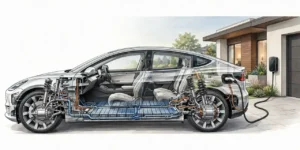
Some technologies even link them directly. Heat pumps electrify home heating, and efficient heating systems reduce the total electricity needed — electricity that nuclear plants can supply carbon-free through the night. And electric vehicles charging overnight on a nuclear-powered grid produce essentially zero emissions. Technologies that remove carbon from the air, like carbon capture systems, pair with nuclear in long-term decarbonization plans, while the fundamental physics connects to everything from the physics of black holes to quantum computing research that may one day simulate new reactor materials.
Conclusion
Nuclear power plants work by sustaining a controlled fission chain reaction, using its heat to make steam, and converting that steam into electricity through turbines and generators. America’s 94 reactors supply about a fifth of the nation’s electricity with no carbon emissions and unmatched reliability. The newest American reactors are online in Georgia, small modular reactors are working through licensing, and the industry’s safety record — learned through hard lessons — is among the best in energy.
Waste storage remains the honest unsolved piece, but its scale is small and the engineering is proven. For a country trying to electrify everything while cutting emissions, nuclear power is not a relic of the past — it is a foundation of the future.