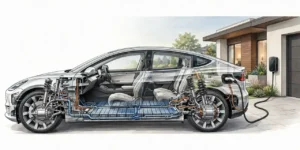
Electric cars are no longer a curiosity. They pass you on the highway in near silence, they charge in driveways across America, and they are reshaping the auto industry. But many drivers still wonder what is actually going on under the hood — or rather, under the floor. Understanding how do electric cars work takes away the mystery and helps you decide whether an EV fits your life.
The good news is that an electric car is mechanically simpler than a gasoline car. There is no engine with hundreds of moving parts, no transmission with gears to shift, no exhaust system, and no oil to change. In its place: a battery, a motor, and clever electronics that shuttle energy back and forth. Let us walk through each piece.
How Do Electric Cars Work: The Big Picture
An electric car stores energy as electricity in a large battery pack, then feeds that electricity to an electric motor that turns the wheels. When you press the accelerator, the car’s power electronics draw energy from the battery and deliver it to the motor. The motor spins, the wheels turn, and you move — instantly, quietly, and with no tailpipe emissions.
A gasoline car, by contrast, burns fuel in hundreds of tiny explosions per minute to push pistons up and down, then converts that motion through a transmission to the wheels. An electric motor produces rotational motion directly, which is why EVs feel so smooth and responsive. There is no gear shifting because the motor delivers strong power across a wide range of speeds.
The Battery: An EV’s Fuel Tank
The battery pack is the heart of every electric car. It sits low in the vehicle, usually stretched flat under the floor between the axles. This placement lowers the car’s center of gravity, which improves handling, and it frees up interior space since there is no bulky engine or transmission tunnel.
Almost all modern EVs use lithium-ion batteries — the same chemistry family as your phone battery, scaled up enormously. A battery pack is built from modules, and modules are built from individual cells. The pack includes cooling systems to keep temperatures in a safe range, protective casing to survive crashes, and a battery management system that monitors every cell’s health.
Battery Capacity and Range
Battery capacity is measured in kilowatt-hours (kWh). Think of it like the size of a fuel tank: a bigger number generally means more driving range. Range is the distance a car can travel on a full charge, and it varies with battery size, vehicle weight, aerodynamics, driving speed, weather, and even tire choice.
Cold weather deserves special mention because many American drivers notice it. Batteries are chemical devices, and chemical reactions slow down in the cold. Running the cabin heater also draws significant energy. As a result, winter range drops noticeably — one reason heat pumps, which move heat efficiently instead of generating it, are becoming standard in newer EVs. You can read how heat pumps work to understand the same principle applied to homes.
The Electric Motor: Instant Power
The electric motor converts electrical energy into motion. Most EVs use alternating current motors controlled by sophisticated electronics. When electricity flows through the motor’s windings, it creates rotating magnetic fields that spin the rotor — the part connected to the wheels.
Two properties make electric motors delightful to drive. First, they deliver maximum torque from a standstill, which is why EVs accelerate so eagerly off the line. Second, they are remarkably efficient. A gasoline engine wastes most of its fuel’s energy as heat; an electric drivetrain converts the large majority of its battery energy into motion. That efficiency gap is the fundamental reason EVs cost less energy per mile.
Many EVs use two motors — one on each axle — to provide all-wheel drive. Software decides how much power goes to each motor in every fraction of a second, which improves traction in rain and snow.
Power Electronics: The Invisible Conductor
Between the battery and the motor sits the power electronics, especially the inverter. The battery stores direct current (DC), but the motor runs on alternating current (AC). The inverter converts DC to AC and precisely controls the frequency and voltage to set the motor’s speed and torque. This happens thousands of times per second, responding to your right foot in real time.
These electronics are one reason modern EVs depend on advanced semiconductor chips. The same silicon advances driving computers and phones also make EV power systems smaller, cheaper, and more efficient every year.
Regenerative Braking: Turning Stops Into Energy
Here is one of the cleverest tricks in how do electric cars work. When you lift off the accelerator or press the brake, the electric motor runs in reverse — acting as a generator. Instead of consuming electricity to create motion, it converts the car’s motion back into electricity and feeds it into the battery.
This means every stoplight and downhill stretch recovers energy that a gasoline car would waste as heat in its brake pads. In city driving with frequent stops, regenerative braking can meaningfully extend range. It also means brake pads last far longer on EVs, since the motor does most of the slowing. Many drivers use “one-pedal driving,” where lifting off the accelerator slows the car so strongly that the brake pedal is rarely needed.
Charging: Filling Up on Electricity
Charging an EV means pushing electricity back into the battery, and there are three common speeds. Level 1 charging uses a standard household outlet and is very slow — fine for plug-in hybrids or drivers with short commutes. Level 2 uses a 240-volt circuit, like an electric dryer outlet, and can fully charge most EVs overnight. DC fast charging delivers high-power direct current at public stations and can add a large chunk of range in under half an hour.
Most EV owners do most of their charging at home overnight, which is why a complete EV charging guide is essential reading before buying. Home charging is convenient and usually the cheapest option, especially on overnight electricity rates. Public fast chargers handle road trips, and networks across America keep expanding.
Why Fast Charging Slows Down
You may notice that fast charging is rapid at first and then tapers off. This is deliberate. Batteries accept charge quickly when nearly empty but must be charged gently as they fill, to protect their chemistry and longevity. Charging from nearly empty to about four-fifths full is fast; the final stretch is slow. Smart road-trippers plan around this, charging just enough to reach the next stop.
What Powers the Electricity?
An electric car is only as clean as the electricity that charges it — which is why the power grid matters. In regions with abundant solar power or wind power, an EV’s lifetime emissions are dramatically lower than a gasoline car’s. Even on a grid with fossil fuels, EVs typically come out ahead because the electric drivetrain is so efficient.
The grid is also getting cleaner. Nuclear power plants provide steady carbon-free electricity day and night, and researchers pursuing nuclear fusion hope to unlock an even more abundant clean source in the future. Meanwhile, carbon capture technology aims to reduce emissions from existing power sources.
EV Maintenance: Simpler by Design
With far fewer moving parts, EVs need less maintenance. There are no oil changes, no spark plugs, no timing belts, and no exhaust repairs. Brake pads last longer thanks to regenerative braking. The main consumables are tires — EVs are heavy and torquey, so they can wear tires faster — plus cabin air filters, wiper blades, and windshield washer fluid.
The big question everyone asks is battery longevity. Modern EV batteries are engineered to last many years, and they degrade gradually rather than failing suddenly. Manufacturers warranty them for long periods, and real-world data shows most packs retain the large majority of their capacity after years of use. Gentle habits help: avoiding constant fast charging, not keeping the battery at full charge for long periods, and parking in shade on hot days.
The Environmental Picture
Manufacturing an EV — especially its battery — does create more emissions upfront than building a gasoline car. But over the car’s lifetime, the much lower emissions per mile quickly make up the difference, and the payback gets better every year as grids add clean energy. At the end of life, EV batteries are increasingly recycled, recovering valuable materials for new batteries.
This fits into a broader wave of climate technology breakthroughs aimed at decarbonizing transportation, from better batteries to cleaner manufacturing.
Conclusion
So how do electric cars work? A battery stores electrical energy, power electronics feed it to an electric motor, and the motor turns the wheels with instant, silent force. Regenerative braking recovers energy when you slow down, and charging refills the battery at home or on the road. Fewer moving parts mean less maintenance, and the electric drivetrain’s efficiency means lower running costs and lower emissions.
Whether you are shopping for your first EV or just curious about the silent cars passing you on the highway, the underlying idea is beautifully simple: electricity in, motion out, and as little waste as possible in between. As batteries get better and charging gets faster, that simple idea keeps getting more compelling for American drivers every year.