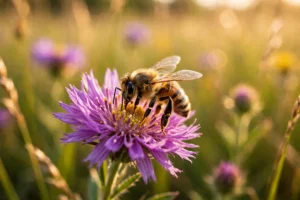
On a warm day in a garden, a bee moves from flower to flower with a focus that looks almost like work, because it is. The bee is gathering nectar and pollen for its colony, but in the process it is doing a job that whole ecosystems depend on: pollination. As a bee brushes against a flower, pollen sticks to its body. When it visits the next flower, some of that pollen rubs off, allowing the plant to produce seeds and fruit. Without that quiet transfer, many plants could not reproduce well, and the animals that eat those plants would feel the loss too.
Bees help ecosystems in ways that go far beyond honey. They support wildflowers, trees, crops, and the food webs built around them. Birds eat seeds that exist because bees pollinated flowers. Small mammals shelter in plants that grow because pollination succeeded. Even soil benefits, because healthy plant cover protects soil from erosion and feeds the organisms living in it. To understand bees is to understand how connected nature really is, with one small insect linking flowers, food, wildlife, and people.
Pollination: The Core Job Bees Do
Pollination is the movement of pollen from the male part of a flower to the female part, where fertilization can happen. Many plants need pollen from another plant of the same kind, a process called cross-pollination, and bees are excellent at it because they visit many flowers in a single trip. Their hairy bodies pick up pollen easily, and their habit of focusing on one kind of flower at a time, known as flower constancy, makes successful transfer more likely. A bee that visits only clover for an afternoon is far more useful to clover than a visitor that jumps randomly between unrelated plants.
Not all bees are honeybees, and that diversity matters. The United States is home to thousands of native bee species, including bumblebees, mason bees, leafcutter bees, and many tiny solitary bees that live alone rather than in hives. Some are generalists that visit many flowers, while others specialize in one plant family. Some nest in the ground, others in hollow stems or wood. This variety means different bees are active at different times, in different weather, and on different flowers, so pollination keeps happening across seasons and habitats. Losing one kind of bee can leave a gap that others may not fill, which is why protecting ecosystems as a whole matters more than protecting a single species.
How Bees Support Food and Wildlife
Many fruits, vegetables, nuts, and seeds depend at least partly on animal pollinators, and bees do a large share of that work. Apples, blueberries, squash, cucumbers, almonds, and many other familiar foods set far better crops when bees visit their flowers. Even plants that people do not eat directly often depend on bees, because they feed livestock, wildlife, or the insects that other animals eat. A meadow full of pollinated wildflowers produces seeds that feed birds through autumn and winter, and its plants shelter insects that feed young birds in spring.
Trees benefit too. Some forest trees and shrubs rely on bees and other pollinators to produce the seeds that grow into the next generation of forest. When pollination works well, forests regenerate with a mix of species, which keeps them healthier and more resilient. When it fails, regeneration can slow, and the forest may become simpler and less able to cope with storms, drought, or disease. In this way, bees help shape landscapes over years and decades, not just over a single summer. Their work connects to wider questions about how nature stores carbon, because healthy, diverse plant cover plays a role in how ecosystems hold carbon in plants and soil.
The Bee Life Cycle and Colony Life
Honeybees live in colonies with a clear division of labor. A queen lays eggs, workers gather food, care for young, guard the hive, and build wax comb, and drones mate with new queens. Young bees pass through stages from egg to larva to pupa to adult, fed and tended by workers inside the hive. In spring and summer, a strong colony can grow large and send out a swarm to start a new colony, a natural form of reproduction. Beekeepers manage this cycle, but wild honeybee colonies also live in tree cavities and other sheltered spaces.
Solitary bees live very differently, and their lives are easy to miss. A female solitary bee builds her own nest, often in a ground tunnel or a hollow stem, stocks each cell with pollen and nectar, lays an egg, and seals the cell. She does not guard a hive or make honey for people, yet her pollination work can be remarkably effective. Mason bees, for example, carry pollen on the underside of their bodies and can pollinate many blossoms in a short visit. Learning about solitary bees changes how people see a garden: bare soil patches and old stems are not mess, they may be bee homes. That insight links to the hidden life in soil and nature, where small, unseen work supports everything above ground.
Why Bee Populations Are Under Pressure
Bee populations face several pressures at once, and researchers are still working out how they combine. Habitat loss is a major one: when meadows, hedgerows, and wildflower-rich areas are replaced by lawns, pavement, or single crops, bees lose both food and nesting sites. A landscape that blooms for only a few weeks leaves bees hungry for the rest of the season. Pesticides can also harm bees, especially when sprayed on blooming plants or when residues reach nests and hives. Diseases and parasites, including mites that affect honeybees, add further stress, and changing weather patterns can shift when flowers bloom relative to when bees are active.
None of these pressures has a single simple fix, and that is an important point. A garden that plants flowers but sprays them heavily may not help much. A farm that protects bees but removes all wild habitat may still leave gaps. The most effective approaches combine several steps: diverse flowers across seasons, safe nesting places, careful pesticide use, and connected habitats that let bees move through a landscape. This joined-up thinking is the same approach scientists use when they study how research improves everyday decisions, testing what works in real conditions rather than relying on one idea alone.
Simple Ways to Help Bees Near Home
Helping bees does not require a large yard or special skills. Planting a mix of native flowers that bloom in spring, summer, and autumn gives bees food across the season. Grouping the same flowers together makes them easier for bees to find, and choosing single, open blossoms over highly bred double flowers often gives bees better access to nectar and pollen. Leaving a small patch of bare soil, some hollow stems over winter, and a few fallen leaves can provide nesting and shelter. Even a balcony pot with herbs like mint, thyme, or lavender can attract visitors, as long as the plants are allowed to flower.
Pesticide habits matter as much as planting. Avoid spraying blooming plants, read labels carefully, and consider hand-picking pests or using barriers before reaching for chemicals. If spraying is truly needed, doing it when bees are less active, such as in the evening, and keeping spray away from flowers can reduce harm, though the safest choice is often to avoid it on bee plants altogether. Providing a shallow dish of water with pebbles for bees to land on can also help on hot days. These steps are small, but they add up across a neighborhood. A street where several yards offer flowers and shelter becomes a corridor bees can travel, rather than a desert they must cross.
Watching Bees and Learning More
Watching bees is one of the easiest ways to learn about ecosystems firsthand. Spend ten quiet minutes near a flowering plant and count how many bees visit, what colors they prefer, and how long they stay. You will quickly notice differences: large, fuzzy bumblebees move slowly and buzz loudly, while tiny bees may dart between small flowers you had barely noticed. Children often love this kind of watching, and it builds patience and observation skills that serve all science learning. It also makes the abstract idea of an ecosystem concrete: here is a living link, moving pollen, feeding a colony, and shaping what grows next year.
Bees remind us that ecosystems depend on relationships, not just on individual species. Flowers need bees, bees need flowers, and many other creatures need both. Protecting that relationship means protecting variety, habitat, and the seasons that keep them in step. Readers who want to keep exploring can look at how DNA shapes living things, what stem cells do in the body, how vaccines work, how mRNA works, how scientific inquiry works, what dark matter might be, how nuclear fusion powers stars, and the latest discoveries in science. Each one shows a different scale of the same story, from tiny molecules to the wider universe, and bees sit right in the middle of it: small, busy, and essential.