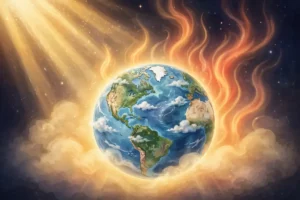
Without the greenhouse effect, Earth would be a much colder and less friendly place. The average temperature would drop far below freezing, oceans would be locked in ice, and life as we know it would struggle to survive. That may sound surprising, because the greenhouse effect is often talked about as a problem. In its natural form, though, it is essential. It is the process that keeps our planet warm enough for liquid water, growing plants, and human life.
The name comes from a rough comparison with a garden greenhouse. In a greenhouse, glass lets sunlight in and slows heat from escaping, so the inside stays warmer than the outside. Earth’s atmosphere works in a broadly similar way, though the details are different. Certain gases in the air, called greenhouse gases, absorb heat rising from Earth’s surface and send some of it back downward. That trapping of heat warms the planet. The key question is not whether the greenhouse effect exists, but how strong it is, and how human activity is changing its strength.
How Sunlight Warms Earth Step by Step
The process starts with the Sun. Sunlight travels through space and reaches Earth as shortwave energy, most of it visible light. Some of that light bounces back into space from clouds, ice, and bright surfaces. The rest is absorbed by the land, oceans, and air, warming them. Earth then gives off that energy again, but in a different form: longwave heat, often called infrared radiation, which we feel as warmth but cannot see.
This is where greenhouse gases come in. Gases such as water vapor, carbon dioxide, methane, and nitrous oxide are especially good at absorbing infrared heat. When heat rising from the surface meets these gases, some of it is absorbed and then released in all directions, including back toward the ground. That extra return of heat keeps the lower atmosphere warmer than it would be otherwise. Think of it as a blanket that slows heat loss rather than a wall that blocks it completely. Heat still escapes to space, but more slowly, so Earth settles at a warmer balance point.
Water vapor is the most abundant greenhouse gas, and it plays a special role because its amount depends on temperature. Warmer air can hold more water vapor, and more water vapor traps more heat, which can warm the air further. This feedback loop is a natural part of the climate system. Carbon dioxide, by contrast, stays in the atmosphere for a very long time once it is added, which is why changes in carbon dioxide have long-lasting effects. Understanding these different roles helps explain why scientists pay close attention to each gas separately, just as they study how carbon capture technology works as one possible way to reduce carbon dioxide in the air.
Natural Greenhouse Effect Versus Human Influence
The natural greenhouse effect has operated for billions of years, and it is part of why Earth has liquid oceans while some neighboring planets do not. Venus, for example, has a very thick atmosphere rich in carbon dioxide, and its surface is extremely hot. Mars, with a very thin atmosphere, is much colder. Earth sits in between, with an atmosphere thick enough to keep it warm but not so thick that it becomes uninhabitable. That balance is delicate, and it depends on the mix of gases in the air.
Human activity has strengthened the greenhouse effect by adding extra greenhouse gases, mainly through burning fossil fuels for energy, transport, and industry, and through changes in land use such as clearing forests. Forests store carbon in trees and soil, so when they are lost, that stored carbon can return to the air, and there are fewer trees left to absorb more. This does not mean every warm day is caused by the greenhouse effect, and it does not mean the natural effect has become bad. It means the blanket has grown thicker, so Earth holds on to more heat than it did before. Scientists track this change through temperature records, satellite measurements, and studies of ice, oceans, and ecosystems, following the same careful approach described in how research shapes everyday life.
Common Misunderstandings About the Greenhouse Effect
Several misunderstandings make this topic harder than it needs to be. One is confusing the greenhouse effect with the ozone hole. They are different issues involving different gases and different parts of the atmosphere. The ozone hole concerns a layer high in the atmosphere that protects life from harmful ultraviolet light, while the greenhouse effect concerns heat near the surface. Another misunderstanding is thinking that greenhouse gases work like a roof. They do not form a solid layer. They are mixed through the air, and they slow heat loss by absorbing and re-emitting energy, not by sealing the planet shut.
A third misunderstanding is assuming that because carbon dioxide is a small share of the atmosphere, it cannot matter. Small amounts can have large effects when they interact strongly with heat. Many familiar examples work the same way: a small amount of salt can change the taste of a whole pot of soup, and a thin layer of insulation can change how warm a house feels. What matters is not only how much of a gas is present, but how it behaves. That is why researchers study each gas on its own terms, including work on how solar panels work and how nuclear fusion could provide energy with different effects on the atmosphere.
What a Stronger Greenhouse Effect Means
When Earth holds more heat, the effects ripple through weather, oceans, and ecosystems. Warmer air can hold more moisture, which can change rainfall patterns, making some places wetter and others drier. Oceans absorb much of the extra heat, which can affect sea life and, over time, sea levels as water expands and land ice melts. Ecosystems that depend on steady seasons may find their timing shifted, with plants blooming earlier or animals migrating at different times. These changes do not happen evenly everywhere, and local effects can differ a great deal.
It is important to keep perspective. A stronger greenhouse effect does not mean every place gets hotter by the same amount, or that cold winters disappear. Weather still varies day to day, and cold snaps still happen. Climate is about long-term patterns, while weather is about short-term conditions. Looking at long records, rather than single events, is how scientists separate a lasting trend from normal variation. That patience is part of scientific inquiry at its best: gather data over time, test explanations, and update understanding as evidence grows.
What Can Be Done About Extra Greenhouse Gases
Reducing extra greenhouse gases starts with using energy more wisely and shifting toward sources that release fewer of them. Homes can use less energy through better insulation, efficient appliances, and mindful heating and cooling. Transport choices matter too, from walking or cycling for short trips to using public transport or efficient vehicles when possible. None of these steps alone solves the problem, but together they lower demand for fossil fuels and give cleaner energy sources room to grow.
Protecting and restoring nature also helps. Forests, wetlands, and healthy soils store carbon and support wildlife at the same time, which is why conservation and climate action often go hand in hand. Readers interested in that connection can explore science’s role in protecting ecosystems and the fascinating world of microbiology, where soil life plays a surprising role in carbon and nutrient cycles. Technology has a part to play as well, from more efficient buildings to cleaner power and new ways to capture carbon. The strongest approach combines all of these: use less, waste less, protect nature, and build cleaner systems.
It also helps to remember that the greenhouse effect is one part of a much larger climate system. Oceans, ice, land, and living things all exchange heat, water, and carbon, and a change in one part can affect the others. That is why scientists study the whole system together, rather than looking at the atmosphere alone. A forest, a coastline, and a farm may seem unrelated, but through air, water, and soil they are connected in ways that shape local weather and long-term climate alike.
For everyday readers, the most useful habit is to stay curious and check claims carefully. If a post promises a single simple fix, or claims the greenhouse effect is a hoax, look for evidence from long-term measurements and trusted scientific sources. The greenhouse effect itself is not a mystery or a matter of opinion. It is a well-tested physical process that keeps Earth livable, and human activity is now adding to it. Understanding that distinction, between a natural process we need and an extra push we can reduce, makes the whole climate conversation clearer. Further reading on related science includes what dark matter might be, what black holes reveal about physics, how satellites observe Earth, how DNA works, and the latest discoveries in science. Each one, in its own way, shows how careful observation turns a puzzling idea into clear, useful knowledge.