H2: A Remarkable Organ Made of Cells
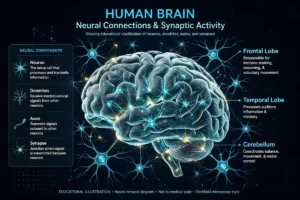
The human brain weighs about as much as a large cantaloupe, yet it controls everything we do, from breathing and heartbeat to remembering a childhood song and planning tomorrow. It is made up of billions of cells called neurons, which send and receive signals, supported by other cells that nourish, protect, and insulate them. Neurons communicate through tiny electrical impulses and chemical messengers, passing signals across small gaps called synapses. When you see a familiar face, hear a favorite song, or decide what to eat, vast networks of neurons are firing in coordinated patterns. No single neuron holds a memory or makes a decision alone; instead, thoughts, feelings, and actions emerge from the activity of many networks working together. That cooperative design is what makes the brain both powerful and adaptable, able to learn new skills throughout life.
H2: The Main Regions and What They Do
Although the brain works as a whole, different regions tend to specialize in different jobs. The outer layer, called the cerebral cortex, is involved in thinking, language, planning, and conscious perception, and its folds allow a large surface area to fit inside the skull. Beneath it, structures involved in emotion, memory, and motivation help decide what matters and what is worth remembering. The cerebellum, at the back of the brain, helps coordinate movement, balance, and timing, so actions feel smooth rather than jerky. The brainstem, at the base, controls essential automatic functions such as breathing, heart rate, and sleep-wake cycles. When these regions work together, a simple act like catching a ball involves seeing the ball, predicting its path, moving the body, and adjusting in real time, all in less than a second.
H2: How Neurons Send Messages
A neuron receives signals through branch-like extensions, processes them in its cell body, and sends a signal along a long fiber called an axon. When the signal reaches the end of the axon, it triggers the release of chemical messengers that cross the synapse and influence the next neuron, either exciting it or calming it down. Myelin, a fatty insulating layer around many axons, helps signals travel faster and more reliably, much like insulation helps an electrical wire. The strength and pattern of these connections change with experience, which is the physical basis of learning. When you practice a skill repeatedly, the relevant connections become more efficient, and the skill begins to feel automatic. This flexibility, called plasticity, continues throughout life, though it is especially strong in childhood.
H2: Memory: How We Store and Recall Experience
Memory is not a single filing cabinet but several systems that work in different ways. Short-term memory holds a small amount of information for a brief time, such as a phone number you just heard. Working memory lets you hold and manipulate information while you solve a problem or follow a conversation. Long-term memory stores experiences, facts, and skills for much longer, and it is formed when patterns of neural activity are strengthened and consolidated, a process that continues during sleep. Recalling a memory is not like replaying a video; it is more like reconstructing an experience from stored pieces, which is why memories can change slightly over time. Strong emotions, repetition, and meaningful connections to what you already know all help memories last longer, which is why studying that connects new ideas to familiar ones tends to work better than simply rereading notes.
H2: Learning, Attention, and Habits
Learning happens when the brain changes its connections in response to experience, and attention acts as a spotlight that decides which experiences get that treatment. When you focus deeply on a task, the relevant networks receive stronger, clearer signals, and learning is more likely to stick. Distraction splits that spotlight, which is why multitasking often feels productive while actually slowing learning. Habits form when a repeated action becomes efficient enough that it no longer needs full conscious attention, freeing the brain to focus on new challenges. This is helpful for routine skills like tying shoes or driving a familiar route, but it also means that unhelpful habits can become automatic too. Changing a habit usually requires noticing the trigger, choosing a different response, and repeating the new response until it becomes the easier path.
Sleep and the Resting Brain
Sleep is not a time when the brain simply switches off. During sleep, the brain consolidates memories, clears waste products, and restores the energy needed for the next day. Different stages of sleep appear to support different kinds of memory, from facts and skills to emotional experiences. A poor night of sleep can affect attention, mood, and decision-making the next day, even if you feel you can push through. Regular sleep, a consistent schedule, and a calm wind-down routine support the brain far more reliably than occasional long sleeps after many short nights. In that sense, rest is not a luxury for the brain; it is part of how the brain does its work.
H2: Emotions, Decisions, and the Body
Emotions are not separate from thinking; they are signals that help the brain decide what matters and what to do next. Structures deep in the brain respond to rewards, threats, and social cues, and those responses influence attention, memory, and choice. The brain also constantly monitors the body, adjusting heart rate, breathing, and stress responses based on what it perceives. This two-way conversation between brain and body explains why stress can affect digestion and sleep, and why exercise and calm breathing can affect mood and focus. Understanding this connection helps explain why health habits are brain habits too, and why research from what DNA is to how vaccines work keeps revealing links between body, genes, and mind.
H2: What Science Is Still Learning
Despite remarkable progress, many questions about the brain remain open. Scientists are still mapping how billions of neurons coordinate to produce consciousness, how memories are stored in such detail, and why certain brain conditions develop. New tools allow researchers to watch brain activity in real time, to study genes involved in brain development, as described in CRISPR gene editing and what gene therapy is, and to explore treatments described in mRNA explained and what stem cells are. Each discovery raises new questions, which is a sign of healthy science rather than failure. The brain remains one of the most complex systems we know, and learning how it works is a journey that connects biology, medicine, psychology, and even the artificial systems explored in how artificial intelligence works. For now, the most useful takeaway is simple: the brain learns from what you repeatedly do, rest, and pay attention to, so those daily choices shape the organ that shapes your life.
Brain Health in Everyday Life
Supporting brain health does not require complicated programs or expensive tools; it grows from ordinary daily habits repeated over time. Regular physical activity supports blood flow to the brain, a balanced diet provides the nutrients the brain needs, and social connection gives the brain rich, meaningful stimulation that isolated screen time rarely provides. Learning new skills, whether a language, an instrument, or a craft, challenges neural networks in ways that routine tasks do not, and that challenge is part of what keeps the brain adaptable. Managing stress matters too, because chronic stress can affect sleep, memory, and mood, while calm routines, time outdoors, and supportive relationships help restore balance. These habits are not guarantees against illness, and anyone with concerns about memory, mood, or thinking should speak with a health professional, but they are the foundation on which brain health is built.
It also helps to be skeptical of simple claims about boosting the brain, since the brain does not work like a muscle that grows with a single exercise. Brain training games may improve performance on those specific games, but the benefits often do not transfer broadly to everyday thinking. What transfers more reliably is varied, real-world engagement: reading, conversation, problem-solving, and hands-on learning that connect new information to what you already know. That principle is reflected across science, from the tiny organisms in world of microbiology to the research described in research shaping everyday life and scientific inquiry, and even in the technology of science and ecosystems and noise-cancelling headphones, where careful design serves human needs. In short, a brain-friendly life is a varied, active, rested, and connected life.
Asking Better Questions About the Brain
When you read claims about the brain, it helps to ask simple, skeptical questions: what evidence supports this claim, was it tested in people or only in animals, and how large was the effect? A single study rarely settles a question, and headlines often exaggerate small findings into dramatic promises. Reliable brain science builds slowly, through repeated studies, careful controls, and honest discussion of limitations. That patience is a strength, not a weakness, because the brain is complex and deserves conclusions that can be trusted. By asking for evidence and avoiding quick fixes, you protect both your time and your health, and you support a scientific culture that values truth over hype. The more we learn about the brain, the more we appreciate both its power and its mystery, and the more carefully we should treat claims about how to improve it.