The best portable chargers solve a simple, annoying problem: a phone that dies when you need it most. Whether you travel, commute, work outdoors, or simply forget to charge overnight, a good power bank can save a day of maps, calls, photos, and tickets. The challenge is that chargers vary widely in capacity, charging speed, size, and cable compatibility, and the biggest number on the box is not always the most useful guide.
This guide explains capacity in plain language, charging speeds, ports and cables, safety, and how to choose a charger for your phone, earbuds, watch, or laptop. It also covers care and travel rules, so your charger stays safe and reliable. With a little planning, a portable charger becomes a quiet backup you rarely think about until it saves the day.
Capacity: What Those Numbers Really Mean
Capacity is usually listed in milliamp-hours, and a larger number generally means more charges, but not in a simple one-to-one way. Energy is lost as heat during charging, and different phones have different battery sizes, so a charger will rarely deliver its full listed capacity to your phone. As a rough guide, a small charger suits a single emergency top-up, a mid-size charger suits a full day out, and a large charger suits multi-day trips or charging several devices.
Size and weight rise with capacity, so match the charger to your bag and routine. A slim charger that fits a pocket is easy to carry every day, while a heavy brick is better left in a backpack or travel bag. If you mainly need insurance against a dead phone on a commute, a small charger you actually carry beats a large charger you leave at home. Think about how many devices you charge, and whether you need one full charge or several partial top-ups.
Charging Speed and Ports
Charging speed depends on both the charger and the device. A charger can only deliver fast charging if your phone supports the same fast-charging standard, and using a faster charger will not force a phone to charge beyond its design. Look for a charger that matches your phone’s supported charging, and check whether it can fast-charge while also charging another device. Some chargers slow down when two ports are used at once, which matters if you charge a phone and earbuds together.
Ports and cables matter just as much. Most modern phones and accessories use USB-C, while older accessories may use other connectors, so check what cables you already own. A charger with both USB-C and USB-A ports is flexible, while a charger with only one port is simpler but less useful for families or multi-device users. Built-in cables can be convenient, but they can also break or become outdated, so a charger with standard ports and a cable you can replace is often the longer-lasting choice.
Power Banks for Laptops and Other Devices
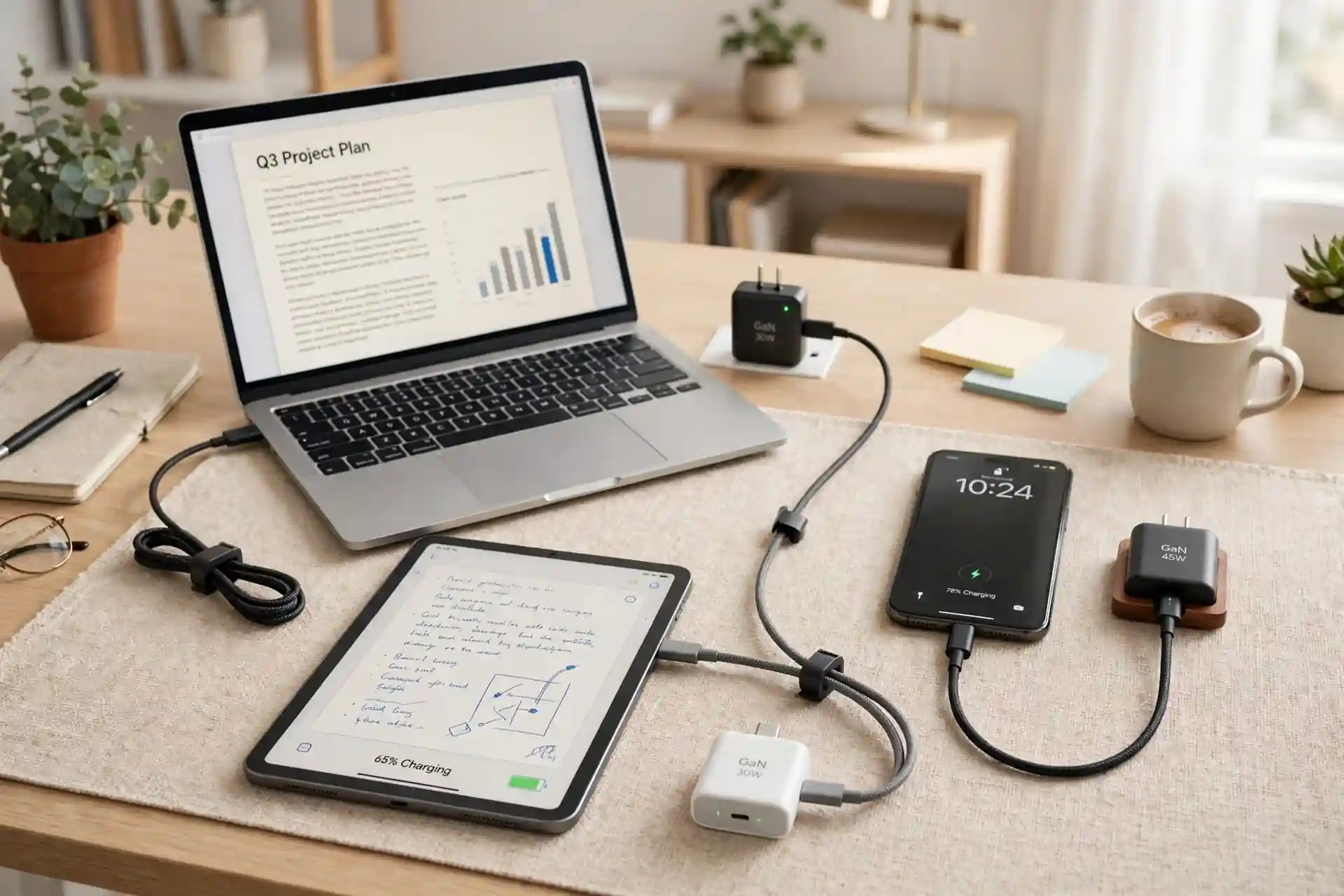
Not every portable charger can charge a laptop. Laptops need higher power output, usually over USB-C, and a charger that is too weak will charge slowly or not at all while the laptop is in use. If you want laptop charging, check the charger’s power output and your laptop’s charging requirements, and expect a larger, heavier charger. For most phone-only users, a smaller charger is lighter, cheaper, and easier to carry every day.
Earbuds, watches, and small accessories need far less power, but they can be fussy about low-power charging. Some chargers shut off when a device draws very little current, which can leave earbuds uncharged. If you often charge small accessories, look for a charger with a low-power or trickle mode, or test the charger with your earbuds during the return window. A charger that works well for a phone but not for earbuds is only a partial solution for many travelers.
Safety, Quality, and What to Avoid
Safety is the most important feature of any battery product. Choose chargers from reputable makers, with clear safety certifications and protection against overcharging, overheating, and short circuits. Avoid unbranded chargers with vague claims, damaged cables, or swollen cases, and stop using any charger that gets unusually hot, smells odd, or shows physical damage. A cheap charger that damages a phone or poses a fire risk is never a bargain.
Understanding how lithium-ion batteries work helps you use a charger safely: lithium batteries dislike extreme heat, deep discharges, and physical damage. Keep chargers out of hot cars, away from water, and in a protective pouch when traveling. Do not charge a phone under a pillow or blanket, where heat builds up, and do not use a charger with a frayed cable. These simple habits protect both the charger and the devices it powers, and they extend battery life over time.
Travel, Flights, and Everyday Carry
Portable chargers are useful for travel, but airlines have rules about battery capacity in checked and carry-on luggage, and those rules can change. As a general practice, carry power banks in cabin luggage, keep them protected from damage, and check your airline’s current rules before flying with a very large charger. For road trips and camping, a larger charger or a solar-assisted charger can help, though solar charging is slow and best treated as a backup rather than a main source.
Everyday carry is about habit. Keep the charger charged, keep a short cable with it, and store both in the same pocket or pouch so you can find them quickly. A charger that is empty when you need it is useless, so recharge it after use, ideally overnight. If you travel often, a second small charger for your bag and one for your desk can remove the need to remember to pack it every time, which is a small convenience that pays off repeatedly.
Portable Power in a Connected Life
Portable chargers support a wider connected life, from navigation to calls to smart devices, which is the practical side of how connected devices fit into daily life. A phone that stays charged can unlock doors, pay for transit, show tickets, and control home devices while you are out. That dependence makes reliable backup power more valuable, not less, especially for people who rely on a phone for work, accessibility, or family contact during the day.
Connectivity also affects how much power you use. Weak signals, constant GPS tracking, and bright screens drain phones faster, and learning how home Wi-Fi works, how 5G networks work, and how GPS navigation works basics can help you save battery by switching to Wi-Fi where available, limiting background location use, and lowering screen brightness. A charger cannot fix a phone that drains in hours due to settings, but combined with sensible settings, it can comfortably cover a long day.
Efficiency improvements in chips and batteries are also changing portable power, and how microchips are made background helps explain why newer phones and chargers can deliver more with less heat. Comparing chargers with the coolest tech gadgets of 2026 and the coolest gadgets of the year can keep you from overbuying: a well-chosen mid-size charger often beats a huge brick for daily use. For remote trips, how the internet actually works alternatives like satellite options, including how Starlink satellite internet works, are worth knowing about, though they do not replace a charged phone and a power bank.
Finally, think about longevity. A charger with standard ports, a durable case, and a replaceable cable will outlast a charger with a fragile built-in cable or a proprietary connector. Check warranty terms, and keep the charger clean and dry. A reliable charger is not exciting, but it is one of the most useful gadgets you can own, because it quietly protects everything else you carry.
A Simple Way to Choose
Answer four questions: what devices will I charge, how many charges do I need between outlets, how much weight will I carry, and do I need laptop power? A phone-only commuter needs a slim mid-size charger. A family on a day trip needs more capacity and two ports. A laptop user needs higher output and a larger charger. Match those answers, buy from a reputable maker, and test the charger with your real devices.
The best portable charger is the one you carry, trust, and keep charged. It does not need the largest capacity or the fastest claim on the box. It needs to fit your bag, charge your devices reliably, and be there when your phone hits low battery at the worst moment. Chosen that way, it becomes an everyday essential rather than another gadget in a drawer. Keep security in mind as well, because a charger and cable can be a point of trust when you borrow one in public, and the habits in cybersecurity tips for 2026 remind you to use your own trusted cables and chargers rather than unknown ones. A little caution, combined with a charger you know and maintain, keeps both your phone and your data safer on the move, especially in busy airports, cafes, and shared workspaces where convenience can tempt you to plug into anything.