Drive an hour outside any American city and your phone signal starts to fade. Drive two hours and your internet options shrink to dial-up-era speeds — or nothing at all. For decades, rural America was stuck with a brutal digital divide: the further you lived from a fiber line, the worse your internet. In 2026, that divide is closing faster than anyone predicted, thanks to the largest fleet of satellites ever launched.
Starlink, SpaceX’s satellite internet constellation, now operates more than 11,000 satellites in low Earth orbit and serves over 12 million subscribers worldwide — including roughly 2 million Americans, making it the seventh-largest fixed internet provider in the United States. But how does it actually work? How can thousands of satellites deliver cable-like speeds from space? This guide explains the physics, the engineering, the 2026 reality, and whether Starlink makes sense for you.
What Is Starlink, Exactly?
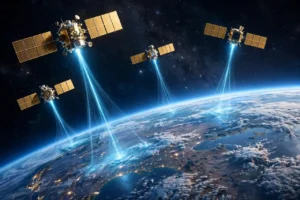
Starlink is a satellite-based broadband internet service operated by SpaceX. Instead of burying fiber-optic cables or building cell towers, SpaceX launched a mega-constellation of small satellites into low Earth orbit (LEO) — about 340 miles (550 km) above your head. Your home connects to whichever satellite happens to be passing overhead at that moment, and that satellite relays your data to and from the global internet.
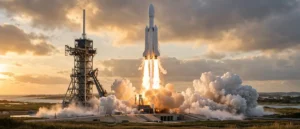
The scale is unprecedented in human history. Starlink accounts for roughly half of all active satellites in orbit — more than every other operator combined. SpaceX launches new batches multiple times per week on its reusable Falcon 9 rockets, and in September 2026 its Starship rocket began deploying a new generation of satellites with ten times the capacity of previous models. Understanding Starlink means understanding why this particular approach — thousands of small satellites flying low — beats everything that came before it.
Satellite Internet Before Starlink: Why It Was Terrible
Satellite internet is not new. Services like HughesNet and Viasat have beamed internet from space for over two decades. The problem was physics: their satellites sat in geostationary orbit, 22,236 miles above the equator — so far that a signal traveling at the speed of light still needed about half a second for a round trip. That built-in ~600 ms latency made video calls stutter, online gaming impossible, and everything feel sluggish.
Worse, three or four giant satellites covered the entire country, so bandwidth was brutally limited. Plans came with tiny data caps — 10 to 50 GB per month — after which speeds crawled. It was a last-resort option, and everyone knew it. Starlink’s insight was that the old satellites were not wrong; they were just too far away and too few.
The Low-Earth-Orbit Advantage
Starlink’s satellites fly at ~550 km, about 65 times closer than geostationary satellites. At that distance, signal round trips take 20–40 milliseconds — comparable to a cable connection and fast enough for Zoom calls, gaming, and streaming. That single number is the whole ballgame: orbit low, and satellite internet stops feeling like satellite internet.
But flying low creates a new problem. A satellite at 550 km sees only a small patch of Earth and zips overhead in minutes, so one satellite can never stay above your house. The fix is a constellation: thousands of satellites in coordinated orbital shells, arranged so that as one sets below your horizon, another rises to take its place. Starlink operates across five orbital shells at different inclinations — 53°, 43°, 70°, and near-polar 97.6° — to blanket everything from the equator to the Arctic.
Your connection hops between satellites every few minutes, seamlessly. This constant handoff choreography, managed by software, is one of the great engineering feats of the network — and a cousin of the navigation magic described in how GPS works, where timing and orbital geometry turn physics into everyday utility.
Inside a Starlink Satellite
Each Starlink satellite is a flat-panel spacecraft about the size of a table. The first generation weighed ~260 kg and was built at SpaceX’s factory in Redmond, Washington. Current V2 Mini satellites weigh ~800 kg and pack roughly four times the throughput of the originals through bigger phased-array antennas and extra spectrum bands.
Three technologies make the fleet special. First, krypton ion thrusters let each satellite raise itself from its deployment orbit to its cruising altitude and dodge debris autonomously using tracking data from the US Space Force. Second, inter-satellite laser links let satellites beam data to each other through space at the speed of light — meaning your data can cross an ocean or reach a polar research station without ever touching a ground station. Third, phased-array antennas steer radio beams electronically (no moving parts) to track your dish and your neighbor’s dish simultaneously.
When a satellite dies — and they all do eventually — it is designed to deorbit and burn up in the atmosphere within about five years, a built-in cleanup plan that older satellites never had.
How the Signal Reaches Your Home: The Journey of a Click
Follow a single click from your laptop to see the whole system in action:
- Your dish (“Dishy”): The Starlink terminal is a flat, pizza-box-sized antenna with its own phased array. You mount it with a clear view of the sky — no precise aiming needed. It electronically tracks satellites overhead and even melts snow off itself in winter.
- Up to space: Your dish beams data to the nearest satellite at Ku-band frequencies. Because the satellite is only 550 km away, the trip takes about 2 milliseconds.
- Across the mesh: The satellite routes your data through laser links to other satellites, hopping across the constellation until it reaches one above a ground station — or, if you are mid-ocean, it can route entirely in space.
- Down to Earth: A satellite beams your data to a Starlink ground station (a field of antennas connected to fiber), which injects it into the terrestrial internet. The reply comes back the same way.
The entire round trip typically lands between 20 and 40 ms. For context, that is roughly what a decent cable connection delivers — and it is why Starlink feels nothing like the satellite internet of 2015. The choreography of thousands of moving satellites, ground stations, and laser links is orchestrated by software at a scale that rivals the most complex software development trends in the industry.
Direct-to-Cell: Your Phone Talking Straight to Space
The newest trick needs no dish at all. Starlink’s direct-to-cell service — rebranded “Starlink Mobile” in March 2026 — embeds LTE modems in a subset of satellites, letting ordinary, unmodified smartphones connect directly to orbit. More than 650 direct-to-cell satellites are already flying.
T-Mobile’s “T-Satellite” service launched commercially in July 2025 on this technology, and by March 2026 it reached about 7.4 million monthly devices, with roughly 30 carrier partners across six continents. Today it handles texting from dead zones — hiking trails, highways between towns, disaster areas. Voice calling is on the roadmap. For Americans who work or travel beyond cell coverage, a phone that can text from anywhere on Earth is quietly revolutionary — and it plugs your smartphone (see our guide to the best smartphones of 2026) into a network with no towers at all.
Starlink in America in 2026: Speed, Price, and Who It Is For
Here is the 2026 reality for US customers. Starlink covers every American state. SpaceX reports median peak-hour residential downloads around 225 Mbps with ~25 ms latency; typical real-world service delivers 100–400+ Mbps. Pricing settled into three tiers in early 2026: $55/month (up to 100 Mbps), $80/month (up to 200 Mbps), and $130/month (up to 400 Mbps), plus a $349 one-time hardware kit. With roughly 2 million American subscribers, it is now the seventh-largest fixed ISP in the country.
Who should get it: rural households with no cable or fiber option; RV owners and remote workers who need connectivity anywhere; anyone whose only alternative is DSL or legacy satellite. Who should skip it: anyone with affordable fiber or good cable — terrestrial fiber remains cheaper, faster, and more consistent. Starlink’s mission was never to beat fiber in Manhattan; it was to end the era when your ZIP code decided your internet quality.
Beyond homes, Starlink now serves airplanes, cruise ships, oil rigs, and even the future of autonomous vehicles — connected cars and trucks need reliable links wherever roads go, and the same low-latency mesh that serves a farmhouse can serve a moving vehicle. It is part of the same wave of connected devices and IoT and smart devices turning the physical world into a networked one.
The Downsides: Debris, Astronomy, and a Crowded Sky
No honest guide can skip the criticisms. Eleven thousand satellites change the night sky. Astronomers report streaks across telescope images, and while SpaceX has added sunshades and dark coatings (“VisorSat” and later designs) to dim the satellites, the sheer number keeps growing. Space-safety experts warn about orbital congestion: with Starlink plus rivals launching thousands more satellites, the risk of collisions — and a cascading Kessler syndrome of debris — is a genuine concern that regulators are only beginning to address.
There are also cybersecurity dimensions to a privately controlled global network of this scale — a single company’s infrastructure now carries critical communications for entire countries, which is why experts urge users to follow solid cybersecurity tips for 2026 regardless of how they connect. And on the ground, Starlink’s residential pricing, while revolutionary for rural users, still costs more than urban fiber — the digital divide is narrowing, not gone.
The Constellation Race: Starlink’s Rivals
Starlink built the playbook, but it will not fly alone. Amazon’s Leo (formerly Project Kuiper) has ~700 satellites in orbit and began enterprise beta in April 2026, targeting consumer service in late 2026 or early 2027. Eutelsat OneWeb operates 600+ satellites focused on enterprise and government customers. AST SpaceMobile is testing direct-to-smartphone service with carrier deals signed. And China is building two mega-constellations — state-run Guowang and commercial Qianfan — with thousands of satellites planned.
In January 2026 the FCC authorized 7,500 additional Starlink satellites, bringing its approved total to 15,000 — and Starship’s September 2026 debut deploying 26 V3 satellites (each with ~1 Tbit/s of downlink capacity, about 10× a V2) means capacity is about to accelerate sharply. The race is no longer about whether satellite broadband works. It is about who owns the sky — a competition as defining for this decade as the new space race back to the moon, and as transformative for machines as the robotics revolution is for the factory floor.
The Bottom Line
Starlink works because SpaceX solved three problems at once: reusable rockets made launching thousands of satellites affordable, low orbits made the latency tolerable, and phased-array electronics made the handoffs seamless. Any one of those missing, and satellite internet stays a punchline.
For millions of Americans beyond the reach of fiber, that engineering trifecta means the difference between participating in the modern economy and watching it from the sidelines. Whether rivals catch up or Starlink’s head start proves insurmountable, one thing is certain: the sky above your house is now infrastructure. And like quantum computing or fusion, satellite mega-constellations have crossed the line from science fiction to the background of everyday American life — you just have to look up to see them.
Curious how the launches themselves work? Our guide on how do rockets work explains thrust, staging, and the 2026 Starship flights that put these satellites in orbit.