Your phone is dying at 2 percent and your electric car has 14 miles of range left. Inside that small rectangle of metal and chemicals, billions of lithium ions are rushing in a carefully choreographed dance — the dance that powers nearly every device you own. Understanding how lithium-ion batteries work explains why electric cars, smartphones, and the power grid look the way they do today.
Lithium-ion batteries are not magic. They are chemistry, physics, and clever engineering packed into a thin pouch or a steel cylinder. In this guide, you will learn exactly how lithium-ion batteries work, why they beat every older battery chemistry, what their limits are, and where the technology is heading in 2026 and beyond.
How Lithium-Ion Batteries Work: The Basic Idea
Every battery converts chemical energy into electrical energy. A lithium-ion battery does this by shuttling lithium ions back and forth between two electrodes — a positive one (the cathode) and a negative one (the anode). When the battery discharges, lithium ions flow from the anode to the cathode through an electrolyte. Electrons, which cannot pass through the electrolyte, take the long way around through an external circuit. That flow of electrons is the electricity that powers your device.
Charge the battery, and the whole process reverses: an external voltage pulls the lithium ions back from the cathode to the anode, storing energy for later.
Inside the Cell: Anode, Cathode, Separator, and Electrolyte
Open up a lithium-ion cell (please do not — the chemistry is hazardous) and you will find a repeating sandwich of four materials:
The anode is usually made of graphite, a form of carbon with a layered crystal structure. Those layers act like a parking garage for lithium ions. During charging, lithium ions slide between the graphite sheets, a process chemists call intercalation. Graphite is cheap, stable, and can host one lithium ion for every six carbon atoms.
The cathode is where lithium ions wait during charging and return during discharge. Most cathodes are metal oxides containing lithium — the two dominant families today are NMC (nickel-manganese-cobalt) and LFP (lithium iron phosphate). NMC packs more energy per kilogram; LFP is cheaper, longer-lived, and safer. The industry’s shift toward LFP in recent years has been one of the biggest stories in battery economics.
The separator is a microscopically thin porous plastic membrane between the electrodes. It lets lithium ions pass while physically preventing the anode and cathode from touching — which would short-circuit the cell.
The electrolyte is the liquid medium the ions swim through, typically a lithium salt dissolved in organic solvents. It conducts ions but not electrons — which is exactly why electrons are forced through your device’s circuit instead.
Discharge and Charge: What Happens Step by Step
Here is the discharge sequence in slow motion:
First, lithium atoms at the anode give up their electrons. The lithium ions then drift through the electrolyte and separator toward the cathode, where they insert themselves into the cathode’s crystal structure. The freed electrons travel through the external circuit — through your phone’s processor, your car’s motor, your flashlight bulb — delivering power on the way. This ion migration continues until the anode is depleted, and your battery reads zero.
When you plug in, the charger applies a voltage higher than the battery’s own. This forces electrons to flow the opposite way, which pulls the lithium ions back out of the cathode, through the electrolyte, and into the graphite anode. The battery “fills up” again. One full discharge-and-charge cycle is one cycle, and every cycle slightly wears the materials — which is why batteries eventually lose capacity.
Why Lithium-Ion Batteries Beat Older Chemistries
Lithium is the lightest metal and one of the most electrochemically eager elements in the periodic table. That combination gives lithium-ion batteries three decisive advantages over older rechargeables like nickel-cadmium (NiCd) and nickel-metal hydride (NiMH).
Energy density is the first. A typical lithium-ion cell stores roughly 250–270 watt-hours per kilogram — several times what NiCd ever managed. That is why a modern laptop weighs a few pounds instead of twenty.
The second advantage is the lack of “memory effect.” Old NiCd batteries lost capacity if you recharged them before fully draining them. Lithium-ion cells suffer no such penalty; topping up at 60 percent is perfectly fine.
The third is self-discharge. A lithium-ion battery loses only about 1–2 percent of its charge per month sitting on a shelf, versus 15–25 percent for older chemistries. That is why a new phone can sit in a warehouse box for months and still power on. If you are shopping for devices this year, battery longevity is one of the key things to compare in the best smartphones of 2026, where battery capacity and charging speed are headline specs.
NMC vs. LFP: The Two Cathodes That Rule the World
Walk through a battery factory and you will mostly find two cathode chemistries. NMC — nickel, manganese, and cobalt — delivers the highest energy density, so it dominates long-range electric cars. Its downside is cost and a supply chain tangled with cobalt, whose prices surged dramatically in 2025 when the Democratic Republic of Congo restricted exports.
LFP — lithium iron phosphate — trades some energy density for much lower cost, longer cycle life, and better safety. It uses iron and phosphorus instead of nickel and cobalt. LFP has become the default for shorter-range EVs and is the main reason battery pack prices keep falling: industry analysts note LFP packs have sold for roughly $80 per kilowatt-hour versus about $128 for NMC. In electric vehicles, the battery is the most expensive component, which is why understanding the battery is essential in any complete EV charging guide for 2026.
How Lithium-Ion Batteries Power Electric Cars
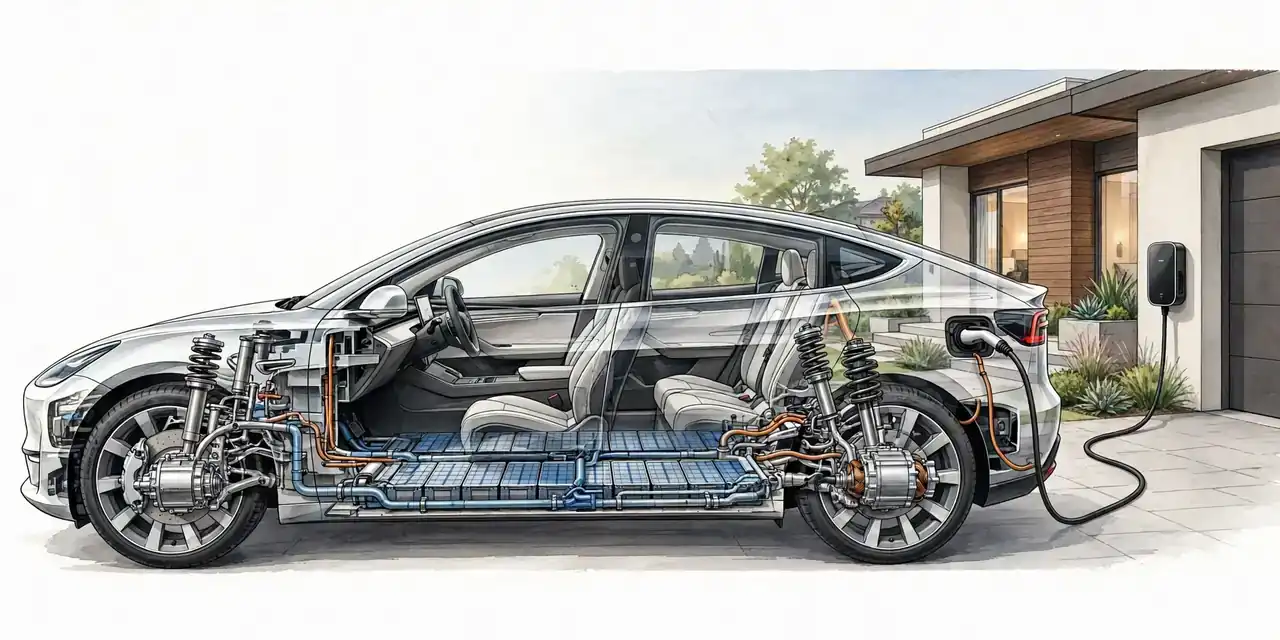
An electric car is essentially a giant lithium-ion battery with wheels attached. A typical long-range EV carries a pack of 60–100 kilowatt-hours — thousands of individual cells wired together, cooled by liquid coolant channels, and managed by a battery management system (BMS) that monitors every cell’s voltage, temperature, and state of charge.
The BMS is the pack’s brain: it prevents overcharging and over-discharging, balances charge across cells, and throttles performance if anything overheats. Cells are happiest between about 15 and 35°C — extreme cold temporarily slows ion movement, which is why EVs lose range in winter.
Fast charging pushes this chemistry to its limits. Pushing a battery from 10 to 80 percent in twenty minutes requires enormous current, which generates heat and stresses the anode. Automakers manage this with sophisticated cooling and charge curves that taper current as the battery fills. Still, frequent fast charging accelerates degradation slightly — a good reason to charge at home on Level 2 power when you can.
Degradation: Why Batteries Lose Capacity Over Time
No lithium-ion battery lasts forever. Each charge cycle grows a thin layer called the SEI on the anode, consuming a little lithium. High temperatures, deep discharges, and sitting at 100 percent charge accelerate the process.
The good news: degradation is slower than many fear. Most EV packs retain most of their capacity after several years, and phone batteries typically survive two to three years of daily charging. Helpful habits: keep charge between 20 and 80 percent daily, avoid parking a fully charged car in a heatwave, and use fast charging when you need it rather than by default.
The 2026 Battery Market: Prices Keep Falling
The economics of lithium-ion batteries in 2026 are remarkable. Industry benchmark surveys found the average global battery pack price fell to about $108 per kilowatt-hour in 2025 — an 8 percent drop — and forecasters project a further decline to roughly $105 per kilowatt-hour in 2026. Compare that to 2010, when packs cost well over $1,000 per kilowatt-hour, and you are looking at a cost decline of more than 90 percent in fifteen years.
What is driving the decline? Manufacturing overcapacity in China created fierce competition, the industry shifted decisively to lower-cost LFP chemistry, and cell sizes keep growing, which means fewer cells, less wiring, and cheaper packaging per megawatt-hour. This cost curve is the engine behind both affordable electric cars and the massive batteries now appearing on the climate tech frontier, where grid-scale storage is one of the biggest climate tech breakthroughs of 2026.
Batteries Beyond Cars: Grid Storage and Home Backup
Lithium-ion batteries are quietly rewiring the power grid. When solar panels stop producing at sunset, grid-scale battery installations discharge stored daytime energy through the evening peak. Analysts tracked enormous growth in these projects through 2025 and 2026, and benchmark storage packs have fallen to roughly $70 per kilowatt-hour.
At home, the same technology pairs with rooftop solar to keep lights on during outages. And the relationship with heating is direct too: heat pumps run on electricity, and pairing them with solar plus storage is becoming one of the most cost-effective home energy setups in America. Home energy hardware in general is getting smarter — efficient radiators and smart heating controls work hand in hand with these storage systems.
Battery Safety: What You Should Actually Worry About
Lithium-ion batteries are remarkably safe — billions of cells are in daily use — but failures make dramatic news. The risk is thermal runaway: if a cell is punctured, crushed, overcharged, or manufactured with a defect, internal short circuits can heat it until the electrolyte ignites. One burning cell can ignite its neighbors in a chain reaction.
The statistics, though, are reassuring. Thermal runaway events are rare in certified products from reputable manufacturers, and modern packs contain multiple safety layers: the separator shuts down ion flow if it overheats, the BMS cuts current at the first sign of trouble, and EV packs include firewalls and cooling between modules. Protect your physical devices by using certified chargers, replacing swollen batteries immediately, and never charging damaged devices.
What should you do in practice? Buy name-brand batteries and chargers, do not leave devices charging on beds or sofas, recycle old batteries at proper drop-off points instead of the trash (punctured cells in garbage trucks cause fires), and if a battery swells, smells sweet or chemical, or gets hot for no reason, stop using it and take it to a battery recycler.
The Future: Solid-State and Beyond
The lithium-ion battery of 2026 is excellent, but researchers are already working on its successor. Solid-state batteries replace the flammable liquid electrolyte with a ceramic or polymer solid. They promise higher energy density, faster charging, and far better safety — the holy trinity of battery wishes. Several automakers and startups have announced pilot production lines, though mass-market solid-state EVs are still a few years out.
Other chemistries are advancing too. Sodium-ion batteries use abundant sodium instead of lithium and are already entering stationary storage and low-cost vehicles. Lithium-sulfur promises very high energy density. And on the manufacturing side, dry electrode processes could cut factory costs further.
What is certain is that lithium-ion itself is not standing still. Incremental improvements in silicon anodes, high-nickel cathodes, and cell-to-pack designs continue to push energy density and cost year after year. The battery in your next car will almost certainly be lithium-ion — and it will be cheaper, longer-lasting, and better than the one in your current car. Batteries now appear in everything from the coolest tech gadgets of 2026 to the drones flying over American neighborhoods and the robots entering American homes and workplaces — and the wind turbines feeding the grid those batteries increasingly stabilize.
Conclusion
Lithium-ion batteries work by rocking lithium ions between a graphite anode and a metal-oxide cathode, forcing electrons through an external circuit. That simple loop has become the foundation of the electric age: costs have fallen more than 90 percent since 2010, LFP chemistry made batteries cheaper and safer, and grid-scale storage is transforming how America uses renewable energy.
Treat your batteries well — moderate charge levels, moderate temperatures, certified chargers — and keep an eye on solid-state: the next battery revolution is already charging up.
Batteries also power machines that work underwater — see how submarines work.