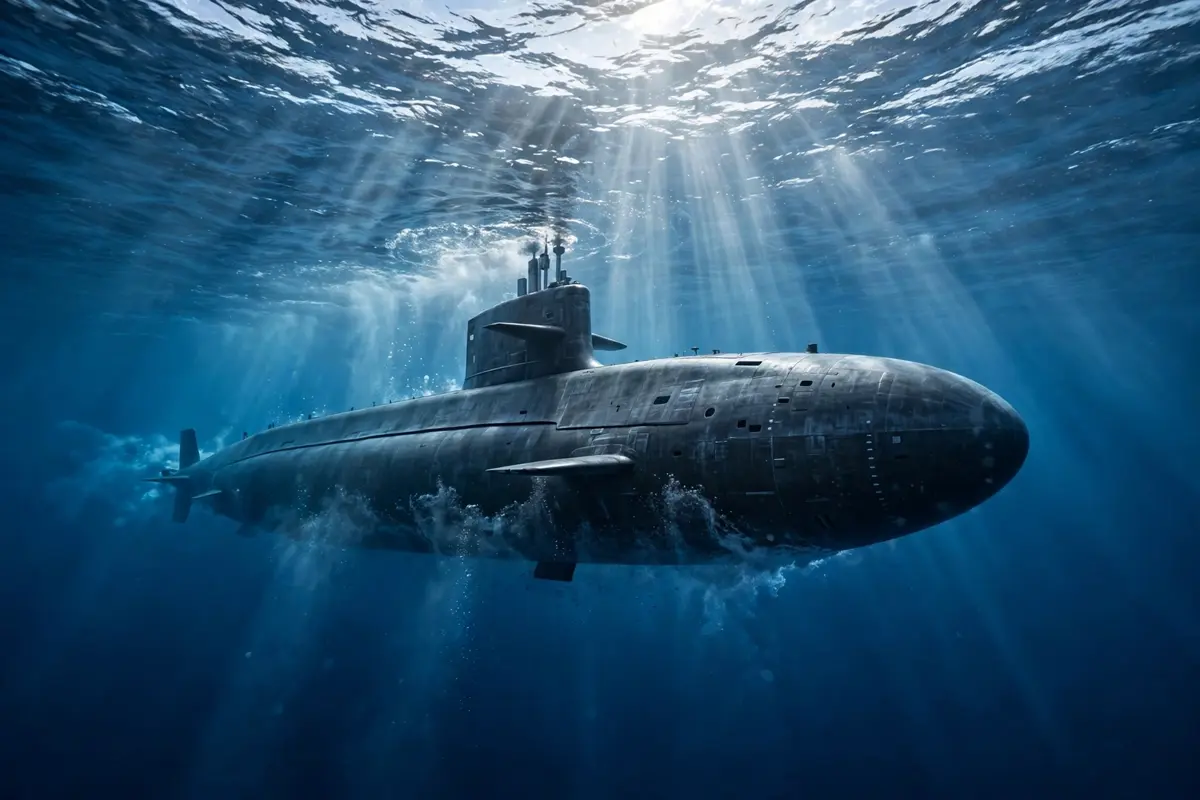
A submarine can dive hundreds of feet below the ocean’s surface, stay hidden for months, and surface again on command — all while its crew breathes, eats, and works inside a sealed steel tube. How do submarines work, and what keeps them from being crushed by the enormous pressure of the deep sea?
A submarine works by carefully controlling its buoyancy. It takes on water to sink, pushes water out to rise, and uses its shape, propellers, and control surfaces to steer. Inside, it generates its own air, water, and power, making it one of the most self-contained machines humans have ever built. This guide explains the physics and engineering that let submarines explore, patrol, and survive beneath the waves.
How Do Submarines Work? Buoyancy Basics
The key principle is Archimedes’ principle: an object submerged in water is pushed upward by a force equal to the weight of the water it displaces. A submarine floats when it displaces a weight of water equal to its own weight. To sink, it must become heavier than the water it displaces — or, more precisely, it must reduce its buoyancy so gravity wins.
Submarines do this with ballast tanks. These are large tanks between the inner pressure hull and the outer hull. When the tanks are full of air, the submarine is light and floats on the surface. To dive, the crew opens vents at the top of the tanks and lets seawater flood in from the bottom, replacing the air. The submarine grows heavier and sinks. To surface, high-pressure compressed air is blown into the tanks, forcing the water out and restoring buoyancy.
Fine control comes from smaller trim and auxiliary tanks. By shifting water between tanks at the front and back, the crew keeps the submarine level. A submarine that is slightly nose-heavy or tail-heavy is hard to steer, so trim is adjusted constantly as fuel is used, food is eaten, and torpedoes are fired — all of which change the boat’s weight and balance.
The Pressure Hull: Surviving the Deep
Water pressure increases by about one atmosphere for every 33 feet of depth. At 800 feet down, the pressure on the hull is roughly 25 times the pressure at sea level — about 350 pounds per square inch. The pressure hull, the inner steel cylinder where the crew lives, is built to withstand this crushing force. It is made of thick, high-strength steel, welded into a cylinder with rounded ends, because a cylinder distributes pressure evenly.
Every opening in the hull — hatches, periscopes, torpedo tubes, propeller shafts — is a potential weak point, sealed with heavy gaskets and locking mechanisms. Engineers test hulls far beyond their rated dive depth, and every submarine has a crush depth, well below its normal operating depth, at which the hull would fail. Staying well above that limit is a matter of life and death, which is why depth gauges are watched as carefully as any instrument on board.
The space between the pressure hull and the outer hull holds the ballast tanks, fuel, and equipment that does not need to withstand full pressure. The outer hull gives the submarine its streamlined shape, reducing drag and noise, and protects the inner hull from minor impacts.
How Submarines Move and Steer
Submarines are propelled by a propeller at the stern, driven by an electric motor or, in older designs, directly by a diesel engine. Modern nuclear submarines use a reactor to generate steam, which drives turbines that produce electricity for the propeller and all onboard systems. Diesel-electric submarines run on batteries when submerged and recharge them with diesel engines while surfaced or snorkeling.
Steering uses control surfaces similar to an airplane’s: stern planes control depth and pitch, like an elevator, and the rudder controls direction. Bow planes near the front help fine-tune depth. To dive, the crew floods ballast tanks and angles the stern planes downward; to rise, they blow ballast and angle upward. At speed, the planes alone can change depth without changing ballast, just as an airplane’s elevator changes altitude without changing weight.
Speed matters for control. A submarine that moves too slowly cannot steer effectively with its planes, so it relies on ballast changes alone. Military submarines typically cruise at 10 to 20 knots submerged, with top speeds above 30 knots for the fastest nuclear boats — fast enough to outrun many surface ships.
How Submarines Breathe: Air, Water, and Power
A submerged submarine must make its own breathable air. Carbon dioxide exhaled by the crew is removed by chemical scrubbers, and oxygen is replenished by electrolyzing seawater — splitting water into hydrogen and oxygen with electricity. The hydrogen is vented safely overboard, and the oxygen is released into the cabin. Air quality is monitored constantly, because in a sealed tube, a buildup of CO₂ or a trace of toxic gas can become dangerous quickly.
Fresh water comes from desalination: seawater is distilled or passed through reverse-osmosis membranes. Nuclear submarines produce plenty of power for this, which is why they can stay submerged for months, limited mainly by food supplies. Diesel-electric boats must surface or snorkel regularly to run their engines and recharge batteries.
Power is the submarine’s lifeline. Nuclear reactors give attack and ballistic missile submarines virtually unlimited range and endurance — the US Navy’s Ohio-class boats carry enough food for patrols lasting over 70 days. Diesel-electric submarines are quieter in some ways and cheaper, which is why many navies, including those of Germany, Japan, and Australia, rely on them for coastal defense. Battery technology keeps improving, and the same advances in lithium-ion batteries that power electric cars are now reaching submarine designs.
How Submarines Navigate Underwater
GPS signals cannot penetrate seawater, so submarines navigate by other means. Inertial navigation systems track every acceleration and turn from a known starting point, using gyroscopes and accelerometers — the same principle that guides rockets on their way to orbit. The system drifts slowly over time, so crews correct it whenever they can get a fix, for example by raising a mast antenna near the surface to receive GPS signals or star sightings, or by matching sonar maps of the seafloor to charts.
Communication is equally tricky. Radio waves barely penetrate water, so submarines receive messages on very low frequency (VLF) and extremely low frequency (ELF) radio, which can reach tens of meters below the surface. To send messages, a submarine usually rises near the surface and raises an antenna or a floating buoy. For routine contact, satellite links work when the boat is at periscope depth, using the same orbital infrastructure described in our guide to how satellites work and the global networks behind how the internet works.
Sonar: Seeing With Sound
Underwater, light fades within tens of meters, but sound travels for miles. Submarines therefore “see” with sonar. Passive sonar simply listens: hydrophones mounted on the hull pick up the sounds of other ships, submarines, and marine life. Skilled sonar operators can identify a vessel type by its propeller rhythm and machinery noise, sometimes from dozens of miles away.
Active sonar sends out a pulse — the famous “ping” — and listens for echoes. It gives precise range and bearing, but it also reveals the submarine’s own position, so military boats use it sparingly. Civilian research submarines and uncrewed underwater vehicles use active sonar freely to map the seafloor, study marine life, and inspect pipelines and cables.
Sound behaves strangely underwater. Temperature layers bend sound waves, creating shadow zones where a submarine can hide and sound channels that carry sound for hundreds of miles. Understanding these layers is a tactical art, and it is also essential for ocean science — the same acoustic knowledge helps researchers track whales and study the ecosystems covered in our guide to science’s role in protecting ecosystems.
Types of Submarines
Military submarines fall into two main classes. Attack submarines (SSN) hunt other ships and submarines, gather intelligence, and protect carrier groups. Ballistic missile submarines (SSBN) carry nuclear missiles as a deterrent, hiding in the deep ocean for months at a time. Both are nuclear-powered in the US Navy.
Research submarines are smaller and built for science. Alvin, operated by Woods Hole Oceanographic Institution, has carried scientists to hydrothermal vents two miles deep, discovering entire ecosystems that live without sunlight. Tourist submarines take visitors to coral reefs and wrecks, while remotely operated vehicles (ROVs) and autonomous underwater vehicles (AUVs) — the underwater cousins of the robots in our look at the robotics revolution — now do much of the dangerous deep work without risking human lives.
The engineering extremes of submarines parallel those of spacecraft. Both are sealed, self-contained environments operating in hostile conditions, which is why submarine lessons inform space missions — a connection explored in our coverage of NASA’s Artemis program. And the uncrewed vehicles exploring the oceans share technology with the aerial drones in our explainer on how drones work.
Submarines in 2026: Quieter, Smarter, Longer Dives
Modern submarines are quieter than ever. Pump-jet propulsors replace traditional propellers on the newest boats, reducing cavitation noise. Anechoic tiles — rubber coatings that absorb sonar — cover the hull. Some experimental designs use air-independent propulsion, letting diesel submarines stay submerged for weeks without surfacing.
Uncrewed underwater vehicles are the fastest-growing part of the field. The US Navy and research institutions now deploy fleets of AUVs that map the seafloor, monitor ocean temperatures, and track marine life for months at a time, surfacing only to transmit data. As batteries, sensors, and autonomy improve, these robotic submarines will do more of the ocean’s exploration work — cheaper, safer, and in places too dangerous for crewed boats.
Conclusion: The Art of Controlled Sinking
So, how do submarines work? They sink by flooding ballast tanks, rise by blowing them out with compressed air, steer with planes and rudders, and survive by generating their own air, water, and power inside a steel pressure hull. It is a brilliant balance of physics and engineering: a machine that controls its own buoyancy so precisely that it can hover silently in the dark, hundreds of feet below the surface, for months on end. The next time you think of the ocean’s depths, remember the steel tube gliding through them — one of humanity’s most remarkable machines.