A flash splits the sky, thunder shakes your windows seconds later, and in that instant a bolt of lightning has unleashed more energy than a small power plant produces in a minute. Lightning kills about 20 Americans every year and starts thousands of wildfires — yet it is also one of nature’s most beautiful displays. So how does lightning work, and what turns an ordinary thunderstorm into a giant electric spark?
Lightning is a massive electrostatic discharge. Inside a thundercloud, collisions between ice crystals and soft hail pellets separate electric charges, building up an enormous voltage between the cloud and the ground. When the voltage grows large enough, the air itself breaks down and conducts electricity, and a brilliant bolt bridges the gap in a fraction of a second.
How Does Lightning Work? Charge Separation in Thunderclouds
Lightning starts in cumulonimbus clouds — the tall, towering thunderheads that can reach 40,000 feet or more. Inside these clouds, powerful updrafts carry warm, moist air upward while downdrafts push cooler air down. In the turbulent middle of the cloud, tiny ice crystals rise while heavier, softer hail pellets called graupel fall. As they collide, the graupel steals electrons from the ice crystals.
The result is charge separation: the top of the cloud becomes positively charged, the bottom becomes negatively charged, and the ground below becomes positively charged by induction, as the cloud’s negative base repels electrons in the earth beneath it. The cloud is now a giant battery, with a voltage difference that can reach hundreds of millions of volts between cloud and ground.
Air is normally an excellent insulator, which is why the charge can build up at all. But every insulator has a breaking point. When the electric field grows strong enough — about 3 million volts per meter — the air ionizes, meaning its molecules are stripped of electrons and become conductive. At that moment, the dam breaks.
The Stepped Leader and the Return Stroke
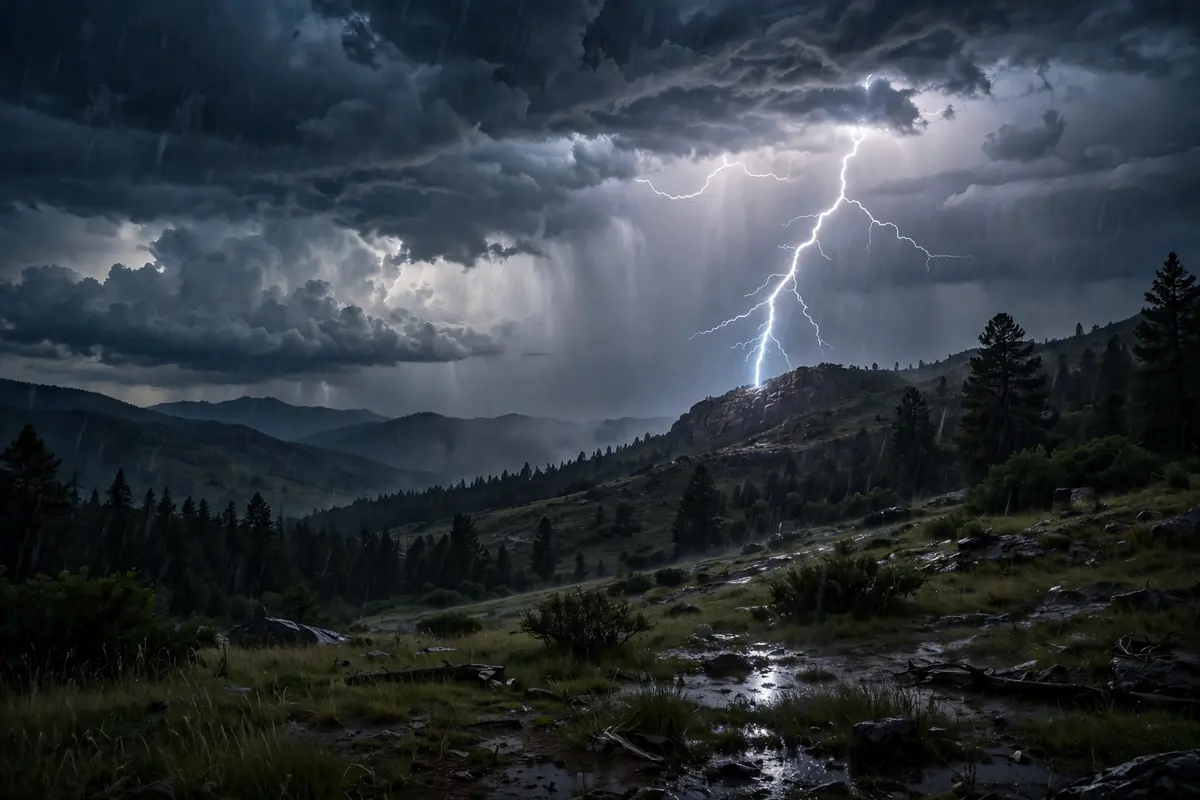
A lightning bolt does not strike in one smooth motion. It happens in two stages that together take less than a second. First, a faint, jagged channel called the stepped leader zigzags downward from the cloud in a series of short jumps, each about 150 feet long, ionizing the air as it goes. It branches as it descends, which is why lightning bolts have their characteristic forked shape.
As the leader nears the ground, the intense electric field causes upward streamers to rise from tall objects — trees, buildings, lightning rods. When a streamer meets the leader, the circuit completes, and the main event begins: the return stroke. A massive current, typically 30,000 amps but sometimes exceeding 200,000 amps, surges upward along the ionized channel at about one-third the speed of light. That return stroke is the bright flash we see.
The channel heats to nearly 30,000 Kelvin — five times hotter than the surface of the Sun — in microseconds. The air around it expands explosively, faster than the speed of sound, creating the shock wave we hear as thunder. Because light travels far faster than sound, you see the flash before you hear the thunder. Counting the seconds between flash and thunder and dividing by five gives a rough distance in miles — a useful rule for anyone caught outdoors in a storm.
Types of Lightning
Cloud-to-ground lightning is the most familiar and most dangerous kind, but it accounts for only about 20 percent of all lightning. Most lightning stays within or between clouds. Intra-cloud lightning flickers inside a single cloud, sheet lightning is intra-cloud lightning illuminating the cloud from within, and cloud-to-cloud lightning jumps between separate storm cells.
Other forms are rarer and stranger. Ball lightning — glowing spheres reported floating through the air — remains poorly understood and is still debated by scientists. Heat lightning is simply ordinary lightning from a distant storm, too far away for its thunder to be heard. Volcanic lightning crackles inside eruption plumes, where ash particles collide and separate charge just as ice crystals do in a thundercloud. And sprites, jets, and elves are fleeting flashes of colored light that dance above thunderstorms in the upper atmosphere, discovered only in the last few decades.
Positive lightning is a special concern. While most cloud-to-ground strikes carry negative charge from the cloud base, about 5 percent carry positive charge from the cloud top. These bolts are longer, last longer, carry far more current, and can strike up to 25 miles away from the storm — the origin of the phrase “a bolt from the blue.” They cause a disproportionate share of wildfires and are the reason experts advise sheltering long before a storm arrives overhead.
How Lightning Causes Thunder, Fire, and Damage
Thunder is the sound of superheated air expanding. The channel’s explosive heating creates a shock wave that decays into the rolling rumble we hear; nearby strikes produce a sharp crack, while distant ones rumble as the sound reflects off clouds and terrain.
Lightning’s heat and current explain its destructive power. A strike can ignite a tree from the inside as its sap boils to steam, shatter concrete as trapped moisture explodes, and start wildfires that burn for weeks. In the United States, lightning ignites roughly 15,000 to 20,000 wildfires per year. It also damages electronics: a strike’s electromagnetic pulse can surge through power lines and phone lines, frying devices far from the strike point. Surge protectors and unplugging sensitive equipment during storms are simple defenses.
The same energy that causes damage also plays a surprising ecological role. Lightning fixes nitrogen: the extreme heat splits nitrogen molecules in the air, which then combine with oxygen and rain to form nitrates that fertilize soil. Before synthetic fertilizers, lightning was one of the main sources of usable nitrogen for plants — a natural link to the ecosystems described in our guide to science’s role in protecting ecosystems and to the green technologies in our coverage of climate tech breakthroughs of 2026.
Lightning Safety: What to Do in a Storm
The United States averages about 25 million cloud-to-ground lightning strikes per year, and Florida, Texas, and the Gulf Coast see the most. Lightning kills an average of about 20 people annually in the US and injures hundreds more. Most victims are caught outdoors — fishing, golfing, farming, or working on roofs — and most strikes happen in the afternoon and early evening in summer.
The safety rule is simple: when thunder roars, go indoors. A substantial building with wiring and plumbing, or a hard-topped vehicle with the windows closed, is safe because the metal frame or wiring conducts the current around you to the ground. Stay away from windows, corded phones, and plumbing during the storm. Wait 30 minutes after the last thunder before going back outside.
If you are caught in the open with no shelter, avoid tall isolated objects, hilltops, and open water. Crouch low with your feet together, minimizing contact with the ground, but never lie flat — that increases the area exposed to ground current, which is how most people are actually injured: current spreads through the ground from a nearby strike. Drop metal objects like golf clubs and fishing rods, which attract attention from streamers.
Lightning rods work by giving the strike a safe path. A metal rod on a roof, connected to a thick cable running into the ground, intercepts the upward streamer and channels the current harmlessly into the earth. Modern lightning protection systems for homes, barns, and cell towers use this same principle, and they protect not just the structure but the electronics inside it — including the backup power systems covered in our guide to how lithium-ion batteries work and the solar installations in our explainer on how solar panels work.
How Scientists Study and Predict Lightning
Scientists track lightning with networks of sensors that detect the radio waves each strike emits. The National Lightning Detection Network uses more than 100 sensors across the United States to locate strikes in real time, accurate to within a few hundred yards. Weather satellites now watch lightning from space — the Geostationary Lightning Mapper on NOAA’s GOES satellites photographs flashes from orbit, using the same kind of orbital observation described in our guide to how satellites work.
Forecasters use lightning data to issue severe thunderstorm warnings, track storm intensity, and predict wildfire ignitions. Lightning frequency is also a climate indicator: warmer air holds more moisture and fuels stronger updrafts, so scientists expect lightning activity to increase as the planet warms, by roughly 12 percent for every degree Celsius of warming according to some studies. Drones are now flying into storms to study lightning up close, part of the aerial research covered in our explainer on how drones work.
On the ground, lightning detection has practical uses beyond forecasting. Utilities use strike data to find damaged power lines faster, fire agencies dispatch crews to lightning-caused ignitions before they spread, and event organizers receive alerts to clear stadiums and golf courses. The same connected infrastructure that delivers weather alerts to your phone — the networks behind electric car charging and the smartphone features in our guide to the best smartphones of 2026 — keeps people informed when storms approach.
Lightning, Power Grids, and Carbon
Lightning is both a threat to and a reminder of the power grid’s fragility. A single strike can knock out power for thousands of homes, and utilities spend billions hardening the grid with surge arrestors, shield wires, and faster fault detection. Some of that resilience work overlaps with the carbon-reduction efforts in our guide to carbon capture, since a cleaner, more distributed grid — with rooftop solar, batteries, and microgrids — is also a more resilient one. Even the newest gadgets people use to stay connected during outages, covered in our roundup of the coolest gadgets of the year, owe their usefulness to surviving the storm.
Conclusion: Nature’s Electric Masterpiece
So, how does lightning work? Ice crystals and hail collide inside a thundercloud, separating electric charge until the air itself breaks down and a colossal current bridges cloud and ground. It is violent, beautiful, and surprisingly common — millions of strikes every year, each one a reminder of how much energy the atmosphere stores and releases. Respect it, shelter from it, and the next time you watch a storm light up the sky, you will understand exactly what you are seeing.