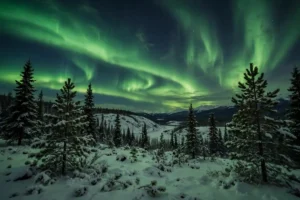
On a clear winter night in Alaska, the sky can suddenly come alive. Green ribbons ripple overhead, purple fringes curl at the edges, and the whole display shifts and shimmers like a curtain caught in a slow wind. People travel thousands of miles and brave freezing temperatures for a glimpse of it. But what causes the aurora borealis, and why does it appear only in certain places and at certain times?
The short answer is that the northern lights are sunlight in disguise. They begin on the Sun, travel across 93 million miles of space as a stream of charged particles, and end when those particles crash into gases high above Earth. That collision releases light, and the color of the light depends on which gas gets hit and how high up the crash happens.
In this guide, you will learn the full chain of events, from a solar storm to the glow above your head, why the lights favor the far north, what the colors mean, and how Americans can plan a trip to see them.
What Is the Aurora Borealis?
The aurora borealis, also called the northern lights, is a natural light display that appears in the sky near Earth’s polar regions. Its southern twin, the aurora australis or southern lights, appears around the South Pole. Both are the same phenomenon, seen from opposite ends of the planet.
Auroras usually appear as arcs, bands, rays, or curtains of light, most often green but sometimes red, purple, pink, or blue. A quiet display may look like a faint green arc on the northern horizon. A strong display can fill the whole sky with moving curtains and rays that seem to dance. Photographs often show the colors more vividly than the naked eye sees them, because cameras collect light over several seconds while your eyes refresh many times a second.
People have watched auroras for thousands of years, describing them as spirits or warriors dancing in the sky. Today we know the real explanation is just as remarkable, and it starts with our star.
It Starts With the Sun: The Solar Wind
The Sun constantly releases a stream of electrically charged particles, mostly protons and electrons, called the solar wind. This wind blows outward in all directions at speeds of roughly 250 to 500 miles per second, carrying a piece of the Sun’s magnetic field with it. Under calm conditions, the flow is steady and gentle. When the Sun is active, it can surge.
The biggest surges come from two sources. Coronal mass ejections are giant bubbles of gas and magnetic field that erupt from the Sun’s outer atmosphere and race outward. Coronal holes are darker, cooler regions on the Sun where the solar wind escapes faster than usual. When either one points toward Earth, a stronger gust of particles heads our way, and the chance of a bright aurora rises sharply.
The journey takes time. A fast coronal mass ejection may reach Earth in about a day, while the slower everyday solar wind takes several days. Space weather forecasters watch the Sun with satellites parked between Earth and the Sun, giving us roughly 30 to 60 minutes of warning before a strong gust arrives. That warning helps power grid operators and satellite internet networks prepare for disturbances. The rockets that launch these sentinels must themselves survive the radiation environment they monitor.
Earth’s Magnetic Shield Funnels the Particles
Earth has a magnetic field generated by molten iron moving deep inside the planet. That field stretches far into space and acts as a shield, deflecting most of the solar wind around the planet like water flowing around a rock in a stream. Without it, the solar wind would slowly strip away our atmosphere, and life on the surface would face far more radiation.
However, the shield is not perfect. At the north and south poles, the magnetic field lines dive down into the planet rather than running parallel to the surface. Some solar particles slip through these openings and get trapped in the upper atmosphere, guided along the field lines toward the polar regions. That is why auroras cluster around the poles instead of appearing everywhere.
In North America, that ring passes over Alaska and northern Canada, and it expands toward the equator during strong storms, which is why people in Minnesota, Michigan, and even Virginia occasionally glimpse the lights.
The Collision That Makes Light
Here is the key moment. About 50 to 400 miles above the ground, in a layer called the thermosphere, incoming solar particles collide with gas molecules, mostly oxygen and nitrogen. The collision gives the gas molecule extra energy, pushing its electrons into a higher energy state. That state is unstable, so the electrons quickly fall back down, and the extra energy escapes as a particle of light.
This is the same basic idea behind a neon sign, where electricity excites gas inside a tube until it glows. In an aurora, the Sun provides the energy, and the whole upper atmosphere becomes the tube. Each collision produces just one tiny flash, but trillions of collisions per second across a huge volume of sky add up to the glowing curtains we see.
Auroras are silent because they occur far above the clouds, in air too thin to carry sound to the ground.
What the Colors Mean
Aurora colors act like a code that tells scientists which gas was hit and at what height.
Green: the classic color
Green is the most common aurora color. It comes from oxygen molecules about 60 to 90 miles up. Green light is produced efficiently and our eyes are very sensitive to it, which is why most aurora photos and memories are dominated by green.
Red: the high-altitude glow
Red also comes from oxygen, but from much higher up, above about 120 miles. There the air is thinner, collisions are rarer, and the glow is fainter and slower to fade. Red auroras often appear as a soft wash above green curtains during strong storms, and they are a favorite of photographers chasing rare displays.
Purple, pink, and blue: nitrogen’s signature
When solar particles hit nitrogen molecules, the result is purple, pink, or blue light, often fringing the lower edges of green curtains. These colors tend to appear during the most active displays, when particles plunge deeper into the atmosphere. A sky that shows strong purple is usually putting on an exceptional show.
Because the colors depend on height and gas, no two aurora displays are exactly alike. The mix changes minute by minute as the solar wind strengthens, weakens, and shifts, which is why watchers describe the lights as dancing.
Why Auroras Follow an 11-Year Cycle
The Sun’s activity rises and falls in a cycle of about 11 years. During solar maximum, sunspots multiply, coronal mass ejections grow more frequent, and auroras become brighter and more widespread. During solar minimum, displays are quieter and rarer, though they never stop entirely.
The good news for American travelers is that the Sun is currently in an active phase of its cycle, and the late 2020s offer excellent chances for strong displays. Space weather agencies publish daily forecasts, including the Kp index, a scale from zero to nine that rates geomagnetic activity. A Kp of five or higher usually means the aurora may be visible in the northern United States, while Alaska and northern Canada enjoy displays at much lower values.
Strong solar storms also remind us how connected Earth is to space. The gusts that paint the sky can disturb radio, GPS, and power grids, so engineers study them closely to protect the networks and connected devices Americans rely on every day.
Where Americans Can See the Aurora Borealis
You do not need a passport to see the northern lights. Fairbanks, Alaska, is one of the best viewing spots in the world, thanks to its position under the auroral oval, the ring where auroras appear most often, and its many clear winter nights. The season runs roughly from late August through April, with the darkest skies around the winter solstice in December.
Farther south, the upper Midwest offers real chances during strong storms. Northern Minnesota, Michigan’s Upper Peninsula, and North Dakota all sit close enough to the oval to catch displays several times a year. New England, especially northern Maine, Vermont, and New Hampshire, also sees the lights when the Kp index climbs.
For the best experience, pick a moonless night, get far from city lights, look north after about 10 p.m., and dress far warmer than you think necessary. A tripod helps for photos: a long exposure captures colors the eye only partly sees.
Auroras Beyond Earth
Earth is not the only planet with auroras. Jupiter has the most powerful auroras in the solar system, driven by its enormous magnetic field and volcanic material from its moon Io. Saturn, Uranus, and Neptune glow too, and even Mars shows faint auroras, despite having only a weak magnetic field. Studying these alien lights helps scientists understand magnetic fields across the solar system, including the extreme environments around black holes, where magnetic fields shape some of the most energetic phenomena known.
That research also feeds back into practical work. The same physics that lights the polar sky helps engineers design better fusion experiments, where hot charged gas must be confined by magnetic fields, and it informs missions like NASA’s Artemis program, which will send astronauts beyond Earth’s protective magnetic bubble.
Closer to home, scientists use aurora observations to study the upper atmosphere itself. The lights trace the invisible structure of Earth’s magnetic field, showing how it bends, reconnects, and channels energy. In that sense, every aurora is a free experiment, written across the sky in light.
How Climate and the Sun Interact
It is worth clearing up a common confusion. Auroras do not cause weather, and they are not a sign of climate change. They happen far above the clouds, in a region where the air is too thin to affect storms or temperatures at the surface. However, scientists who study the upper atmosphere also track how it changes over decades, and their work overlaps with climate technology research that monitors Earth’s atmosphere from the ground to space.
The Sun’s energy also drives weather, powering winds and the water cycle, and solar panels capture a fraction of that energy for homes and businesses. The aurora is simply the most beautiful visible proof that our star’s influence reaches far beyond daylight.
Conclusion
So, what causes the aurora borealis? A chain that begins with an eruption or fast wind stream on the Sun, continues across millions of miles of space, and ends when charged particles slide down Earth’s magnetic field lines and collide with oxygen and nitrogen high above the poles. Those collisions release light in green, red, purple, and blue, painting curtains across the night sky.
The next time you see a forecast for strong aurora activity, step outside, look north, and give your eyes time to adjust. You will be watching the Sun’s energy become light, 60 miles overhead, in one of nature’s most spectacular performances. And if the sky stays dark, remember that the show will return: as long as the Sun shines and Earth keeps its magnetic shield, the northern lights will keep dancing.
Frequently Asked Questions
Can you see the aurora borealis from the United States?
Yes. Alaska offers the best views, and during strong storms the lights can appear in Minnesota, Michigan, North Dakota, and Maine.
What time of year is best for northern lights?
Late August through April, with the darkest skies in winter. Long nights, clear air, and a new moon give you the best odds.
Do auroras make sound?
Generally no. Auroras occur far above the ground in extremely thin air, so any sound would not reach listeners. Reports of aurora sounds are rare and unproven.
Are auroras dangerous?
Watching an aurora is harmless, but the solar storms behind strong displays can disturb satellites, radio, and power grids.