They film weddings, inspect power lines, deliver prescriptions, and patrol wildfires. Drones have gone from military exotic to American everyday in barely a decade — the FAA now counts hundreds of thousands of registered commercial drones and well over a million recreational ones buzzing over US neighborhoods, farms, and job sites.
This guide explains how drones work in plain English: the physics that keeps them airborne, the sensors and software that keep them stable, how pilots actually control them, what the camera sees, and what the 2026 rulebook requires American flyers to know. Whether you are shopping for your first quadcopter or just curious about the buzzing overhead, start here.
What Is a Drone, Exactly?
“Drone” is a casual word for an unmanned aerial vehicle (UAV): an aircraft with no pilot on board. Most consumer and commercial drones are multi-rotors — typically quadcopters with four propellers — prized for hovering in place, taking off vertically, and maneuvering in tight spaces. Fixed-wing drones, which look like small airplanes, trade hovering for range and efficiency, flying for hours on mapping or agricultural missions. Hybrids that take off vertically then transition to winged flight combine both strengths.
Under the hood, every drone is a flying robot: a lightweight frame, motors and propellers, a battery, a flight controller (its brain), sensors for balance and position, a radio link to the pilot, and usually a camera. The magic is how these parts cooperate hundreds of times per second to do something no human could: balance an inherently unstable aircraft in gusty wind.
How Do Drones Work? The Physics of Staying Airborne
A drone flies by pushing air down. Each spinning propeller acts like a wing rotating at thousands of RPM, generating lift. Four (or six, or eight) propellers together must produce lift equal to the drone’s weight to hover — and a bit more to climb.
Steering is beautifully simple in concept. To move forward, the flight controller spins the rear propellers slightly faster than the front ones, tilting the whole craft forward; the tilted lift vector now has a forward component, and the drone glides ahead. To turn, it speeds up one pair of diagonal propellers and slows the other, spinning the craft around its vertical axis (yaw). Climbing, descending, and strafing sideways all reduce to the same trick: varying individual motor speeds to tilt and twist the thrust.
The catch is stability. A quadcopter is naturally unstable — like balancing a broom on your palm. That is why the flight controller runs a tight feedback loop: gyroscopes and accelerometers report the drone’s orientation up to a thousand times per second, and the controller adjusts each motor’s speed in milliseconds to correct every wobble before you ever see it. When a gust hits, the drone fights back faster than any human pilot could react. This sensor-fusion ballet is a close cousin of the stabilization tech in modern robotics, where machines balance and navigate in real time.
The Brains: Flight Controllers, GPS, and Autonomy
The flight controller is a small computer running specialized firmware that fuses sensor data and commands the motors. But the sensors deserve the spotlight, because they are what make consumer drones feel almost magical.
GPS and positioning
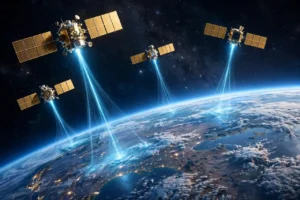
Outdoors, drones navigate primarily by GPS satellite signals, holding their position in the sky to within a few feet even in wind. Lose GPS — say, under a bridge or indoors — and the drone falls back on its other senses. Many drones add visual positioning: downward-facing cameras that track the ground’s texture, like an optical mouse reading the floor, to hold still without satellites.
Obstacle sensing and avoidance
Mid-range and premium drones carry arrays of sensors — forward, backward, upward, and downward cameras, plus sometimes lidar or time-of-flight sensors — that build a 3D picture of the surroundings. The flight controller uses it to stop before hitting a tree, route around a building, or land precisely on a marked pad. It is the same perception challenge self-driving cars wrestle with, compressed into a flying package the size of a shoebox.
Autonomous flight modes
Modern drones fly themselves through complex routines: tap a subject on the screen and the drone orbits it while keeping the camera locked on (ActiveTrack); draw a path on the map and it flies the survey; press return-to-home and it climbs, navigates back to the launch point, and lands itself — even computing the battery needed to get home. These modes run on waypoint navigation and computer vision, previewing the autonomy that AI advances are spreading across every machine.
How Pilots Actually Control a Drone
The classic controller has two joysticks: one for throttle and yaw (up/down, rotate), one for pitch and roll (forward/back, left/right). Video from the drone’s camera streams to the pilot’s phone or goggles in near-real time — first-person view, or FPV — with latency low enough to thread the craft through gaps at speed.
The radio link typically uses 2.4 or 5.8 GHz frequencies (the same neighborhood as the crowded wireless bands our smart devices share, which is why crowded areas can interfere) or proprietary long-range protocols. Premium systems now push control and video for miles with robust anti-interference encoding. If the link drops entirely, a well-built drone does not fall from the sky: it climbs to a safe altitude and flies itself home on GPS — the return-to-home failsafe every pilot should test before trusting.
Smartphones increasingly double as controllers and planning tools: flight apps handle pre-flight checklists, airspace maps, firmware updates, and the latest phones even process drone footage with impressive editing apps on the spot.
Batteries: The Limit of Every Flight
Ask any drone pilot about the technology’s biggest constraint and you will hear one word: batteries. Lithium-polymer packs give a typical consumer drone 25 to 45 minutes of flight; heavier commercial drones carrying cameras or sensors may manage 20 to 30. Cold weather steals capacity, aggressive flying drinks it faster, and every gram of payload shortens the trip.
Pilots plan around this religiously: the 30-percent rule (land with nearly a third of battery remaining) keeps a margin for wind or a missed landing. Swappable batteries, charging hubs, and portable power stations are standard kit for serious work. Longer-term, solid-state batteries and hydrogen fuel cells promise to stretch endurance dramatically — the same energy-density race reshaping everything portable, from phones to power tools.
What Drones Do in America in 2026
The American drone economy has matured far beyond hobbyists in parks. Real estate photographers shoot listings, roofers inspect shingles without ladders, farmers map crop health with multispectral cameras, and utilities patrol thousands of miles of power lines. Public safety agencies deploy drones as first responders — arriving over an emergency scene in minutes with thermal cameras that find missing hikers at night.
Delivery is the frontier everyone watches. Companies like Zipline, Wing, and Amazon’s Prime Air operate commercial drone delivery in select US markets, dropping prescriptions, groceries, and packages by parachute or winch. Progress has been slower than the hype promised — airspace rules, noise, and economics all bite — but the trajectory is unmistakable, and satellite connectivity is beginning to extend drone operations far beyond the pilot’s radio range.
On the playful side, FPV racing and cinematic flying have become genuine sports and art forms, with pilots threading custom-built quads through abandoned buildings at 80 mph — wearing goggles, grinning wildly. The gadget world of 2026 treats a good drone as essential creative kit, not a toy.
The 2026 Rulebook: What American Flyers Must Know
Drones share the sky with airplanes, so the rules are real and the FAA enforces them. Here is the 2026 essentials list — not legal advice, but the shape of compliance every US pilot needs.
Registration. Drones weighing over 250 grams (0.55 lbs) must be registered with the FAA — $5 per drone, valid three years, done through the FAA DroneZone portal. Commercial pilots register under Part 107; hobbyists under the recreational exception.
Remote ID: the digital license plate. Since September 2023, nearly all drones in US airspace must broadcast Remote ID — identification, location, altitude, and control-station position — continuously from takeoff to shutdown. In 2026, enforcement is fully active with civil penalties that can exceed $10,000 per violation. Most modern drones (DJI, Autel, Skydio, and others) have it built in; older aircraft need an add-on broadcast module or must fly in an FAA-Recognized Identification Area (FRIA).
The basic flight rules. Keep the drone within visual line of sight, fly at or below 400 feet above ground, never fly over crowds or moving traffic without specific authorization, yield to all manned aircraft, and check airspace authorization via LAANC before flying near airports. Night flying is allowed with anti-collision lighting.
Part 107 vs. recreational. Flying for fun requires passing the free TRUST safety test. Flying for any business purpose — even a single paid photo — requires a Part 107 Remote Pilot Certificate, earned by passing an FAA knowledge exam. The long-awaited Part 108 framework for routine beyond-visual-line-of-sight (BVLOS) operations is expected to finalize in 2026, which would standardize long-range commercial flights that today need individual waivers.
Privacy and common sense. The law varies by state, but the etiquette is universal: do not hover over neighbors’ backyards, respect posted no-drone zones (national parks ban them), and remember that a camera in the sky raises hackles. Good pilots introduce themselves before launching near people.
And like any connected device, keep firmware updated and accounts secured — drones are computers that fly, so basic cybersecurity hygiene applies at 400 feet too.
Choosing Your First Drone in 2026
Shopping advice in brief: decide your mission first. For travel and casual photography, a sub-250-gram drone (like DJI’s Mini series) dodges FAA registration while still shooting excellent 4K video — the sweet spot for beginners. For serious photography or commercial work, step up to a larger sensor and obstacle sensing in every direction, and budget for the Part 107 exam if you will earn money with it.
Buy extra batteries before extra accessories — flight time is the true currency. Practice in an open field with the beginner modes on, learn return-to-home before you need it, and log your first dozen flights close and low. The learning curve is gentler than it looks: modern drones practically fly themselves, leaving you to focus on the shot. For a taste of where aerial robotics is heading, watch how NASA’s Mars helicopter Ingenuity proved powered flight works on another planet — your backyard quadcopter shares its DNA.
The Bottom Line
How do drones work? Spinning propellers generate lift, a flight controller corrects a thousand wobbles per second using gyroscopes and GPS, sensors map the surroundings, and a radio link (plus increasing autonomy) puts a pilot — human or software — in charge. Batteries limit the flight; imagination sets the mission.
In 2026, drones sit at a fascinating intersection: mature enough for mainstream industry, regulated enough to be taken seriously, and still improving fast enough that each generation feels like a leap. The buzzing overhead is not a fad. It is the sound of the sky becoming infrastructure.