Watch a rocket lift off and you are watching one of the most violent machines humans ever built work perfectly. In seconds, millions of pounds of metal shake free of the pad, climb through the thickest air on Earth, and accelerate to five miles per second. It looks like magic. It is physics pushed to the extreme — and in 2026, with SpaceX flying the largest rocket ever built and NASA reshaping its moon plans, the physics has never been more dramatic.
So how do rockets work, really? This guide breaks the answer into pieces you can picture: the one law of physics behind everything, the engineering tricks that turn that law into moonshots, and the 2026 reality of Starship and Artemis.
How Do Rockets Work? Start With Newton’s Third Law
A rocket throws hot gas out of its engines at enormous speed in one direction, and the universe shoves the rocket in the opposite direction. There is nothing to push against in space — no air, no road — and the beautiful part is that a rocket never needed anything to push against in the first place.
Think of standing on a skateboard and throwing a heavy bowling ball forward. You roll backward. Now throw a thousand bowling balls per second. That is, roughly, what a rocket engine does: exhaust gases expelled at velocities that make a fighter jet look parked.
A rocket does not just need to reach the height of space; it needs orbital speed — about 17,500 miles per hour — so it keeps falling around Earth instead of falling back to it. The battle with gravity is so fundamental that it shapes all of physics, from missions studying the most extreme gravity wells in the universe, black holes to the hunt for dark matter, the invisible substance whose hidden gravity seems to steer galaxies.
Once you grasp the third law, everything else in rocketry answers one follow-up question: how do we throw more mass, faster, without the machine getting too heavy to move?
Thrust and the Rocket Equation: How Do Rockets Work at the Math Level?
Thrust is the push an engine produces: the mass of exhaust thrown out each second multiplied by the exhaust’s velocity. Engineers obsess over this multiplication because it is the engine’s report card — every pound of thrust must lift a pound of something, including the rocket itself.
The deeper question — how fast can a rocket ultimately go? — is answered by the Tsiolkovsky rocket equation, written down by Konstantin Tsiolkovsky in 1903. It says a rocket’s final speed depends on only two things: how fast its exhaust moves, and the ratio of its fully fueled mass to its empty mass. Physics does not negotiate.
The equation delivers a brutal lesson. Because fuel itself has mass, every extra gallon makes the rocket heavier, demanding even more fuel to push that fuel. This is the tyranny of the rocket equation, and it is why rockets are roughly 90 percent propellant by weight. Staging, lightweight materials, and engine choices are all attempts to cheat this equation — and the only legal cheat is shedding weight along the way.
Why Rockets Shed Stages: Ditching Dead Weight Mid-Flight
One of the most counterintuitive answers to how do rockets work is that rockets throw away perfectly good hardware mid-flight. Once a stage burns its fuel, its tanks and engines become dead weight. So the rocket lets them go.
Watch any multi-stage launch: the big first stage does the heavy lifting through the thick lower atmosphere, then separates and falls away while the smaller second stage ignites — already moving fast and already high, where its job is easier. Each separation buys extra speed for the payload.
Starship has pushed this further with hot-staging, where the upper stage ignites its engines before the booster fully separates. Instead of the traditional pause — coast, separate, then light — the ship’s engines fire while still attached, with a vented section letting exhaust escape. It saves the propellant a cold separation would waste.
Fuel: How Do Rockets Work With Cryogenic Propellants?
A rocket engine is a controlled explosion that never stops, burning propellant — fuel plus oxidizer. Jets breathe oxygen from the air; rockets must carry their own, because there is no air in space. For the most demanding jobs, engineers reach for cryogenics: fuels chilled hundreds of degrees below zero.
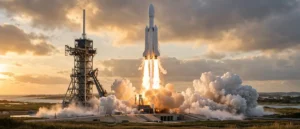
Starship burns methane with liquid oxygen, both cryogenic. Methane burns cleaner than kerosene, so engines can be reused without heavy scrubbing, and it stays liquid at milder temperatures than hydrogen, simplifying tanks and plumbing. SpaceX’s Raptor engines burn this methane-LOX mix, and 33 of them on the Super Heavy booster produce roughly 16 million pounds of thrust at liftoff — more than double the Saturn V that carried Apollo astronauts to the moon.
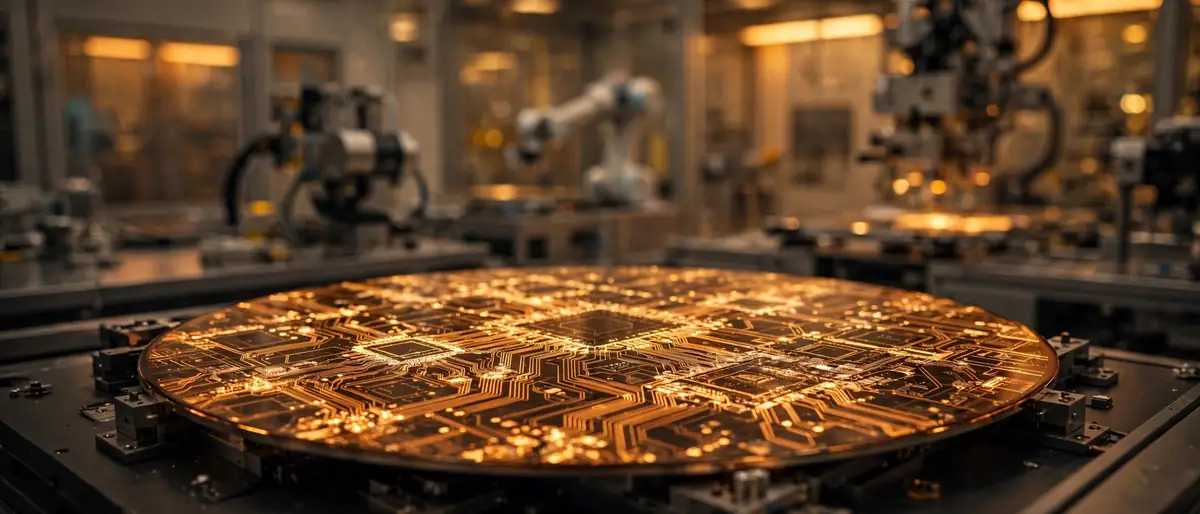
Today, advances in 3D printing and advanced manufacturing let engineers build complex, lightweight engine parts — cooling channels, injectors, turbomachinery — in shapes no machine shop could cut, at a fraction of the old cost.
Surviving the Trip: How Do Rockets Work Against Reentry Heating?
Getting to space is only half the journey for a reusable rocket. Coming back is where physics turns savage. A returning booster hits the upper atmosphere at orbital speeds, and slamming into even thin air compresses that air until it glows hotter than lava. This is compression heating, not friction, and it can reach thousands of degrees.
Expendable rockets never cared — they burned up. Reusable rockets must survive the fireball. Boosters flip and fire engines against their direction of travel, killing speed before the atmosphere can do it violently. Starship belly-flops like a skydiver, spreading heat across its broad stainless-steel body before flipping vertical to land. Each approach answers the same question: how do you slow from orbital speed without melting?
Reusability: The Economics of How Do Rockets Work in 2026
For most of the space age, rockets were single-use machines — billion-dollar fireworks. The revolution was treating the booster like an airplane: fly it, land it, refuel it, fly it again. SpaceX’s Falcon 9 proved the economics, with individual boosters routinely flying 20 or more missions. Each reuse spreads the manufacturing cost across many flights, collapsing launch costs.
Starship’s ambition is full, rapid reusability of both stages. The Super Heavy booster has already been caught multiple times by the launch tower’s giant mechanical arms — the “chopsticks” catch — where the tower arms close on the descending booster so it never touches the ground. Catching both stages this way would eliminate landing legs entirely, saving enormous weight: another legal cheat against the rocket equation.
Landing a skyscraper-sized booster on a tower demands absurd precision, built on technologies familiar from smaller machines. GPS navigation gives boosters their pinpoint return accuracy, while the autonomous control loops adjusting fins and engine gimbals hundreds of times per second share their DNA with how autonomous drones stabilize and steer themselves. Different scale, same feedback-control mathematics.
How Do Rockets Work in 2026? Starship’s Big Year
All of this physics came together on September 28, 2026, when Starship Flight 14 became the first Starship mission to reach orbit — and it worked there, deploying 26 Starlink V3 satellites. For the first time, the largest rocket ever built was not merely a test article but an operational cargo hauler, carrying real payloads for the Starlink satellite internet constellation.
The numbers behind Starship’s V3 configuration are staggering: the full stack stands about 124.4 meters — over 400 feet — tall, its 33 Raptor engines generate roughly 16 million pounds of thrust, and it is designed to deliver more than 100 metric tons of cargo to orbit. Picture a 40-story building you can refuel and fly again.
Bigger tests are coming. Flight 15, planned for November 2026, aims for something never attempted: catching both the Super Heavy booster and the Starship upper stage with the tower on the same flight. The booster has been caught multiple times; catching the ship — returning at orbital velocity, glowing from reentry — would prove full rapid reusability is real. If it works, the economics of spaceflight change overnight.
Meanwhile, NASA has reshaped its moon plans around this rocket. NASA overhauled its Artemis architecture in February 2026, and Starship is now NASA’s Human Landing System — the vehicle carrying astronauts from lunar orbit to the surface. The first crewed landing is retargeted to Artemis IV in early 2028, with Artemis III repurposed for lander tests. Follow NASA’s Artemis program and America’s return to the moon for the full story — but the key point is that the biggest rocket ever built is now officially the moon rocket too.
The Brains of the Rocket: Guidance, Computers, and Power
Engines get the glory, but a modern rocket is a flying supercomputer wearing an engine. Guidance systems fuse data from inertial sensors, star trackers, and GPS hundreds of times per second, computing exact position and velocity and commanding engine gimbals to hold a razor-thin trajectory. No human pilot could react fast enough; the machine flies itself.
The precision borders on the robotic. The tower-catch arms that pluck a descending booster from the sky move with coordination echoing the robotics revolution transforming factories, homes, and workplaces across America — the same blend of sensors, software, and steel, applied to a falling 400-foot building.
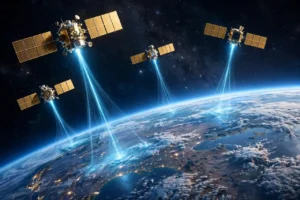
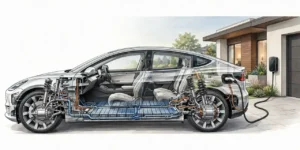
All this hardware needs electricity, and the payloads on top need it even more. Satellites and the avionics steering them run on power systems whose batteries are close cousins of the ones in phones and electric cars — the same lithium-ion battery technology that powers American EVs, hardened for space radiation and temperature swings. Once deployed, many satellites — including the Starlink craft Starship now carries — unfold solar panel wings that turn sunlight into electricity, generating power for years with no fuel at all.
How Do Rockets Work? Putting the Whole Puzzle Together
Propellant flows into engines, explodes continuously, and throws exhaust out the back at supersonic speed. Newton’s third law converts exhaust into thrust. Staging sheds empty tanks so remaining fuel pushes less dead weight. The rocket equation governs final speed. Reusable stages flip, burn, survive reentry, and land to fly again. Guidance computers steer the stack within meters. It is a chain of physics, and every link must hold.
What Comes Next: How Do Rockets Work in the Future?
Chemical rockets approach the practical limits of the rocket equation — there is only so much energy in any chemical bond. The next leap may be nuclear fusion propulsion, which could one day slash travel times across the solar system, turning Mars trips from months into weeks. Fusion is still a laboratory dream — but so was landing a booster on a tower, not long ago.
Closer in, the revolution is operational: flight rates. SpaceX’s goal is Starship launches measured in days between flights, not months. If Flight 15’s double catch succeeds in November 2026 and Artemis hardware tests stay on schedule, the late 2020s could see something unprecedented — a fully reusable super-heavy rocket flying often enough that the moon becomes a destination, not an expedition.
Conclusion: How Do Rockets Work? Now You Know
Rockets work because Newton said so, because Tsiolkovsky did the math, and because generations of engineers found legal cheats against the rocket equation: throw exhaust faster, shed stages, burn cleaner cryogenic fuel, and — the great insight of our era — land the machine and fly it again. In 2026, that insight produced a 400-foot reusable giant that reached orbit, delivered real satellites, and is now NASA’s chosen ride to the lunar surface.
Next time you watch a launch, watch for the pieces: the slow initial climb as thrust barely beats gravity, the staging flash, the impossible flip and the tower catch. You are not watching magic anymore. You are watching physics, working exactly as advertised, on the way to the moon.