Earth looks solid under our feet, but on a grand scale it is slowly moving. The outer shell of our planet is broken into large pieces called tectonic plates, and those pieces drift, collide, and slide past each other over millions of years. That slow motion, called plate tectonics, shapes almost everything on Earth’s surface: mountains rise where plates collide, oceans widen where plates pull apart, and earthquakes and volcanoes cluster along plate boundaries. It is one of the most powerful ideas in earth science, because it ties together so many separate observations.
Before plate tectonics, scientists struggled to explain why matching fossils and rock layers appeared on continents now separated by wide oceans, or why mountain ranges looked as if they had been squeezed. Once researchers mapped the ocean floor and measured how the seafloor spreads, the picture fell into place. Continents do not plow through oceans on their own. Instead, continents ride on plates that include both continental and oceanic crust, moving together as part of a larger system driven by heat inside Earth.
What Tectonic Plates Are Made Of
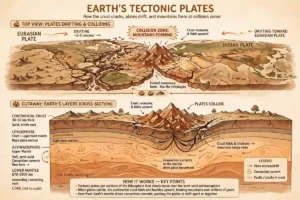
Earth has layers, much like an onion. The thin outer layer is the crust, which is thicker and lighter under continents and thinner and denser under oceans. Below the crust sits the mantle, a thick layer of hot rock that can flow very slowly over long times, even though it feels solid. Together, the crust and the uppermost, rigid part of the mantle form the lithosphere, and it is the lithosphere that is broken into plates. Below the lithosphere, the asthenosphere is hotter and weaker, allowing plates to move over it, much as a stiff board might slide over thick honey.
Plates come in different sizes. Some carry whole continents, others are mostly ocean floor, and some are small fragments caught between larger neighbors. Their edges, called boundaries, are where most geological action happens. The interior of a plate is usually quieter, though not entirely still, since stresses can build up far from a boundary. Learning the structure of plates is a first step toward understanding how satellites help measure Earth’s slow movements, because modern instruments can now track plate motion with remarkable precision, confirming movements that were once only inferred from rocks.
The Three Types of Plate Boundaries
At divergent boundaries, plates move apart. New crust forms in the gap, often at mid-ocean ridges where molten rock rises from below and cools into fresh seafloor. As new crust forms, older crust moves outward, which is why the ocean floor is youngest near ridges and older farther away. On land, divergent boundaries can stretch continents thin and form rift valleys, long lowlands where the crust is pulling apart. Over very long times, a rift valley on land can widen into a new ocean basin, though that process takes millions of years.
At convergent boundaries, plates move toward each other, and the result depends on what kinds of crust meet. When oceanic crust meets continental crust, the denser oceanic plate usually sinks beneath the lighter continental plate, a process called subduction. That sinking can create deep ocean trenches, coastal mountain ranges, and chains of volcanoes. When two continental plates collide, neither sinks easily, so the crust crumples upward into high mountain ranges instead. The Himalayas, for example, formed and continue to grow as India pushes into Asia, a slow collision that still raises mountains today.
At transform boundaries, plates slide past each other sideways. No new crust forms and none is destroyed, but friction along the boundary builds stress. When that stress is finally released, the ground can slip suddenly, causing an earthquake. The San Andreas Fault in California is a well-known transform boundary, where the Pacific Plate slides past the North American Plate. Transform boundaries remind us that plate motion is not always smooth. It can stick, build pressure, and then move in a sudden jump, which is why earthquake science focuses so much on faults and stress.
How Heat Inside Earth Drives the Plates
What powers all this motion? Much of the energy comes from heat inside Earth, left over from the planet’s formation and produced by natural radioactive decay in rocks. That heat makes mantle rock move in slow convection currents, somewhat like warm water rising and cool water sinking in a pot, though far slower and in solid rock rather than liquid. As mantle material rises, cools, and sinks, it drags plates along, though the exact balance of forces is still studied and debated. Slab pull, where a sinking plate drags the rest of the plate behind it, and ridge push, where new crust at a ridge pushes outward, are both thought to play roles.
This slow engine has run for billions of years, recycling ocean crust back into the mantle at subduction zones while new crust forms at ridges. Continental crust, being lighter, is harder to subduct, so continents tend to survive and grow over time by collecting fragments and volcanic material. That is why some continental rocks are far older than any ocean floor. The ocean floor is constantly renewed, while continents keep a longer memory of Earth’s history in their rocks, a memory geologists read like a book when they study how scientific inquiry reconstructs the past.
Earthquakes, Volcanoes, and Mountains
Plate tectonics gives a single explanation for three dramatic features that once seemed unrelated. Earthquakes happen most often at plate boundaries, where stress builds and releases, though some occur within plates as well. Volcanoes cluster at divergent boundaries, where magma rises to fill gaps, and at subduction zones, where sinking crust melts and feeds magma upward. Mountains rise at convergent boundaries, where crust is squeezed and thickened. By mapping earthquakes and volcanoes, scientists can trace plate boundaries even where they lie hidden under oceans.
This understanding also helps communities prepare. Knowing where faults lie, how often they have moved in the past, and what kind of shaking they can produce helps engineers design safer buildings and helps emergency planners prepare. It does not allow precise prediction of the next earthquake, and honest science says so. What it does allow is a clear picture of risk: which areas are more likely to shake, which coastlines face tsunami risk after undersea earthquakes, and which volcanic regions need monitoring. That knowledge saves lives when it shapes building codes, warning systems, and public education, much as research shapes everyday safety decisions in other fields.
Why Plate Tectonics Matters Beyond Geology
Plate motion affects more than rocks. Over millions of years, moving continents change ocean currents, wind patterns, and climate, because the positions of land and sea steer heat around the planet. When continents join or split, species become isolated or connected, shaping evolution and the distribution of life we see today. That is why similar fossils on distant continents were an early clue to moving plates, and why protecting ecosystems today requires understanding the long history that shaped them. Mountains formed by collision also affect rainfall, creating wet slopes on one side and dry rain shadows on the other, which in turn shapes farms, forests, and cities.
Plate tectonics also connects to resources people use. Many mineral deposits form at plate boundaries, where hot fluids move through cracked rock, and fossil fuels form in basins shaped by plate history. Geothermal energy, which uses Earth’s internal heat, is strongest in volcanic and rift regions where plates are active. Even the search for cleaner energy links back to plate science, alongside work on carbon capture and solar power. In each case, understanding Earth’s deep processes helps people make wiser choices about the surface world.
How Scientists Measure Plate Motion Today
Plate motion is far too slow to feel, but modern instruments measure it with impressive precision. Satellite positioning systems track fixed points on Earth’s surface year after year, revealing movements of a few centimeters annually, about as fast as fingernails grow. Seafloor instruments, laser measurements, and earthquake records add further detail, showing how strain builds along faults between earthquakes and how it releases when faults slip. Together, these tools turn a theory inferred from rocks into a motion measured in real time, and they help scientists refine maps of plate boundaries and zones of risk.
Over even longer times, plate motion rearranges whole continents in a cycle of assembly and breakup. Supercontinents form when continents collide into one large landmass, then split apart again as new oceans open, a cycle that has repeated several times in Earth’s history. Each assembly and breakup reshapes ocean currents, climate patterns, and the distribution of life, creating the conditions for new species to evolve in isolation and old ones to spread when land bridges form. That deep-time perspective makes present-day geography look temporary: the map we know is a single frame in a very long film, and plate tectonics is the projector moving it forward.
For readers who love big-picture science, plate tectonics is a rewarding topic because it rewards patience. The movements are too slow to see in a lifetime, yet their results are everywhere: in mountain skylines, ocean trenches, and the very shape of continents on a map. Once you learn to see Earth as a moving, living planet rather than a fixed stage, ordinary landscapes gain a deeper story. Further exploration can include what dark matter might be, what black holes reveal, how DNA carries information, the world of microbes, how fusion powers stars, and the latest discoveries in science. Each one shows a different force shaping the world, from the smallest particles to the largest plates, all moving to rhythms far older than us.