On a dark night far from city lights, the unaided eye can see perhaps a few thousand stars. Point a modest telescope at the same sky, and the view explodes: craters on the Moon, the rings of Saturn, the moons of Jupiter, and faint smudges of light that turn out to be galaxies millions of light-years away. How does a simple tube of glass and metal achieve such a transformation?
How telescopes work comes down to one job: gathering light. Your pupil opens to only about a quarter of an inch, catching a trickle of light from each star. A telescope’s lens or mirror may be feet across, collecting thousands of times more light. Magnification helps, but light gathering is the real superpower.
In this guide, you will learn how lenses and mirrors bend light, why bigger telescopes see fainter objects, how different telescope designs compare, and how to start observing the night sky yourself.
The One Job of a Telescope: Collect Light
Every telescope, from a child’s first refractor to the great observatories on mountaintops, does the same basic task. It collects light from a distant object and brings it to a focus, forming an image that your eye or a camera can examine.
Think of it like a bucket in the rain. A small cup catches a few drops, while a wide bucket catches far more. In the same way, a telescope with a wide opening, called its aperture, catches far more starlight than your eye. That extra light reveals faint objects that would otherwise stay invisible, and it lets you see details in brighter objects, like the bands of clouds on Jupiter.
Aperture also controls resolution, which is the ability to separate fine details. A larger aperture can distinguish two close stars as separate points, while a smaller one blurs them together. That is why astronomers keep building bigger telescopes, and why a large telescope on a dark mountaintop can outperform a small one even when both point at the same target.
Refracting Telescopes: Bending Light With Lenses
The oldest telescope design uses lenses. A refracting telescope has a large glass lens at the front, called the objective lens. That lens bends, or refracts, incoming light and brings it to a focus near the back of the tube. An eyepiece, which is a small magnifying lens, then enlarges that focused image for your eye.
Refractors give crisp, high-contrast views, which makes them excellent for the Moon and planets. They have sealed tubes, so dust rarely reaches the optics, and they need little maintenance. Their weakness is size: a large glass lens is heavy, expensive, and supported only at its edges, so it can sag. Large lenses also suffer chromatic aberration, where colors focus at different points and fringe bright objects. Special glass reduces this, but costs climb steeply.
Still, a small refractor is a wonderful first telescope. It is intuitive to use, easy to carry, and forgiving for beginners who are learning the sky.
Reflecting Telescopes: Gathering Light With Mirrors
Most serious amateur and professional telescopes use mirrors instead of lenses. In a reflecting telescope, a curved primary mirror at the back of the tube collects light and reflects it to a focus. Because mirrors can be supported from behind, they can grow far larger than lenses without sagging, and they reflect all colors to the same focus, so there is no chromatic aberration.
The most popular reflector design is the Newtonian, invented by Isaac Newton in the 1660s. Light enters the open front of the tube, hits the primary mirror, and reflects back up the tube to a small flat secondary mirror. That mirror diverts the light sideways into an eyepiece mounted on the side of the tube. The design is simple, affordable, and easy to build at home, which is why many beginners choose a Newtonian reflector as their first serious instrument.
Large observatories use more elaborate reflector designs, often with mirrors many feet across, polished to astonishing precision. The surface of a professional mirror must be accurate to a fraction of the wavelength of light, which is smaller than a bacterium. Achieving that precision takes months of grinding and polishing, but the reward is a view of the universe in extraordinary detail.
What Magnification Really Does
Beginners often shop for the highest magnification they can find. That is a mistake. Magnification is simply the telescope’s focal length divided by the eyepiece’s focal length, and you can change it by swapping eyepieces. What matters far more is whether the telescope gathers enough light and whether the atmosphere allows a sharp image.
As a rule, the useful maximum magnification of a telescope is roughly fifty times its aperture in inches. A four-inch telescope therefore tops out near two hundred times magnification. Pushing beyond that limit only makes the image larger and blurrier, like enlarging a small photograph until it turns to mush. On nights when the air is unsteady, even modest magnification may look soft, because heat rising from rooftops and turbulence high in the atmosphere smears the image.
Experienced observers spend most time at low and medium magnification. Low power gives a wide, bright field ideal for star clusters and galaxies, medium power suits the Moon and planets, and high power is reserved for rare nights of steady air.
Mounts: Holding the Telescope Steady
A telescope is only as good as its mount: at high magnification, even a tiny tremor becomes a violent shake in the eyepiece.
Alt-azimuth mounts move up and down and side to side, like a camera tripod. They are simple and intuitive, and they suit casual observing, especially with computer guidance that points the telescope for you. Equatorial mounts are tilted to align with Earth’s axis, so they can follow a star across the sky by turning a single axis. That tracking matters for long-exposure photography, where the camera must stare at one spot for minutes while Earth rotates beneath it.
Computerized mounts can find thousands of objects automatically: type in a galaxy’s name and the telescope slews to it. Still, experienced observers recommend learning the constellations first, so you always know where you are looking.
Why Telescopes Sit on Remote Mountaintops
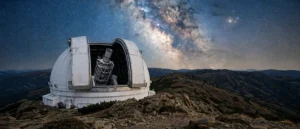
Professional astronomers place telescopes in remote, high, dry locations for three reasons: darkness, steady air, and clear skies. City lights wash out faint objects, so observatories sit far from urban glow. High altitude puts the telescope above much of the atmosphere’s turbulence and water vapor, which is especially important for infrared observations. Dry desert air means more cloudless nights per year.
That is why the great observatories cluster in places like Hawaii’s Mauna Kea, Chile’s Atacama Desert, and the Canary Islands. Some telescopes even leave Earth entirely. Space telescopes orbit above the atmosphere, enjoying perfectly steady, dark skies around the clock, though at far greater cost and complexity.
The same logic applies to satellites that watch Earth and the Sun. Getting above the atmosphere changes what an instrument can see, and crowded orbits are why astronomers work with satellite networks to keep skies dark for science.
Telescopes and Cameras: Photography Changes Everything
The human eye is a wonderful instrument, but it refreshes many times per second and cannot accumulate light. A camera attached to a telescope can stare at one galaxy for hours, gathering photons one by one until a faint smudge becomes a spiral of stars, dust, and glowing gas. That is how we obtained the deep images of distant galaxies that now fill textbooks and screensavers.
Modern detectors are microchip sensors, cousins of phone camera sensors but far more sensitive and cooled to reduce noise. Software stacks exposures and stretches faint details into view, while artificial intelligence helps spot supernovae and asteroids a human might miss.
Even amateur astrophotographers can now produce stunning images with modest equipment. A small telescope, a tracking mount, and a modern camera are enough to capture the Orion Nebula, the Andromeda Galaxy, and the colorful clouds where new stars are born.
Radio Telescopes: Listening Instead of Looking
Not all telescopes use visible light. Radio telescopes collect radio waves from space using large dish antennas. Radio waves pass through clouds and dust that block visible light, so radio telescopes can peer into regions of the galaxy that optical telescopes cannot see. They reveal cold gas clouds, the remnants of exploded stars, and the faint afterglow of the Big Bang itself.
Some radio telescopes link across continents, acting as one instrument as wide as Earth. This technique, interferometry, produced the first image of a black hole’s shadow in 2019.
Radio telescopes study black holes, collapsed stars whose gravity traps even light, and distant galaxies whose light traveled billions of years to reach us.
Choosing Your First Telescope
If you want to start observing, keep three rules in mind. First, prioritize aperture and a stable mount over advertised magnification. Second, buy from a reputable astronomy dealer rather than a department store, where telescopes often promise impossible magnification on shaky tripods. Third, consider a pair of binoculars first: they are cheap, portable, and surprisingly powerful for sweeping the Milky Way and spotting Jupiter’s moons.
A good beginner setup is a four- to six-inch reflector on a sturdy mount, or a small refractor for the Moon and planets. Joining a local astronomy club is the best step a newcomer can take: clubs hold star parties, lend equipment, and pair beginners with mentors.
Start with easy targets: the Moon’s craters, Jupiter and its four bright moons, Saturn’s rings, and bright star clusters like the Pleiades. Each one rewards patience and practice. As your skills grow, fainter targets like galaxies and nebulae will open up, and you will begin to understand why astronomers describe observing as a lifelong hobby.
The Future of Telescopes
Telescope technology keeps advancing. Giant ground-based telescopes with mirrors nearly 130 feet across are under construction, and they will gather enough light to study the atmospheres of planets around other stars. In space, new observatories extend our vision into infrared wavelengths, revealing the first galaxies that formed after the Big Bang and the dusty nurseries where stars are born today.
Data handling advances just as fast: quantum computing research may one day process enormous observatory data streams, while high-speed wireless networks already move data from remote mountaintops to researchers, and solar panels power sites far from the grid.
These instruments also support exploration. Telescopes track asteroids that might threaten Earth, study the planets that rockets will visit, and scout destinations for missions like NASA’s Artemis program, which aims to return astronauts to the Moon. Every mission begins with a telescope image and a question.
Conclusion
A telescope is a light bucket with a precise focus. Its lens or mirror gathers far more light than your eye, its eyepiece magnifies the focused image, and its mount holds everything steady enough for you to see. From that simple recipe comes the entire visible universe: craters, rings, moons, clusters, nebulae, and galaxies.
The next clear night, step outside and look up. Then, if you get the chance, look through a telescope. The difference will stay with you, because you will no longer be reading about the universe. You will be seeing it, with your own eyes, through an instrument that turns faint starlight into wonder.
Frequently Asked Questions
How much magnification do I need?
Less than advertisers suggest. Low and medium magnification give the brightest, sharpest views, with a useful maximum of about fifty times the aperture in inches.
Is a refractor or reflector better for beginners?
Both work well. Refractors are low-maintenance and great for planets; reflectors offer more aperture for the money.
Can I see galaxies with a small telescope?
Yes. Under dark skies, even a small telescope shows the Andromeda Galaxy as a glowing oval, along with bright star clusters and nebulae.
Why do professional telescopes sit on mountaintops?
High, dry, dark sites offer steadier air, less water vapor, and fewer cloudy nights, all of which sharpen images and reveal fainter objects.