Thinking about going electric but confused by kilowatts, connectors, and charging networks? You are not alone. For many Americans, EV charging is the most mysterious part of owning an electric vehicle — yet it quickly becomes the easiest part of the routine.
This EV charging guide for 2026 explains everything in plain English: the different charging levels, what it costs, how to charge at home, and how to road-trip across the country with confidence — essential reading as EVs become one of the latest tech trends.
1. EV Charging Levels Explained: Level 1, Level 2, and DC Fast Charging
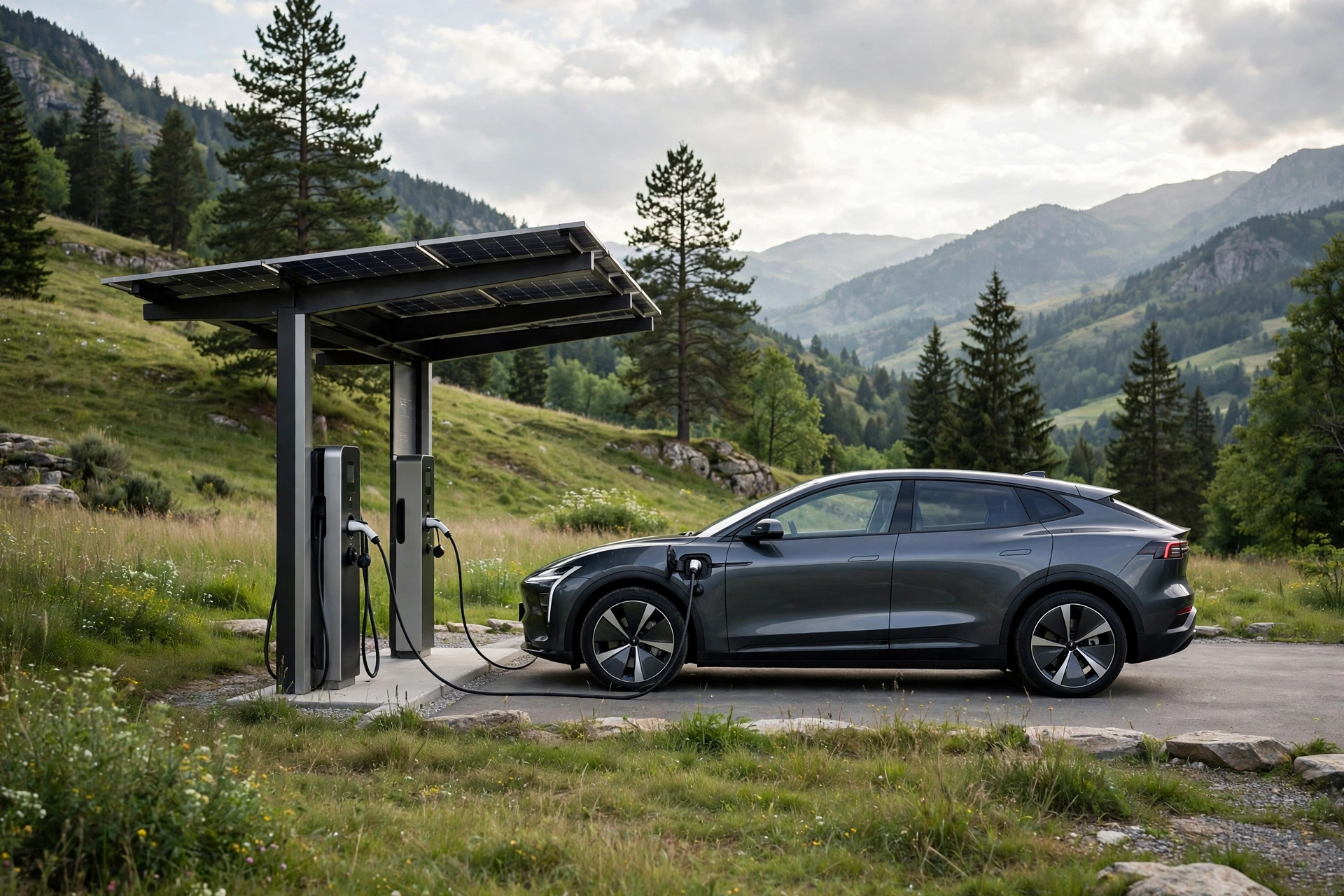
All EV charging falls into three levels. Level 1 uses a standard 120-volt household outlet and adds roughly 3–5 miles of range per hour — fine for plug-in hybrids or very low-mileage drivers, but slow for a full EV. Level 2 uses a 240-volt circuit (like a dryer outlet) and adds 25–40 miles per hour, fully charging most EVs overnight. DC fast charging bypasses the car’s onboard charger to deliver 100–350 kW, adding 100+ miles in 15–20 minutes at public stations.
Most American EV owners do 80–90% of their charging at home on Level 2 and use DC fast chargers only for road trips — the exact opposite of the gas-station habit.
2. How Much Does It Cost to Charge an EV in 2026?
Charging costs vary by state, but the math favors EVs almost everywhere. At the average US residential electricity rate of around 17 cents per kWh, “filling” a 75 kWh battery costs roughly $13 for about 250 miles of range — equivalent to paying about $1.50 per gallon of gas.
Public DC fast charging costs more, typically 30–50 cents per kWh, but still undercuts gasoline in most states. Many utilities now offer time-of-use rates that make overnight charging dramatically cheaper, and some employers and shopping centers still offer free Level 2 charging as a perk.
3. Home Charging: What American Drivers Need
A home Level 2 charger is the single best investment for EV ownership. Units cost $400–$700, and installation by a licensed electrician typically runs $500–$1,500 depending on your electrical panel and garage layout. Many states and utilities offer rebates that cover a large share of the cost. Modern chargers are smart devices that schedule charging for off-peak hours automatically.
Renters and apartment dwellers have growing options too: workplace charging, public Level 2 stations, and an expanding network of curbside chargers in major US cities. Before buying an EV, check apps like PlugShare — your phone is one of the essential connected devices for EV life — to see what is available near your home and office.
4. Public Charging Networks in the US
America’s public charging network has grown enormously. Tesla’s Supercharger network — now open to most EV brands via adapters or native NACS ports — remains the largest and most reliable — and a foundation for the coming era of autonomous vehicles. Electrify America, EVgo, and ChargePoint operate tens of thousands of additional fast chargers along highways and in metro areas.
Connector confusion is fading: the industry has largely standardized on Tesla’s NACS connector, and new EVs sold in the US increasingly come with it built in. For road trips, download two or three charging apps and always have a backup station in mind.
5. Road Trips: Planning Your First Electric Journey
EV road trips take a little planning but are entirely practical in 2026. Use your car’s built-in trip planner or an app like A Better Routeplanner, which factors in your battery, terrain, and weather to schedule charging stops.
- Charge to 80%, not 100%: Fast charging slows dramatically past 80%, so short frequent stops are faster overall.
- Precondition the battery: Most EVs warm the battery en route to a charger for maximum speed.
- Build in buffer: Arrive with 15–20% charge in case a station is busy or offline.
6. Keep Your Battery Healthy for Years
Modern EV batteries are designed to last 10–15 years, and a few habits help them go the distance. For daily driving, limit charging to 80–90% unless you need the full range. Avoid letting the battery sit at 100% or near 0% for long periods, and park in the shade during extreme heat when possible. Most manufacturers warranty their batteries for 8 years or 100,000 miles, so you are well covered.
7. The Future of EV Charging in America
Charging is getting faster and more convenient every year. Ultra-fast 350 kW chargers are becoming common along interstates, cutting road-trip stops to the time it takes to grab a coffee. Wireless charging pads — already being piloted in several US cities — could let future EVs top up simply by parking — among the most exciting emerging technologies in transportation. Vehicle-to-grid technology promises to turn millions of parked EVs into a giant backup battery for the power grid, potentially earning owners money while their cars sit idle. Federal investment in charging infrastructure continues to fill gaps in rural America, making electric driving practical from coast to coast.
Conclusion
EV charging in 2026 is simpler, cheaper, and more widespread than most gas-car drivers imagine. Install a Level 2 charger at home, learn the basics of fast charging for road trips, and you will spend less time “refueling” than you ever did at gas stations — while saving serious money. The electric era of American driving is here, and charging is the easy part.
To understand the chemistry inside your EV’s battery pack, see our guide on how lithium-ion batteries work.