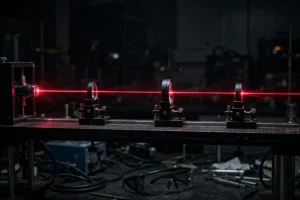
Point a laser pointer at a wall across a large room, and the dot stays tiny and bright. Shine a flashlight the same distance, and its beam spreads into a wide, dim circle. That difference is the whole magic of the laser: it produces light that is focused, orderly, and intense, where ordinary light is scattered, mixed, and weak.
Lasers now touch nearly every part of American life: they read barcodes, correct vision, cut steel, carry internet traffic, and scan the world around self-driving cars. Yet the device is surprisingly simple, built on a quantum trick discovered over a century ago.
In this guide, you will learn how lasers work, what makes laser light different from ordinary light, how the main types of lasers compare, and where this focused light is changing medicine, manufacturing, and communication.
What Is a Laser?
Laser stands for Light Amplification by Stimulated Emission of Radiation. That mouthful describes exactly what happens inside the device: light is amplified by a process called stimulated emission, and the result is a beam of radiation in the form of visible or invisible light.
A laser has three essential parts. The gain medium is the material that produces the light, which may be a gas, a crystal, a liquid dye, or a semiconductor. The energy source, often called the pump, supplies energy to excite that material. And the optical cavity, usually two mirrors facing each other, bounces the light back and forth through the medium, amplifying it with each pass until a powerful beam escapes through one partially transparent mirror.
The result is light with three unusual properties. It is monochromatic, meaning it consists of a single color or wavelength. It is coherent, meaning its waves march in step like soldiers, rather than jumbled like a crowd. And it is directional, meaning it travels as a narrow beam that spreads very little over distance. Together, those properties let a laser focus enormous energy onto a tiny spot.
Ordinary Light vs Laser Light
Ordinary light sources, like the Sun or a light bulb, produce many colors at once, with waves traveling in every direction and out of step with each other. That is why a bulb lights a whole room but cannot cut paper or reach the Moon in a tight beam.
Laser light differs in every respect: its waves share one wavelength and move in step, reinforcing each other, and its narrow beam stays concentrated over long distances. Scientists have bounced lasers off reflectors left on the Moon by Apollo astronauts, measuring the Earth-Moon distance to within an inch.
That concentration is why lasers demand respect: a seemingly harmless beam can damage the eye in a fraction of a second, as the eye’s lens focuses it onto a tiny retinal spot. Safety glasses rated for the wavelength are essential in labs and factories, and no pointer should ever be aimed at a person, vehicle, or aircraft.
Stimulated Emission: The Quantum Trick
The heart of the laser is stimulated emission, predicted by Albert Einstein in 1917. Picture an atom as an energy ladder: normally its electrons sit on the lowest rung, but absorbing energy lifts an electron to a higher, unstable rung. When it falls back, it releases the extra energy as a photon, a particle of light. This random process, spontaneous emission, happens in light bulbs and stars.
Stimulated emission adds a twist. If a photon of exactly the right energy passes an already-excited atom, it stimulates that atom to release its energy as a second photon. Crucially, the new photon matches the first one exactly: same wavelength, same direction, same phase. One photon becomes two, two become four, and the light amplifies in a chain reaction of perfect copies.
To make this work, the laser needs population inversion, a state where more atoms are excited than resting. That is unnatural, since atoms prefer their lowest energy state, so the pump must work hard to maintain it. The pump might be a flash lamp, an electric current, or another laser. Once inversion is achieved, even a few photons can trigger an avalanche of identical light, and the optical cavity keeps that avalanche bouncing through the medium until it grows into a powerful beam.
The Optical Cavity: Mirrors That Build the Beam
The two mirrors of the optical cavity turn a burst of light into a steady beam. One reflects nearly all light, while the other reflects most but lets a small fraction escape. Light bounces between them dozens of times, stimulating more emission on each pass through the gain medium.
Only light traveling exactly along the mirror axis survives many round trips; light heading elsewhere escapes and is lost. That selection is why the emerging beam is so straight and narrow.
The escaping fraction forms the laser beam you see. Inside the cavity, the light may be far more intense than the output beam, which is one reason laser equipment must be handled carefully even when the visible beam looks modest.
The Main Types of Lasers
Lasers come in many forms, each suited to different jobs.
Gas lasers
Gas lasers use a gas, such as helium-neon or carbon dioxide, as the gain medium. Helium-neon lasers produce the familiar red beam used in early barcode scanners and laboratory demonstrations. Carbon dioxide lasers produce powerful infrared beams that cut and engrave wood, acrylic, leather, and metal in workshops across America.
Solid-state lasers
Solid-state lasers use a crystal or glass rod, often ruby or neodymium-doped yttrium aluminum garnet, known as Nd:YAG. These lasers deliver strong pulses and are widely used in manufacturing, medicine, and research. A related design, the fiber laser, guides light through a specially doped optical fiber, producing a rugged, efficient beam ideal for cutting metal and marking parts.
Semiconductor lasers
Semiconductor lasers, also called laser diodes, are tiny chips that produce laser light when current flows through them. They power barcode scanners, laser printers, Blu-ray players, and the fiber-optic transmitters that carry internet traffic. Their small size and low cost made lasers a household technology, and they are the reason your phone can measure distance with a tiny laser sensor.
These diodes are close relatives of the chips in every electronic device. The same semiconductor factories that produce them also rely on lasers for precision work, which is why how microchips are made reads like a tour of laser applications, from lithography to inspection.
Lasers in Medicine
Medicine was one of the first fields to embrace lasers, and the uses keep growing.
In eye care, lasers reshape the cornea to correct nearsightedness and farsightedness, and they treat retinal problems by sealing tiny leaks with pinpoint heat. Because the beam can be focused so precisely, surgeons can operate on delicate tissue with minimal damage to surrounding areas.
In dermatology, lasers remove tattoos, treat birthmarks, and resurface skin by vaporizing thin layers of tissue. In surgery, they cut and seal blood vessels at the same time, reducing bleeding and speeding recovery. Dentists use them to treat gum disease and prepare cavities with less drilling.
Newer medical lasers activate light-sensitive drugs that attack tumors, a treatment called photodynamic therapy, and guide gene therapy research, where precise delivery matters enormously. These advances feature in health science breakthroughs changing how American doctors treat disease.
Lasers in Industry and Everyday Technology
Factories use lasers for cutting, welding, engraving, and marking. A laser cutter follows a computer design to slice metal or wood cleanly for cars, airplanes, and furniture; laser welders join metals with deep seams, including electric vehicle battery packs; and engraving lasers mark serial numbers and barcodes on tools and medical implants.
At home and in offices, lasers are equally common. Laser printers draw an image onto a charged drum that attracts toner and transfers it to paper, barcode scanners read labels in a fraction of a second, and the best smartphones of 2026 use tiny lasers for autofocus and facial recognition.
Surveyors use laser levels and distance measurers faster and more accurate than tape measures, farmers use laser-guided equipment for straight rows and level fields, and robots navigate with lidar, a laser radar mapping surroundings many times per second.
Lasers and Communication: Carrying the Internet
Some of the most important lasers are ones you never see. Fiber-optic networks carry internet traffic as laser pulses through hair-thin glass fibers, traveling miles with little loss and pulsing billions of times per second, so one fiber carries enormous data.
That is why streaming video, video calls, and cloud computing work as smoothly as they do. The laser pulses that encode your data travel under oceans and across continents, linking American homes to servers around the world. Modern networks also use lasers to connect satellites directly to each other in orbit, beaming data through space at the speed of light.
Wireless communication benefits too. 5G networks and future wireless systems rely on precise timing and frequency control, technologies that share roots with laser science. And satellite internet constellations use laser links between satellites to route traffic without touching the ground, cutting delays for users in remote areas.
Lasers at the Frontier of Science
At the research frontier, lasers cool atoms near absolute zero for slow-motion quantum study, drive fusion experiments by compressing fuel pellets to stellar temperatures and pressures, and measure gravitational waves through distance changes smaller than an atomic nucleus.
Lasers also enable quantum computing research, where laser beams trap and manipulate individual ions or atoms as quantum bits. And artificial intelligence systems increasingly use laser-based sensors and optical processors to see and decide faster than traditional electronics allow.
Perhaps most remarkably, lasers let us measure the universe itself. Astronomers use laser guide stars, artificial stars created by shining a laser into the upper atmosphere, to correct the blurring caused by turbulent air. That technique sharpens telescope images dramatically, revealing details that would otherwise stay hidden.
Laser Safety: Powerful Tools Demand Care
Lasers are classified by power and risk, from pointers to steel-cutting industrial beams. The key rules are simple: never look into a beam, never point one at people or vehicles, wear wavelength-rated safety glasses, and treat shiny-surface reflections as seriously as the direct beam.
Regulators in the United States limit the power of consumer laser pointers, and shining a laser at an aircraft is a federal crime, because even a brief flash can blind or distract a pilot. These rules exist because the same concentration that makes lasers useful also makes them hazardous when misused. With basic care, however, lasers are among the safest and most reliable tools in modern technology.
Conclusion
A laser turns disorderly energy into orderly light: its pump excites atoms into population inversion, stimulated emission multiplies identical photons, and the optical cavity shapes them into a narrow, single-color, coherent beam. From that recipe comes a tool that cuts steel, corrects vision, carries the internet, and probes the quantum world.
The next time you check out at a store, stream a movie, or watch a robot vacuum map your living room, remember the focused beam working behind the scenes. It began as a quantum curiosity in 1917, became a working device in 1960, and now quietly powers much of modern American life. That is how lasers work, and it is one of the brightest ideas in the history of science.
Frequently Asked Questions
What does laser stand for?
Laser stands for Light Amplification by Stimulated Emission of Radiation, which describes how the device amplifies light through stimulated emission.
Why is laser light different from flashlight light?
Laser light is one color, with waves in step in a narrow beam, so it stays focused over distance. Flashlight light mixes colors and spreads everywhere.
Are laser pointers dangerous?
They can be: even a small laser can damage the eye if stared into, and pointing one at aircraft is illegal.
How are lasers used in the internet?
Fiber-optic networks send data as laser pulses through glass fibers, and satellites use laser links to pass data between each other in orbit at the speed of light.