Every day, electric motors quietly do an enormous share of America’s work. They spin the fan that cools your bedroom, run the compressor in your refrigerator, power the elevator in your office building, and drive the wheels of the electric car in your driveway. In fact, the average American home contains dozens of them, and most people never notice a single one.
So, how do electric motors work? At heart, the answer is beautifully simple: a motor turns electricity into motion by pushing magnets against each other. When electric current flows through a coil of wire, it creates a magnetic field. That field pushes against fixed magnets, and the push becomes rotation. Everything else in a motor exists to keep that push going, smoothly and efficiently, thousands of times a minute.
In this guide, you will learn exactly how that happens, what the parts inside a motor do, how different types of motors compare, and why electric motors now sit at the center of American transportation, manufacturing, and clean energy.
What Is an Electric Motor?
An electric motor is a machine that converts electrical energy into mechanical energy. Feed it electricity, and its shaft spins. Attach that shaft to a wheel, a fan blade, a pump, or a drill bit, and you get useful work.
This is the opposite of a generator, which converts motion into electricity. Interestingly, the two machines are close cousins. Many motors can work as generators if you spin them instead of powering them, and engineers use that trick in electric vehicles, where braking spins the motor to recharge the battery. That process, called regenerative braking, is one reason how electric cars use motors matters so much to drivers who want more range from every charge.
Electric motors come in many sizes. Tiny ones vibrate your phone. Medium ones run washing machines and power tools. Huge ones drive freight trains, factory lines, and the pumps that move water through American cities. Despite the size differences, they all rely on the same physics.
The Key Idea: Magnetism Creates Motion
To understand motors, you first need two facts about magnetism and electricity.
First, opposite magnetic poles attract, and like poles repel. A north pole pulls a south pole toward it and pushes another north pole away. Second, when electric current flows through a wire, the wire becomes a temporary magnet. Wrap that wire into a coil, and the magnetic effect grows much stronger.
Now imagine a coil of wire mounted on a shaft, sitting between two permanent magnets. Send current through the coil, and the coil becomes a magnet too. Its poles push and pull against the fixed magnets, and the shaft turns. That turning is the motor’s output, and it is the whole secret of the machine.
Of course, there is a catch. Once the coil turns halfway around, its poles would line up with the fixed magnets and stop. A working motor must solve this problem, and the solution is what separates one motor design from another.
The Main Parts Inside a Motor
Almost every electric motor contains the same core parts, even though their shapes vary.
The stator
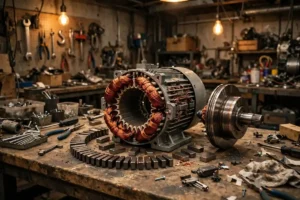
The stator is the stationary part of the motor. It usually holds fixed magnets or coils of wire arranged around the inside of the motor’s housing. The stator creates a steady magnetic field that the moving part reacts against.
The rotor
The rotor is the part that spins. It sits on the shaft and carries coils of wire. When current flows through those coils, the rotor’s magnetic field interacts with the stator’s field, and the rotor turns. The shaft then carries that rotation out of the motor to do useful work.
The commutator and brushes
In a direct current motor, the commutator solves the halfway-around problem. It is a split metal ring attached to the rotor. As the rotor turns, the commutator reverses the direction of current in the coils at exactly the right moment. That flip keeps the magnetic push going in the same direction, so the rotor keeps spinning instead of rocking back and forth. Small carbon blocks called brushes press against the commutator to deliver current to the spinning rotor.
Brushes wear down over time, which is why many modern motors use designs that eliminate them entirely. Still, the commutator remains a brilliant piece of nineteenth-century engineering, and it still appears in toys, small appliances, and power tools across the United States.
DC Motors vs AC Motors
Motors fall into two big families, based on the type of current they use.
Direct current motors run on batteries and steady current. They are simple to control, which makes them ideal for toys, small fans, and older power tools. You can speed one up by raising the voltage, and slow it down by lowering it. That simplicity explains why DC motors dominated early electric vehicles and still power countless small devices.
Alternating current motors run on the alternating current supplied by the American power grid. The current in your wall outlet reverses direction sixty times per second, and AC motors exploit that rhythm. In an induction motor, the most common AC design, the stator’s coils create a rotating magnetic field. That field induces current in the rotor, and the rotor chases the field around, spinning slightly slower than the field itself. There are no brushes and no commutator, so induction motors are rugged, quiet, and long-lived. They run factory machines, air conditioners, and many of the pumps and compressors that keep American industry moving.
Modern electric vehicles often use a refined cousin of the AC motor: the permanent magnet synchronous motor. It pairs a rotating magnetic field with powerful permanent magnets on the rotor, delivering strong torque from a standstill. That instant torque is why an electric car can accelerate so briskly from a red light, and why drivers often describe the experience as surprisingly quick and smooth. If you are weighing a purchase, our EV charging guide for American drivers explains how the rest of the system supports these motors on the road.
How an Induction Motor Keeps Spinning
The induction motor deserves a closer look, because it powers so much of the modern world. Its stator contains three sets of coils, fed by three-phase power. As the alternating current rises and falls in each set, the combined magnetic field rotates smoothly around the stator, like a lighthouse beam sweeping in a circle.
The rotor, meanwhile, is usually a simple cage of metal bars. The rotating field sweeps past those bars and induces electric current in them. Those currents create their own magnetic field, which tries to catch up with the stator’s field. The rotor spins, always chasing a field it can never quite catch. The small speed gap between the two is called slip, and it is essential: without slip, there would be no induced current and no torque.
Because the rotor has no electrical connections, there is nothing to wear out. That is why induction motors can run for decades in factories, water plants, and heat pumps with little more than occasional bearing maintenance. Their reliability is a major reason American industry adopted them so widely.
Where Electric Motors Show Up in American Life
Once you know what to look for, you will see electric motors everywhere.
In the home, they run refrigerators, washing machines, dishwashers, vacuum cleaners, garage door openers, and bathroom fans. A typical American household may contain fifty or more, counting the tiny ones in phones, laptops, and toys.
In transportation, they drive electric cars, buses, and trains. They also appear in places you might not expect: the window motors in a gasoline car, the fuel pump, and the cooling fan are all electric. Even drones rely on small, fast, brushless motors that can change speed hundreds of times per second to stay stable in the air.
In industry, motors power conveyor belts, machine tools, compressors, and fans. Factories use them alongside robots that assemble products, weld car frames, and package food. And in energy, motors and generators work as a team: wind turbines use generator versions of the same technology to turn breezes into electricity, while solar panels feed that electricity back into motors across the grid.
Modern control electronics make all of this smarter. Tiny microchips in motor controllers adjust speed and torque thousands of times per second, saving energy and reducing wear. Increasingly, artificial intelligence helps factories predict when a motor needs maintenance before it fails, which keeps production lines running and costs down.
Why Electric Motors Are So Efficient
Electric motors convert a very high share of their input energy into motion. A good electric motor can exceed ninety percent efficiency, while a gasoline engine typically converts only about a quarter of its fuel’s energy into motion, losing the rest as heat. That gap matters for household bills, factory costs, and the climate.
Motors also deliver full torque from zero speed. A gasoline engine must rev up before it pulls hard, but an electric motor pulls hardest the instant it starts. That trait makes electric motors ideal for elevators, trains, and cars, where heavy loads must start moving smoothly from a standstill.
Finally, motors are quiet and clean at the point of use. They produce no exhaust, which is why cities across America are switching buses, delivery vans, and garbage trucks to electric power. Cleaner air in neighborhoods is a direct, everyday benefit of a technology that began in laboratories nearly two centuries ago.
Looking After a Motor
Most motors need little care, but a few habits extend their life. Keep vents clear so the motor can cool itself, since heat is the main enemy of insulation and bearings. Avoid overloading a motor, because a stalled motor draws extra current and overheats quickly. Listen for new noises: grinding or squealing often means bearings need attention.
The Future of Electric Motors
Motor technology keeps improving. Engineers are designing motors with fewer rare-earth magnets, which lowers cost and eases supply-chain pressure. New materials and better cooling allow smaller motors to produce more power, which matters for electric aircraft and compact autonomous vehicles. Wireless motor control and smarter sensors promise factories where every motor reports its own health in real time.
As America electrifies more of its economy, from home heating to heavy trucking, electric motors will only grow more important. They are the quiet link between clean electricity and physical work, and they will shape how the country moves, builds, and cools itself for decades to come.
Conclusion
An electric motor is a simple idea executed with great precision: use electricity to create magnetism, let magnets push against each other, and turn that push into rotation. The stator, rotor, and commutator or controller keep the push going in one direction, and the result is a machine that is efficient, quiet, reliable, and everywhere.
The next time you hear a fan hum, a refrigerator kick on, or an electric car pull away silently from a light, you will know what is happening inside. A coil is becoming a magnet, magnets are pushing, and a shaft is turning. That is how electric motors work, and it is one of the most useful tricks in all of engineering.
Frequently Asked Questions
Do electric motors wear out?
Yes, but slowly. Bearings and, in brushed motors, brushes wear over time. Brushless motors can last for decades with basic care, since they have no brushes to replace.
Why do electric cars accelerate so fast?
Electric motors deliver maximum torque from zero speed, so they pull hard the instant you press the accelerator. There is no waiting for an engine to build revs.
Can an electric motor run as a generator?
Yes. Spinning a motor’s shaft generates electricity, and electric vehicles use this effect for regenerative braking, turning slowing-down energy back into battery charge.