When your phone switches from a spinning loading icon to an instant-loading page, 5G is usually the reason. The fifth generation of mobile networks now blankets most of America, powering everything from video calls on the interstate to robots on factory floors. But what is actually happening inside that invisible network?
In this guide, we break down how 5G works in plain English: how the technology carries data through the air, why it beats 4G, the three “flavors” of 5G, and how America’s 5G landscape looks in 2026. No engineering degree required.
What Is 5G, Exactly?
5G stands for the fifth generation of cellular network technology. Each generation before it followed roughly a decade apart: 1G gave us voice calls, 2G added texting, 3G brought mobile web browsing, and 4G made streaming video on a phone normal. 5G is the first generation designed not just for faster phones, but for an entire connected ecosystem.
Technically, 5G is a family of radio standards defined by the 3GPP, the global body that writes the rules for mobile networks. Unlike earlier upgrades, which mostly cranked up speed, 5G was engineered around three goals at once: far higher speeds, dramatically lower latency, and the ability to connect vastly more devices per square mile. In practice, that means a 5G network can serve a packed stadium, a fleet of delivery drones, and your living room at the same time.
By 2026, connecting over 5G has become the default American experience. Independent testing firm RootMetrics reported that in the first half of 2026, fully 93 percent of mobile speed tests in the United States ran over 5G networks, up from 84 percent a year earlier. Carriers have largely finished the first wave of build-out, and the competition has shifted to who delivers the fastest, most reliable experience.
How Does 5G Work? The Core Ideas
To understand how 5G works, it helps to start with the fundamentals of wireless communication. Every cell network moves data using radio waves — invisible electromagnetic energy that carries information between your phone and a nearby cell site. Your voice, video, or message gets converted into digital packets, those packets ride radio waves to the tower, and the tower hands them off to the wired internet. 5G changes how that handoff happens at nearly every step.
The three layers of 5G spectrum
The single most important concept in 5G is spectrum: the slices of radio frequency that carriers license to transmit signals. Think of spectrum like lanes on a highway. Wider lanes move more traffic, and 5G cleverly uses three very different kinds of lanes at once.
Low-band spectrum (roughly under 1 GHz) is the coverage layer. These long-wavelength signals travel miles and punch through walls easily, but they carry relatively little data — speeds look a lot like a strong 4G connection. When you see 5G available in a rural county, it is almost certainly low-band.
Mid-band spectrum (roughly 1 to 6 GHz) is the sweet spot, and it is where the real 5G speed revolution happened in America. Mid-band waves balance solid range with big data capacity. T-Mobile bet early and heavily on its 2.5 GHz mid-band spectrum, and that bet is why it has led national speed rankings for years. Verizon and AT&T spent billions acquiring C-band mid-band spectrum, and their speeds have surged since those networks went live. If you enjoy a 300 Mbps speed test on your phone, mid-band is doing the heavy lifting.
High-band or millimeter-wave (mmWave) spectrum (above 24 GHz) is the speed demon. These ultra-short waves carry enormous amounts of data — multi-gigabit speeds — but they fade within a few city blocks and barely penetrate glass. Carriers deploy mmWave in dense downtowns, airports, and stadiums. It is spectacular where it exists and invisible everywhere else.
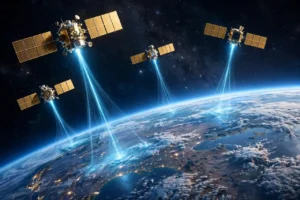
How 5G works in practice is by orchestrating these layers — your phone constantly moves between low, mid, and high bands depending on where you are and what you need, all without you noticing. It is the same kind of precise coordination that lets GPS satellites keep the whole system in sync.
Massive MIMO: many antennas, one tower
A classic 4G tower sends one stream of data to your phone at a time, like a single cashier serving a line. 5G towers use massive MIMO — multiple-input, multiple-output — which is more like opening dozens of checkout lanes at once. A 5G antenna array can contain 64 or more individual antenna elements, each transmitting and receiving simultaneously.
This antenna forest lets one tower serve many devices on the same slice of spectrum at the same time, multiplying capacity. It is the main reason 5G can keep 50,000 phones connected in a football stadium without the network collapsing, as engineers have demonstrated at major venues.
Beamforming: signals that follow you
Old cellular antennas sprayed radio energy in every direction, like a sprinkler. 5G uses beamforming to aim a focused beam of signal directly at your phone, like a spotlight tracking you across a stage. The tower calculates where you are and shapes the radio wave accordingly, even as you walk down the street.
Beamforming makes the connection stronger, faster, and more efficient — and it dramatically reduces interference with nearby devices. It also helps mmWave signals survive: an aimed beam reaches further than a scattered one. In a sense, the technique works much like satellite links that must be precisely pointed to stay connected.
5G vs 4G: What Actually Changed
Speed grabs the headlines, but 5G’s three headline improvements each matter in different ways. Here is how the fifth generation compares to LTE, the most advanced 4G technology:
Speed. Median real-world 5G download speeds in the US now sit in the hundreds of megabits per second. RootMetrics’ nationwide testing for the first half of 2026 found T-Mobile leading at a median of 392 Mbps, Verizon at 302 Mbps, and AT&T at 228.7 Mbps. Aggregate nationwide mobile speeds have roughly doubled since 2024. A full HD movie that took minutes over 4G can now download in seconds.
Latency. Latency is the delay between asking for data and receiving it. 4G typically delivered 30 to 50 milliseconds of latency; well-built 5G cuts that to 10 milliseconds or less, and mmWave can dip under 5. Low latency makes remote surgery, cloud gaming, and instant video calls feel natural. Latency is also what lets self-driving systems and industrial robots react in real time — the network effectively disappears.
Capacity. 5G is engineered to support up to a million connected devices per square kilometer, versus roughly a hundred thousand for 4G. That density is what makes the explosion of IoT and smart devices feasible: sensors, cameras, trackers, and meters all sip the network at once.
The American 5G Landscape in 2026
America’s three national carriers each built their 5G networks differently, and by 2026 the results are clear. T-Mobile remains the national speed leader thanks to its mid-band head start, winning most categories in both Ookla’s Speedtest Awards and Opensignal’s 2026 mobile experience report, including fastest download and upload speeds and 5G availability. Verizon took top marks for coverage experience and 5G video, leaning on its dense network and mmWave in cities. AT&T has been the fastest climber, with 5G download speeds up roughly 21 percent in six months after investing heavily in new spectrum.
Which carrier suits you depends on where you live: T-Mobile for raw speed, Verizon for coverage breadth, AT&T as the fast-improving middle ground. Nearly every new flagship now ships with a 5G radio as standard — our 2026 smartphone buyer’s guide treats 5G support as table stakes.
The competitive story has a twist: in May 2026, AT&T, T-Mobile, and Verizon announced a joint venture to improve direct-to-device satellite connectivity, so phones in cellular dead zones can link to satellites for basic service. The phone in your pocket is slowly gaining a backup connection from space.
5G Home Internet: The Cable Competitor
One of 5G’s most surprising American success stories is not on phones at all. Fixed wireless access — 5G home internet delivered over the cellular network instead of cable or fiber — has become a genuine alternative for millions of households.
The setup is simple: a plug-in gateway box connects to the nearest 5G tower and broadcasts Wi-Fi through your home — no technician or drilling. By the first quarter of 2026, the three major carriers had signed up more than 17 million fixed wireless connections, capturing nearly 14 percent of all US home broadband subscriptions, according to Census-derived data cited by Ookla.
Performance is competitive. In the second quarter of 2026, T-Mobile Home Internet delivered a median download speed of about 223 Mbps, ahead of AT&T Internet Air at about 160 Mbps and Verizon 5G Home at about 127 Mbps. Uploads remain the weak spot — typically 10 to 18 Mbps — but for streaming, gaming, and video calls, 5G home internet comfortably serves most American families, often at prices that undercut cable.
Limitations and Honest Myths About 5G
No technology lives up to every claim, and 5G has its share of misunderstandings worth clearing up.
5G does not automatically make your phone faster. The network is only as fast as your plan, your phone’s modem, and the cell site you connect to. A phone locked to low-band 5G in a congested area can feel no faster than 4G. Check which bands your phone supports if speed matters to you.
Coverage maps exaggerate. Carrier maps showing “nationwide 5G” mostly mean low-band 5G — good coverage, modest speeds. The blazing speeds in ads require mid-band or mmWave, which fade with distance and buildings. Rural users in particular should test performance at their own address before switching.
5G is not a health hazard. 5G radio waves are non-ionizing radiation — the same fundamental type as FM radio and Wi-Fi — and decades of research plus every major health authority find no evidence that cellular signals at regulated power levels harm human health. The technology has been studied far more than most things you interact with daily.
Finally, keep cybersecurity basics in mind: faster networks do not protect you from phishing, scam texts, or weak passwords. 5G moves threats as quickly as it moves everything else.
What Comes Next: 5G Advanced and 6G
The 5G story is not finished. Carriers are now deploying 5G Advanced, an incremental upgrade that brings AI-driven network optimization, sharper uplink speeds for creators and remote workers, and native support for satellite fallback. It is the polished version of the network you already use.
Beyond that, researchers worldwide are prototyping 6G, expected around 2030. Early targets include speeds up to 100 times faster than 5G, latency under a millisecond, and networks that double as sensors — detecting objects and movement the way radar does. That will sound familiar to anyone following quantum computing research or how AI is reshaping daily life: each breakthrough in connectivity unlocks the next wave of devices.
Practical advice for shoppers: any phone worth buying in 2026 includes 5G, and the best value comes from mid-range models on carriers with strong mid-band coverage in your area. The coolest gadgets of 2026 increasingly assume always-on 5G — from AR glasses to portable hotspots that replace hotel Wi-Fi entirely.
The Bottom Line
How does 5G work? At its heart, it is smarter radio: wider spectrum lanes, towers with dozens of antennas, and signal beams that follow your phone. Layered together, those tricks deliver speeds, responsiveness, and device density that 4G could never reach.
In America in 2026, 5G is no longer the future — it is the floor. Ninety-three percent of mobile tests run over 5G, home internet over 5G serves millions of families, and even EV charging networks rely on 5G links to report status and process payments. The invisible infrastructure has become visible in everything it enables. The next time a page loads before you finish tapping, you will know exactly why.